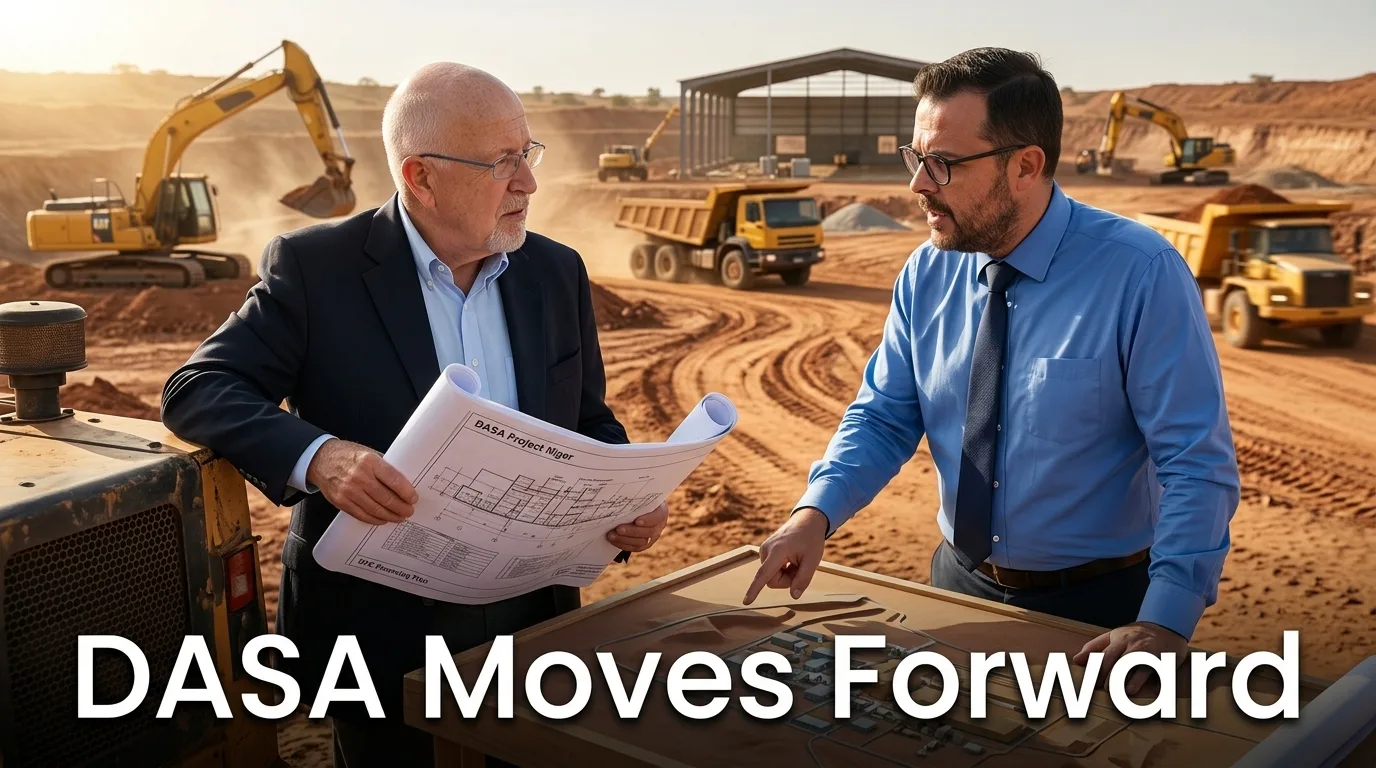
Global Atomic is entering what could be one of the most important phases in the development of its DASA uranium project in Niger.
Global Atomic CEO Stephen Roman provided an extensive update on the company’s progress, including the recently approved financing from the U.S. International Development Finance Corporation (DFC), construction at DASA, negotiations with nuclear utilities, potential transportation routes for future uranium exports, the security environment in Niger, and the company’s strategy for funding the remaining capital requirements.
The interview comes after several years of delays and uncertainty surrounding Niger, particularly following the July 2023 military coup that disrupted the company’s financing process. Despite those challenges, Global Atomic continued advancing the project, maintaining its operations and construction activities while working toward securing the long-term financing required to bring DASA into production.
According to Roman, the company has now reached a major milestone with the DFC financing agreement, while construction continues to advance on the ground.
The company is targeting completion of construction by the end of 2027, commissioning thereafter, and initial uranium production and shipments in 2028.
One of the central developments discussed in the interview was the DFC financing.
Global Atomic has been working with the U.S. development finance institution for approximately four years. The process was originally expected to reach final approval in 2023, but the political upheaval in Niger interrupted the process.
Roman explained that the DFC financing had been scheduled for final approvals in September 2023. However, the July 26, 2023 coup d'état in Niger effectively caused the process to pause as governments and institutions assessed the situation in the country.
Global Atomic nevertheless continued working on the DASA project.
The company ultimately reached an agreement with the DFC, representing a significant milestone not only for Global Atomic but also for Niger.
Roman emphasized that the financing was not simply a publicity announcement. According to him, the transaction went through the DFC’s credit committee, investment committee and final board approval after years of due diligence.
The facility is expected to provide approximately US$400 million of financing, with an additional cost-overrun facility taking the total potential amount to approximately US$414 million.
For Global Atomic, the significance goes beyond the financing itself.
The DFC’s involvement provides an important degree of validation for a project that has been navigating political, logistical and financing challenges for years.
It also brings the United States directly into the development of a uranium project in Niger.
Although the DFC financing has been approved, Global Atomic still needs to satisfy several conditions before the company can begin drawing funds.
Roman described three key areas that need to be resolved:
Importantly, Roman characterized these conditions as achievable rather than major obstacles.
The company is currently evaluating three potential routes for future uranium shipments:
Each route has different advantages, and Global Atomic is working with the respective governments and authorities to determine the best long-term solution.
Roman said the Nigerian route currently appears to be the fastest and most realistic option.
Global Atomic has already been using Nigeria as an important logistics corridor for supplies going into Niger.
Materials arriving through the port of Apapa near Lagos are transported north to Kano, close to the Niger-Nigeria border, where Nigerien trucks take over and transport the materials to DASA.
According to Roman, this route has been functioning very well.
That has led the company to investigate whether the same logistics network could eventually be used in reverse to transport uranium out of Niger.
The idea is relatively straightforward: instead of trucks returning empty after delivering materials to DASA, they could potentially transport uranium back toward the Nigerian port.
Global Atomic is already communicating with the Nigerian Nuclear Energy Commission regarding the possibility.
Algeria represents another potentially attractive option.
Global Atomic’s DASA project is located relatively close to the Algerian border, and Roman highlighted the quality of Algeria’s roads and security infrastructure.
The company is already using the Algerian route to transport construction materials, including cement and rebar, to the DASA site.
According to Roman, DASA is approximately 300 kilometres from the Algerian border.
The company has also held discussions with senior Algerian officials after Niger and Algeria signed a cooperation agreement.
Global Atomic representatives were invited to high-level meetings in Algeria, including discussions with senior government authorities.
The potential attraction of Algeria is not simply the transportation route itself.
It would provide DASA with direct access toward the Mediterranean and could also offer logistical advantages for importing materials required by the mine.
Roman pointed out that materials such as sulfur could potentially be brought through the Mediterranean route from major producing countries including Spain and Poland.
This could reduce dependence on longer and more complicated logistics routes.
The third alternative is Benin.
Roman noted that Benin has significant historical experience handling uranium shipments because uranium was transported through the Port of Cotonou for decades during the period when France was operating uranium mines in the region.
Global Atomic has already communicated with the port, and according to Roman, the port authorities have indicated that they would be willing to handle DASA material.
The challenge is primarily the political and logistical relationship between Niger and Benin.
If the border situation can be resolved, Benin could become another viable export route.
Alternatively, Global Atomic could potentially move material through Nigeria before accessing the Benin port.
The important point is that the company is not dependent on a single route.
It is developing multiple alternatives, reducing the risk that a problem with one transportation corridor would prevent future uranium exports.
The DFC investment also reflects the growing strategic importance of uranium supply.
Western nuclear utilities are increasingly focused on securing reliable uranium supplies from jurisdictions outside traditional sources.
For the United States, developing additional sources of uranium production is particularly important as Washington seeks to strengthen the nuclear fuel cycle and diversify supply chains.
Roman suggested that the DFC financing could ultimately become a first step toward broader U.S. involvement in Niger.
The DFC could potentially participate in infrastructure projects associated with the broader development of the region.
One example discussed was an older coal-fired power plant north of Agadez that supplies electricity to the local grid.
Global Atomic is investigating the possibility of upgrading the facility, which could benefit multiple mining operations in the region as well as the broader population.
Roman described this as the type of infrastructure project that could potentially fit within the DFC's mandate.
The significance is that DASA could potentially become more than a standalone uranium mine.
It could become part of a broader Western-backed investment and infrastructure strategy in Niger.
Perhaps one of the most important commercial developments discussed in the interview was the response from nuclear utilities following the DFC financing announcement.
Roman said Global Atomic has received a number of requests for proposals from utilities interested in DASA uranium.
The company is currently in discussions with approximately half a dozen utilities.
These discussions are not all structured in the same way.
Some utilities are interested in beginning deliveries around 2028, while others are looking at 2029 or 2030.
There is also interest in longer-term contracts extending beyond five years.
The utilities involved are primarily Western utilities, including U.S. utilities.
This is significant because securing uranium contracts before production is an important component of financing a major uranium development project.
The DFC financing itself required Global Atomic to have uranium contracts in place because the lender needs confidence that the future project will generate sufficient revenue to service its debt.
The company therefore expects its book of offtake agreements to continue growing.
Global Atomic currently has only a portion of the DASA mine plan covered by offtake agreements.
Roman indicated that the company would ideally like to have approximately three million pounds per year under contract against potential production of roughly four million pounds annually.
That would leave approximately one million pounds flexible.
The flexibility is important.
Rather than selling the entire production profile years in advance, Global Atomic wants to retain some exposure to potentially higher uranium prices.
Roman also indicated that the plant could potentially produce around five million pounds initially if throughput exceeds expectations.
The company therefore has an opportunity to balance financing security with exposure to the uranium market.
The strategy is essentially to build a contracted base that supports debt repayment while retaining enough uncommitted production to benefit from rising uranium prices.
Another important part of the discussion involved uranium prepayment agreements.
Roman said Global Atomic has historically considered prepayments from utilities an attractive way to help finance mine development.
The concept is simple.
A nuclear utility provides capital to a uranium producer before production, and in return receives future uranium supply, potentially under agreed pricing terms.
However, Roman said the uranium industry has changed significantly.
Many of the executives and procurement professionals who historically negotiated uranium supply contracts have left the industry.
For years, utilities had access to abundant uranium and therefore had little incentive to provide significant upfront capital to producers.
That environment may now be changing.
According to Roman, utilities are increasingly recognizing that uranium prices have not fallen as expected and that securing reliable long-term supply is becoming more difficult.
This could eventually force utilities to become more proactive in supporting new mine development.
Roman emphasized a fundamental characteristic of the uranium industry:
A uranium mine cannot simply be turned on when a utility suddenly needs additional supply.
From exploration through feasibility, permitting, financing and construction, developing a new uranium mine can take many years.
Roman estimated that the complete process can take approximately 20 years.
That creates a strategic incentive for utilities to secure future production well before they actually need the material.
While financing discussions have attracted much of the attention, construction at DASA continues to advance.
Roman provided a detailed snapshot of the project during his recent visit to Niger.
According to the CEO:
Roman described the construction process as increasingly resembling "Lego," with major components already delivered to the laydown yard and then moved into position for installation.
This is an important transition for the project.
The development is moving from groundwork and site preparation toward the physical erection of the processing infrastructure.
Global Atomic also plans to release another construction update video showing progress at the site.
The DASA project has not been immune to the financial consequences of delays.
Roman explained that every year of delay adds significant costs because the project's infrastructure, contractors and other resources remain in place.
The company has therefore seen its capital requirements increase.
Global Atomic's latest project numbers put the total capital requirement at approximately US$777 million, with roughly US$550 million remaining as of June 30, according to the figures discussed during the interview.
The DFC is expected to provide approximately US$400 million of the financing, with the cost-overrun facility increasing the total potential amount to approximately US$414 million.
This still leaves Global Atomic with a funding requirement.
Roman indicated that the company had previously estimated approximately US$150 million would need to be covered by Global Atomic, but that number could potentially be closer to US$100 million as the company works on additional non-equity financing solutions.
For shareholders, financing is arguably one of the most important issues.
Global Atomic has already raised capital to keep DASA moving during the long period in which the DFC financing was being finalized.
Roman acknowledged that he does not like equity raises and recognizes the dilution that shareholders have experienced.
However, he argued that shutting down the project was not a realistic option.
The company had made commitments to the Niger government, had employees and contractors working at the site, and had already invested substantial capital into the project.
Stopping construction would have created its own significant risks.
Instead, Global Atomic continued moving forward while seeking the DFC financing and other sources of capital.
The company is now exploring non-dilutive alternatives.
One potential transaction is a bridge loan facility involving an entity within the uranium industry that also has an interest in securing offtake.
Global Atomic is also continuing discussions with utilities regarding prepayment structures.
The objective is clear: reduce the need for additional equity financing as DASA approaches the DFC drawdown and eventual production.
The company still needs to complete the legal documentation and satisfy the remaining conditions associated with the DFC facility.
Roman said the paperwork and agreements are expected to progress through October and November.
He indicated that the company could potentially see its first DFC drawdown beginning around April.
That creates an important bridge between the current financing requirements and the next stage of construction.
For investors, the next several months could therefore be particularly important as Global Atomic works toward completing the conditions required to access the DFC funds.
Another major issue is the harmonization of the DASA mining permit with the DFC loan.
The DFC extended the loan term from seven years to ten years.
Because Niger's mining permit system operates on five-year renewal periods, the DFC wants the relevant arrangements harmonized so that the mining rights and financing term are aligned.
Roman said the Niger government has been receptive to the proposal.
The company expects the necessary documentation to be prepared during October, with signing potentially taking place in November.
A separate element is a country-to-country cooperation agreement between Niger and the United States.
The purpose is to establish a formal framework around the U.S. involvement in the project and help provide long-term certainty.
Roman said progress has already been made on these issues and that the Niger government has not pushed back against the proposed arrangements.
The structure of mining projects in Niger has become an important issue for investors.
Lucijan raised the example of another uranium project where the government's ownership interest increased materially.
The obvious question is whether something similar could happen at DASA.
Roman said that Global Atomic has discussed the issue directly with the Niger government.
According to him, the government has indicated that it is satisfied with Global Atomic's performance and has no current intention of changing the company's existing structure.
Roman pointed to the company's record of delivering on its commitments as an important factor in its relationship with the government.
The proposed harmonization of the mining permit and DFC financing, along with the U.S.-Niger cooperation agreement, could provide an additional layer of comfort regarding the stability of the project's current arrangements.
Operating a major mining project in Niger naturally comes with security considerations.
Global Atomic has had security personnel at the DASA site since the exploration phase.
Roman explained that Niger requires security protection for exploration projects, while projects transitioning into development and mining generally move toward protection by the Nigerien military.
At the time of the interview, Roman described the security situation around DASA as calm.
Importantly, DASA is located approximately 1,000 kilometres from the main area of concern in southwestern Niger near the borders of Niger, Mali and Burkina Faso.
That region has experienced insurgent activity, but Roman emphasized that DASA is geographically distant from the principal hotspot.
He also pointed to increased military involvement from Turkey, the United States and Russia, including training and military equipment.
Nevertheless, security remains something Global Atomic must continuously monitor.
The company expects security arrangements to evolve as construction intensifies and the project eventually moves into production.
The interview also highlighted a broader transformation taking place in Niger and the surrounding region.
Global Atomic is not operating in isolation.
Roman pointed to several major infrastructure and investment developments, including:
The development of infrastructure could potentially improve the operating environment for DASA over time.
For Global Atomic, improved transportation and energy infrastructure could reduce some of the logistical challenges associated with operating a large-scale mine in a landlocked country.
The company therefore sees DASA as part of a broader regional development story rather than simply an isolated mining operation.
Roman also addressed the role of China in Niger.
His assessment was that Chinese involvement remains significant.
China continues to work on its existing projects in Niger, including the Azelik uranium project, while also maintaining interests in oil and gas.
China also has infrastructure connections involving the country's refinery and the route toward Cotonou.
Roman therefore described Chinese influence as still strong rather than significantly weaker than a year earlier.
This creates an interesting geopolitical backdrop for Global Atomic.
Niger is simultaneously attracting interest from China, Russia, Turkey and the United States, while European influence has changed considerably following the political developments of recent years.
For uranium investors, this makes Niger strategically important well beyond the economics of an individual mine.
While DASA remains the company's primary growth asset, Global Atomic also operates a zinc recycling business in Turkey.
The business processes electric arc furnace dust generated by steel mills.
Roman said the operation is currently running at approximately 65–70% capacity, broadly in line with the operating rate of Turkish steel mills.
The economics remain positive.
Zinc prices have been supportive, and Roman expects the business to generate approximately US$10 million of EBITDA attributable to Global Atomic in 2026 if the performance seen during the first part of the year continues.
While that level of cash flow is not enough to finance construction of the DASA uranium project by itself, it provides a useful source of revenue and helps cover corporate overheads.
The Turkish asset is not currently being sold.
Roman acknowledged that the company's partner would like to purchase the asset, but the parties currently have different views on valuation.
Global Atomic believes the asset is worth more than the price currently being offered.
Therefore, for the time being, the company intends to continue operating the business and benefiting from its cash generation.
The situation could change if the valuation becomes sufficiently attractive.
Global Atomic has previously discussed the possibility of bringing a joint venture partner into DASA.
According to Roman, that is not currently the company's preferred route.
The company wants to complete the financing structure already in place, satisfy the DFC conditions and move toward drawing the facility.
However, Roman left the door open to alternative financing.
If a potential partner were willing to provide approximately US$100 million in exchange for an attractive financial return, Global Atomic would naturally evaluate the proposal.
But the current focus is on completing the existing structure rather than fundamentally changing ownership of DASA.
The overall timeline presented by Roman is becoming increasingly defined.
The company expects construction to continue through 2027, with the project targeted for completion by the end of that year.
Commissioning would then follow, with uranium production and shipments targeted for 2028.
That means Global Atomic is no longer discussing DASA as a distant exploration or development concept.
The company is now transitioning toward becoming a uranium producer.
This distinction is extremely important.
DASA has already moved through exploration, resource definition, feasibility work, permitting, financing negotiations and early construction.
The remaining challenge is execution.
Based on Roman's comments, several developments could become particularly important for Global Atomic shareholders over the coming months.
The first major milestone will be completing the agreements required for the DFC facility.
This includes harmonization of the mining permit and loan term and the proposed Niger-U.S. cooperation agreement.
Global Atomic is evaluating Nigeria, Algeria and Benin.
Roman identified Nigeria as the fastest and most advanced route.
A formal agreement or letter of intent could therefore become an important catalyst.
The company expects the first drawdown potentially around April, subject to completion of the necessary documentation and conditions.
Investors should expect further updates showing the progression from civil works into full plant construction and installation.
The company is in discussions with approximately half a dozen Western utilities.
Additional contracts would strengthen the project's financing profile and potentially reduce funding risk.
Global Atomic is pursuing alternative financing structures, including a potential bridge facility connected to the uranium industry.
Success here could reduce the need for additional equity issuance.
The company still needs to finance the remaining capital requirement not covered by the DFC.
Finding solutions that minimize shareholder dilution will remain an important issue.
The DASA story is taking place against a uranium market that Roman believes is increasingly constrained.
His argument is straightforward.
Nuclear reactors require reliable long-term uranium supply, but bringing new mines into production takes many years.
The industry therefore faces a structural mismatch between the speed at which utilities may need uranium and the speed at which new mines can be developed.
This is particularly important for projects such as DASA that have already passed many of the difficult stages of development.
A producing mine cannot be replaced quickly.
If utilities wait until they urgently need additional pounds, there may simply not be enough time to develop new production.
That creates an incentive for utilities to secure long-term supply contracts and potentially participate financially in mine development.
Global Atomic is attempting to position DASA within that environment.
The DASA project potentially combines several characteristics that are increasingly valuable in the uranium market.
It is a large-scale project that is already under construction.
It has significant financial backing from the United States through the DFC.
It is located in a major uranium-producing region.
It is attracting interest from Western utilities.
It has multiple potential export routes.
And construction is already well underway.
At the same time, the project remains exposed to several risks.
These include Niger's political environment, security, logistics, financing requirements, construction costs, uranium prices, offtake negotiations and potential changes to the country's mining framework.
The DFC financing significantly changes the project's profile, but it does not eliminate execution risk.
Perhaps the most important message from the interview is that Global Atomic has moved into a different phase.
For years, investors have heard about DASA's resource potential, feasibility work and financing plans.
Now the discussion is increasingly focused on construction progress, financing drawdowns, offtake contracts, transportation agreements and commissioning.
Roman's comments suggest that the next stage will be about execution.
The company has already spent substantial capital developing DASA and has continued construction despite an extraordinary series of challenges, including the 2023 coup, border closures, changes in the U.S. administration and turnover at the DFC.
The project has nevertheless continued moving forward.
Now, with DFC financing approved and construction progressing, the focus shifts toward completing the remaining conditions and securing the capital required to reach production.
Global Atomic is approaching a potentially transformative period.
The DASA uranium project is under construction, the U.S. DFC has approved approximately US$400 million of financing with a potential total of approximately US$414 million including the cost-overrun facility, and the company is in discussions with multiple Western nuclear utilities about future uranium supply.
At the same time, Global Atomic is working on several alternative transportation routes, including Nigeria, Algeria and Benin, while negotiating the remaining agreements with the Niger government and the United States.
Construction is advancing, with earthworks complete and civil works approximately 30–40% complete, while major plant components are already arriving at the site.
The company is targeting project completion by the end of 2027 and uranium production and shipments in 2028.
For shareholders, the major question is no longer whether DASA can theoretically become a uranium mine.
The question is whether Global Atomic can successfully navigate the remaining financing, construction, political, logistical and security challenges and deliver the project into production.
If it does, DASA could move from being one of the world's most closely watched undeveloped uranium projects to becoming a significant Western uranium producer.
And with uranium supply security becoming an increasingly important strategic issue for the United States and its allies, the importance of a project like DASA may extend well beyond Global Atomic itself.
Sign up to our free monthly newsletter to recieve the latest on our interviews and articles.
By subscribing you agree to receive our newest articles and interviews and agree with our Privacy Policy.
You may unsubscribe at any time.
We use cookies to improve your experience on our site. By using our site, you consent to cookies.
Websites store cookies to enhance functionality and personalise your experience. You can manage your preferences, but blocking some cookies may impact site performance and services.
Essential cookies enable basic functions and are necessary for the proper function of the website.
These cookies are needed for adding comments on this website.
Statistics cookies collect information anonymously. This information helps us understand how visitors use our website.
Google Analytics is a powerful tool that tracks and analyzes website traffic for informed marketing decisions.
Service URL: policies.google.com (opens in a new window)
Marketing cookies are used to follow visitors to websites. The intention is to show ads that are relevant and engaging to the individual user.
You can find more information in our Privacy Policy.