Disclaimer: This article is based on the interview with Myriad Uranium. It is provided for informational purposes only and does not constitute investment advice or a recommendation to buy or sell securities. Investors should conduct their own due diligence and review the company's official filings and technical reports. The interview was paid by the presented company.
Myriad Uranium is advancing its Copper Mountain project in Wyoming, pursuing new exploration opportunities in Arizona, and working toward a U.S. exchange listing. CEO Thomas Lamb discussed the company’s latest drilling results, the potential of its historical uranium deposits, processing test results, and its strategy for building a portfolio of U.S. uranium assets.
Lamb also addressed the company’s recent transaction involving Red Basin in New Mexico, the acquisition of Rush Rare Metals, and the possibility of additional acquisitions.
While the company is making progress across several fronts, Lamb emphasized that historical resource estimates and exploration targets must not be confused with current mineral resources.
Myriad Uranium’s flagship asset is the Copper Mountain Uranium Project in Wyoming, a historically explored uranium district that the company is advancing through modern drilling and geological work.
The project has a historical resource estimate of approximately 26.63 million pounds of equivalent uranium oxide (eU₃O₈). The estimate is based on historical work and is not a current mineral resource under NI 43-101 standards.
A separate historical assessment by Bendix Field Engineering for the U.S. Department of Energy identified an exploration target of up to 655 million pounds of uranium across a broader area. This figure is an exploration target, not a defined mineral resource or reserve.
Lamb explained that the historical work provides a substantial foundation for the company’s current exploration program.
The original operators, including Union Pacific and Southern California Edison, had planned a large conventional mine involving six deposits. Myriad is now revisiting those deposits using modern drilling methods and updated geological interpretation.
The company is also investigating areas beyond the historical assessment boundaries.
One of the key developments at Copper Mountain has been the comparison of modern chemical assays with historical gamma-probe readings.
According to Lamb, assays from the company’s first-phase drilling showed grades that were 20% to 60% higher than the historical gamma-probe equivalent readings, depending on the grade range.
He highlighted that this difference could have implications for how mineralization is interpreted and how future resource estimates are developed.
“We have established that the grades are higher than their historic probe information.”
The results are important because historical drilling relied heavily on radiometric methods rather than modern chemical assays.
However, the implications for a future resource estimate, mine planning, and project economics remain to be established through additional work.
Myriad is continuing to evaluate how these differences may affect its understanding of the deposits.
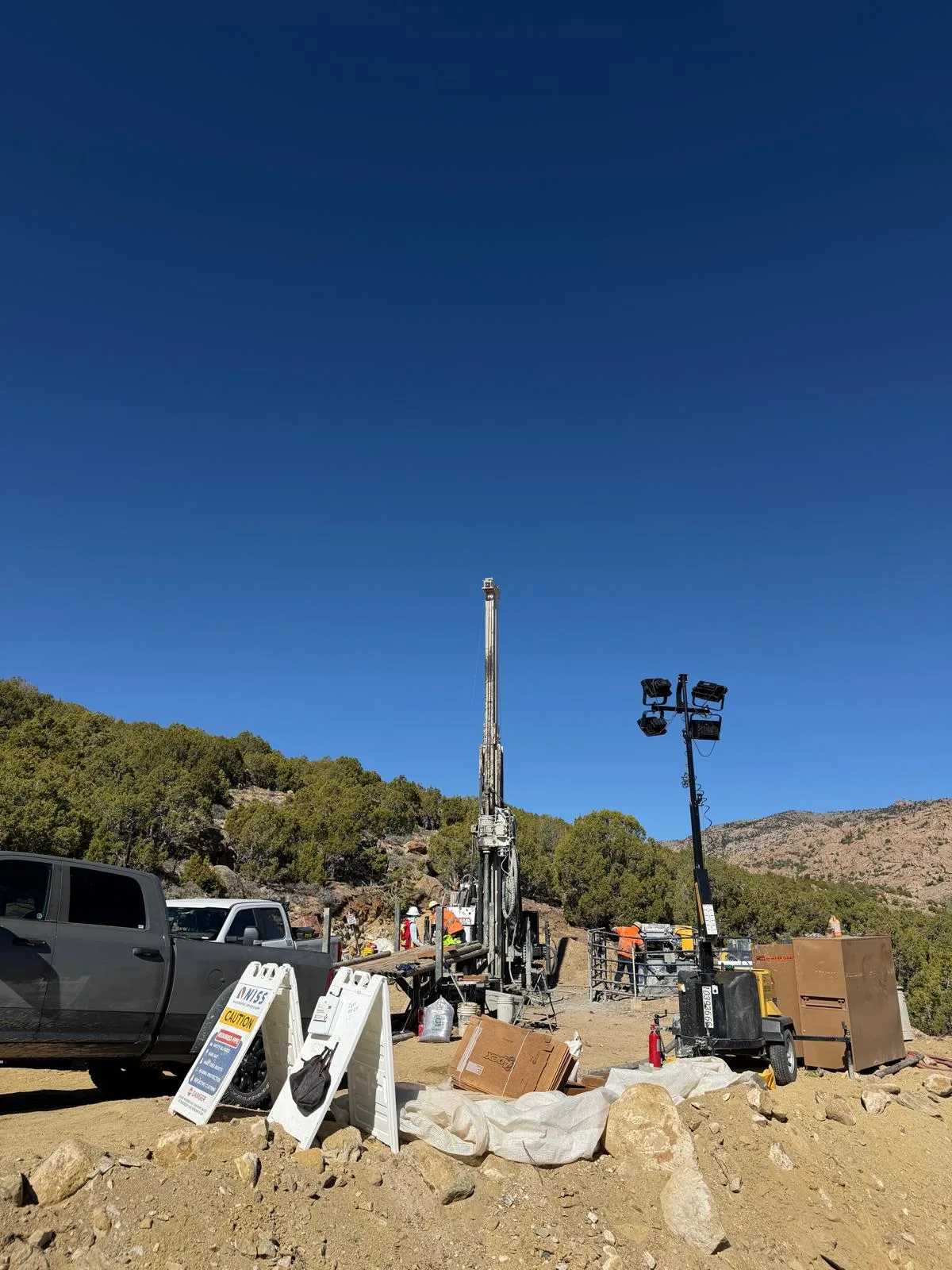
Myriad’s Phase II drilling program is focused on validating historical information, testing mineralization, and expanding the company’s understanding of Copper Mountain.
During the interview, Lamb discussed drilling at two areas: Lucky Cliff and Gem.
Lucky Cliff is located north of the main Copper Mountain project area and outside the historical assessment area associated with the 655-million-pound exploration target.
Lamb reported that the company drilled four holes totaling approximately 716 metres at Lucky Cliff.
The program identified multiple mineralized intervals, including a reported interval of approximately 19.96 metres at 269 ppm eU₃O₈, beginning at a depth of around 18 metres.
The company also reported higher-grade readings within some of the mineralized intervals.
These figures are based on preliminary radiometric equivalent uranium measurements, not chemical assays, and remain subject to laboratory verification.
Gem is one of the six historical deposits that were included in the original conventional mine plan.
According to Lamb, Myriad drilled three vertical holes totaling approximately 507 metres at Gem.
The drilling identified multiple mineralized intervals, including:
The results were described by Lamb as supporting the historical geological interpretation and helping the company assess the potential for a modern resource estimate.
As with the Lucky Cliff results, these are preliminary equivalent uranium measurements and should not be interpreted as confirmed chemical assay grades.
Beyond the known deposits, Myriad has identified a new area east of the historical Copper Mountain deposits that displays geophysical characteristics similar to those observed around known mineralization.
The company used magnetic and radiometric surveys to identify these anomalies and has acquired additional ground in the area.
Lamb said the company is planning drilling to test the new zone.
The company is also evaluating deeper mineralization. Previous drilling encountered uranium below the historical assessment’s 600-foot depth boundary, and Myriad intends to investigate this further through its ongoing program.
However, the timing and extent of deeper drilling remain subject to planning and prioritization.
The combination of historical deposits, new areas of interest, and deeper targets gives Myriad several exploration avenues to evaluate.
A major objective for Myriad is to convert historical geological information into a modern, independently supported mineral resource estimate.
Lamb explained that the company intends to use historical drilling data to guide new drilling, including targeting areas where additional holes could help validate historical results.
This approach could allow the company to focus on selected deposits and potentially reduce the amount of drilling required to establish a current resource.
However, Lamb cautioned against treating previously discussed resource-growth scenarios as guaranteed outcomes.
He clarified that a previously mentioned scenario involving approximately $20 million in additional drilling and a potential 50-million-pound resource was speculative and dependent on favorable exploration results.
The company has not established that this scenario will be achieved, and the timing of a first current resource estimate remains subject to the progress of the drilling program.
Myriad has also been evaluating processing options for Copper Mountain.
In September 2026, the company announced preliminary test results involving high-pressure slurry ablation (HPSA) technology developed by DISA Uranium.
The testing indicated that approximately 70% of the rock mass could be rejected while retaining around 84% of the uranium, according to the figures discussed during the interview.
The purpose of the process is to concentrate uranium-bearing material before subsequent processing.
Lamb said the results could potentially reduce the amount of material that needs to be transported, handled, and leached, while also producing a cleaner waste stream.
He also discussed the possibility that the technology could complement historical heap-leach testing at Copper Mountain.
Historical testing reportedly achieved uranium recovery rates of approximately 92% overall, with most samples returning around 96%.
However, these historical results and the new ablation tests are separate stages of work and should not be treated as proof of commercial-scale recovery or project economics.
Lamb emphasized that further analysis and testing are required.
“Of course, you have to test all that stuff at scale and all that kind of thing.”
The company has expressed interest in continuing discussions with DISA Uranium, although the future structure of the relationship has not been finalized.
Myriad has also expanded into Arizona through a portfolio of 23 breccia pipe uranium and rare earth element exploration targets.
The project is located in the Arizona Strip, a region known for breccia pipe uranium deposits.
One of the targets is the Wate Pipe, which has a historical resource estimate. The company has highlighted the potential of the target, but historical estimates should not be treated as current mineral resources.
The Arizona targets have been optioned to Wedgemount Resources, allowing Myriad to pursue potential value from the portfolio while limiting its direct exposure to exploration costs and risks.
Lamb discussed the nearby Pinyon Plain Mine, operated by Energy Fuels, as an example of the potential that breccia pipe deposits can offer.
He cautioned, however, that the results achieved at Pinyon Plain cannot be assumed to apply to Myriad’s targets.
The company intends to evaluate the Arizona assets as part of its broader strategy of acquiring exploration opportunities and seeking partners to advance them.
Myriad completed the sale of its Red Basin Uranium Project in New Mexico to Subatomic in May 2026.
The transaction was valued at US$2.5 million, and Myriad retained a 10% free-carried interest in the project.
Lamb described the transaction as an example of the company’s approach to acquiring assets, identifying opportunities, and bringing in partners to advance them.
He said the company believes the retained interest could provide future value while reducing the capital burden associated with directly developing the project.
Lamb also highlighted the involvement of investors associated with the technology and venture capital sectors.
The transaction reflects Myriad’s stated strategy of pursuing opportunities beyond its flagship Copper Mountain project while managing its exposure to exploration and development costs.
Myriad completed its acquisition of 100% of Rush Rare Metals on August 21, 2026, consolidating its ownership of the Copper Mountain project.
The transaction is central to Myriad’s strategy of advancing Copper Mountain under a single corporate structure.
With the acquisition completed, the company can focus on further drilling, validating historical data, and evaluating the project’s broader exploration potential.
During the interview, Lamb discussed Myriad’s financial position and outstanding warrants.
He cited approximately C$12.5 million in cash as of the previous quarter, referring to the company’s public financial disclosures.
He also referenced an analyst estimate of approximately C$9.6 million in cash at a later point, while noting that this was not the company’s own public disclosure.
Lamb said warrant exercises were bringing additional funds into the company.
He highlighted several warrant tranches, including:
These figures reflect the interview discussion and should be checked against the company’s latest filings for current outstanding amounts and expiry terms.
Lamb said the company believes warrant exercises could provide additional funding without requiring a new equity financing, depending on market conditions and whether holders exercise their warrants.
Myriad is also pursuing a U.S. exchange listing.
Lamb said the company was working toward a transition to the TSX Venture Exchange as an interim step, with the intention of establishing a foundation for a future U.S. listing.
He noted that the company was advancing legal and accounting preparations and holding discussions with potential strategic groups.
However, he did not confirm a definitive listing date.
A listing in early 2027 was discussed during the interview as a possibility, not a confirmed timeline.
The company’s plans remain subject to regulatory requirements and the completion of the necessary steps.
Looking ahead, Myriad expects to continue its Phase II drilling program, with a focus on areas where recent results and historical data may justify additional work.
Lamb said the company may concentrate more heavily on selected deposits rather than immediately expanding drilling across a wider area.
He also noted that some access and permitting adjustments with the Bureau of Land Management may be required to facilitate work in certain areas.
The company expects a pause in drilling activity during part of the upcoming hunting season, followed by a resumption of work.
Additional priorities include:
Lamb said the company remains interested in acquiring additional projects if suitable opportunities emerge.
He described Myriad’s approach as identifying assets, structuring transactions to limit risk, and seeking partners to advance projects.
Myriad Uranium is advancing several initiatives across its U.S. uranium portfolio.
At Copper Mountain, the company is using modern drilling and assay work to validate historical information, test new areas, and work toward a current mineral resource estimate.
The preliminary drilling results at Lucky Cliff and Gem provide additional geological information, while the processing tests with DISA Uranium offer a potential avenue for reducing the amount of material handled during future processing.
The Arizona breccia pipe portfolio and the retained interest in Red Basin give Myriad exposure to additional projects beyond its flagship Wyoming asset.
At the same time, the company is working through its exchange-listing plans and evaluating opportunities for further acquisitions.
The key milestones to watch are the continuation of Phase II drilling, laboratory verification of preliminary results, further processing analysis, and progress toward a current mineral resource estimate.
Historical resource estimates and exploration targets remain distinct from current mineral resources, and the company’s future development and economic potential will depend on further exploration, technical work, and project evaluation.
Sign up to our free monthly newsletter to recieve the latest on our interviews and articles.
By subscribing you agree to receive our newest articles and interviews and agree with our Privacy Policy.
You may unsubscribe at any time.
We use cookies to improve your experience on our site. By using our site, you consent to cookies.
Websites store cookies to enhance functionality and personalise your experience. You can manage your preferences, but blocking some cookies may impact site performance and services.
Essential cookies enable basic functions and are necessary for the proper function of the website.
These cookies are needed for adding comments on this website.
Statistics cookies collect information anonymously. This information helps us understand how visitors use our website.
Google Analytics is a powerful tool that tracks and analyzes website traffic for informed marketing decisions.
Service URL: policies.google.com (opens in a new window)
You can find more information in our Privacy Policy.