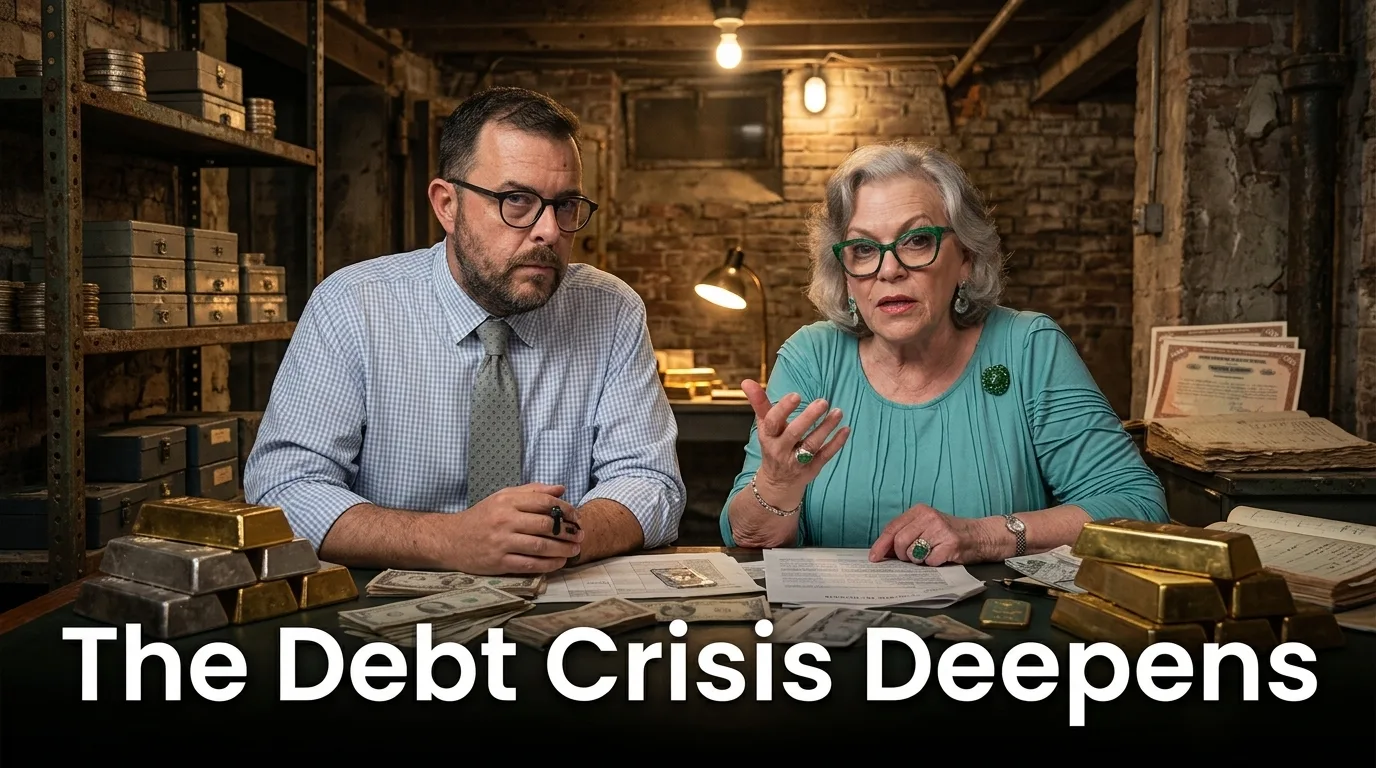
Lynette Zang, a precious metals and monetary system commentator, joined me to discuss growing pressure in the U.S. Treasury market, the risks of rising sovereign debt, the expansion of stablecoins, and why she believes gold and silver could play a critical role in a changing global financial system.
As government debt continues to expand and financial markets become increasingly interconnected, questions about the stability of the global monetary system are gaining attention.
Lynette examined what she sees as structural weaknesses beneath the surface of the financial markets. The discussion covered the U.S. Treasury market, the growing role of technology companies and stablecoins in the financial system, the potential consequences of a sudden loss of confidence in government debt, and the implications for investors holding gold, silver, and other assets.
Zang argued that the current financial environment cannot be understood by looking at individual market movements in isolation. Instead, she believes investors need to examine the longer-term changes in the global monetary system, particularly those that began during the 2008 financial crisis.
She also outlined her view that physical precious metals could become increasingly important if confidence in traditional financial assets deteriorates.
While Zang expressed strong concerns about the possibility of a future financial crisis, she acknowledged that the timing and ultimate outcome remain uncertain.
The interview began with a discussion of the U.S. Treasury market and the broader implications of rising government borrowing costs.
With the 10-year U.S. Treasury yield recently moving above 5%, the conversation focused on whether the market was experiencing a temporary adjustment or revealing deeper structural problems in the sovereign debt system.
Zang argued that the current pressures are not new. In her view, the underlying changes began years ago, particularly during the 2008 global financial crisis.
She pointed to the actions of major central banks, including the Federal Reserve, the European Central Bank, and the Bank of England, arguing that monetary expansion helped sustain the financial system after the earlier crisis.
However, she believes that the growing volume of government debt and the changing composition of Treasury market participants have created new vulnerabilities.
One of the central themes of her analysis is the shift in the ownership and trading of U.S. government debt.
Historically, major banks and foreign governments played important roles in supporting the Treasury market. Zang argued that this structure began changing around 2008, with greater participation from hedge funds and other market traders.
According to her, this shift has contributed to greater price volatility and has changed the way investors interact with government bonds.
She also highlighted the role of China and Japan, historically among the largest foreign holders of U.S. Treasuries, in the broader evolution of the market.
Zang's central concern is that the Treasury market, which serves as a foundation for global financial markets, has become increasingly dependent on participants whose trading decisions may be driven by short-term market opportunities.
She questioned whether this evolving structure provides a sufficiently stable foundation for the global financial system.
The U.S. Treasury market plays a central role in the global financial system. Government bonds are widely used as financial assets, collateral, and benchmarks for pricing other forms of credit.
When Treasury market conditions become unstable, the effects can extend beyond government borrowing costs.
Changes in Treasury yields can influence mortgage rates, corporate financing, asset valuations, and the cost of borrowing throughout the economy.
Zang argued that investors should pay attention not only to the amount of government debt being issued but also to the structure of the market that absorbs it.
In her view, the growing importance of trading firms and the changing behavior of traditional buyers raise questions about the market's ability to absorb large volumes of new debt during periods of stress.
She also questioned whether extraordinary measures intended to support the Treasury market can provide a lasting solution to deeper structural problems.
Her broader argument is that the stability of the global financial system depends heavily on confidence in government debt and the institutions that support it.
As the U.S. government continues to issue debt, an increasingly important question is who will ultimately absorb the growing supply of Treasury securities.
Traditional buyers include domestic banks, pension funds, foreign investors, and other institutional participants.
The Federal Reserve has also played a significant role in the Treasury market through its monetary policy and balance sheet operations.
However, Zang believes that the emergence of stablecoins could introduce another important source of demand for U.S. government debt.
She argued that stablecoin issuers could become increasingly relevant to the Treasury market because many stablecoins are backed by reserves that include U.S. government securities.
This creates a potential connection between the expansion of digital currencies and the demand for government debt.
According to Zang, the development of stablecoins represents another way for the financial system to extend the role of the U.S. dollar through private-sector financial infrastructure.
She expressed concern that this could deepen the dependence of the monetary system on government debt and the continued confidence of users in dollar-backed financial instruments.
Her argument is that the expansion of new forms of money does not necessarily eliminate the structural vulnerabilities of the existing system.
Instead, she believes it could create additional channels through which those vulnerabilities are transmitted.
Stablecoins emerged as one of the most important themes of the interview.
These digital assets are generally designed to maintain a stable value relative to another asset, most commonly the U.S. dollar.
Their growing role in digital payments and financial markets has prompted debate about their potential impact on the banking system, government debt markets, and the future of money.
Zang focused on the relationship between stablecoins and U.S. Treasury securities.
She argued that dollar-backed stablecoins could create additional demand for government debt while extending the dollar's influence into new digital financial ecosystems.
However, she also raised concerns about the implications of allowing private companies to issue digital currencies that are closely tied to their own commercial platforms.
One of Zang's concerns is that stablecoins issued by large technology companies could become deeply integrated into their commercial ecosystems.
She used the example of a hypothetical stablecoin issued by Amazon, suggesting that a company could offer incentives to encourage customers to use its digital currency within its own network.
In her view, this could create a situation in which consumers become increasingly dependent on a particular platform to access and spend their money.
She questioned whether users would retain the same freedom to move between payment systems that they have traditionally associated with cash.
Zang also raised concerns about the declining acceptance of physical cash in certain locations, arguing that the expansion of digital payment systems could reduce the range of payment options available to consumers.
These concerns reflect a broader debate about financial inclusion, competition between payment providers, consumer choice, and the concentration of economic power in large technology companies.
For Zang, the issue is not simply whether stablecoins can make payments faster or more convenient.
She believes the more important question is whether individuals will retain control over their financial resources as money becomes increasingly digital.
A particularly important part of the interview focused on Zang's definition of money and the functions it is supposed to perform.
She outlined four key functions:
Zang argued that the fourth function is especially important because individuals cannot recover the time and energy they have already invested in earning their income.
In her view, a monetary system that steadily erodes purchasing power undermines the ability of people to preserve the value of their work.
She believes this distinction is particularly relevant in an environment characterized by rising debt, monetary expansion, and the growing use of digital financial instruments.
Zang also emphasized the difference between money and currency, arguing that conventional currency does not necessarily provide the same long-term store-of-value characteristics that she associates with gold.
As she explained during the interview:
"The value, the function of money to hold the value over time."
Her argument is that investors should consider not only how much money they have in nominal terms but also what that money will be able to purchase in the future.
This perspective forms the foundation of her preference for physical precious metals as a means of preserving purchasing power.
Beyond government debt and financial market liquidity, Zang identified public confidence as one of the most important indicators to watch.
She argued that confidence in institutions and the monetary system is essential to maintaining the willingness of individuals and investors to hold financial assets.
In her view, a sustained deterioration in confidence could become a significant source of financial instability.
Zang pointed to consumer confidence and public trust in political leadership as indicators that she believes deserve more attention than conventional financial statistics alone.
She argued that a financial system based on continuous borrowing and the expansion of credit depends on the willingness of new participants to continue using and holding its financial instruments.
If that willingness weakens, she believes the system could face increasingly severe pressure.
She also connected these concerns to the potential effects of inflation on household purchasing power.
Her broader argument is that confidence, purchasing power, and financial stability are closely linked.
However, the relationship between consumer confidence and financial crises is complex, and confidence indicators alone cannot establish whether a crisis is imminent.
One of the most significant questions in the interview concerned what might happen during the first 24 to 72 hours of a sudden loss of confidence in government debt.
Zang pointed to the 2008 global financial crisis as an example of how quickly financial conditions can deteriorate.
In her view, one of the first effects of a severe financial shock would be a sharp contraction in credit availability.
She argued that borrowers and businesses could find it increasingly difficult to obtain financing as lenders reassess risk and financial institutions attempt to protect their balance sheets.
This could affect mortgage lending, corporate borrowing, and other forms of credit.
Zang also warned that problems in the bond market could spread through the broader financial system because government securities play an important role in collateral arrangements and financial transactions.
A major theme of Zang's analysis is the interconnected nature of modern financial markets.
Government bonds are widely used as collateral in financial transactions. They also play an important role in the pricing and management of interest-rate risk.
When bond prices move sharply or market liquidity deteriorates, institutions that rely on those assets may face additional collateral requirements.
This can trigger margin calls, forcing investors to provide additional cash or sell assets to meet their obligations.
Zang believes that these dynamics could intensify during a severe financial shock.
She also highlighted the complexity of the derivatives market, arguing that the full extent of interconnected financial exposures can be difficult for investors to assess.
Her concern is that stress in one part of the financial system could spread through multiple institutions and markets.
The potential result, in her view, would be a broader contraction in credit and a sharp repricing of financial assets.
While the precise scale and timing of such an event cannot be predicted, the underlying mechanisms of collateral pressure, forced selling, and reduced liquidity are important considerations for investors assessing systemic financial risk.
Gold and silver were central to the discussion of how investors might respond to a potential financial crisis.
Zang argued that physical precious metals could become increasingly important if confidence in traditional financial assets deteriorates.
However, she made a distinction between the markets for paper-based precious metal contracts and the markets for physical metal.
According to her, the price discovery process could increasingly shift toward physical supply and demand rather than being determined primarily by financial contracts.
She believes that a major financial crisis could accelerate this transition.
Gold and silver trade through multiple market structures, including physical transactions, exchange-traded products, futures contracts, and other financial instruments.
These markets are interconnected, but they do not necessarily reflect identical trading dynamics at every moment.
Zang argued that the physical markets deserve greater attention because actual metal is a finite resource with industrial, investment, and other uses.
She contrasted this with financial contracts, which can represent exposure to precious metals without requiring immediate physical delivery.
In her view, a severe financial crisis could expose differences between the availability of physical metal and the pricing of financial contracts.
She also highlighted the broad range of uses for gold and silver.
Gold is held by investors, central banks, and various industries, while silver has significant industrial applications alongside its role as an investment asset.
Zang believes these different sources of demand could become increasingly important if confidence in the traditional monetary system weakens.
Her position is that physical precious metals could play a larger role in determining market prices during a period of financial instability.
This remains her market thesis rather than an established outcome.
Zang expressed the view that a major financial crisis could ultimately strengthen the role of gold and silver as stores of value.
However, she also acknowledged that precious metals could experience short-term volatility during a liquidity shock.
When investors face margin calls, they may be forced to sell assets to raise cash, even if those assets are traditionally viewed as safe havens.
Gold and silver are not immune to these dynamics.
Zang suggested that the initial stages of a financial crisis could therefore involve selling pressure in precious metals, followed by a stronger focus on their perceived long-term value.
She believes the outcome could depend on whether investors continue to prioritize liquidity and financial contracts or increasingly seek physical assets.
Her broader argument is that a major crisis could expose the difference between the nominal value of financial assets and the underlying purchasing power they provide.
She sees physical gold and silver as potential beneficiaries of such a shift.
One of the most striking moments of the interview came when Zang discussed what she believes gold and silver could be worth based on the scale of global debt and the amount of currency in circulation.
During the conversation, she suggested that gold's fundamental value could be approximately $48,000 per ounce under her framework.
She also argued that silver's fundamental value could be significantly higher than its prevailing market price, citing a figure approaching $2,000 per ounce.
These figures represent Zang's own valuation framework and should not be interpreted as established market prices, consensus forecasts, or guaranteed future targets.
Her argument is based on the relationship between precious metals, the global debt system, and the purchasing power of currencies.
She believes that if the monetary system undergoes a major restructuring, the prices of physical precious metals could eventually reflect a very different valuation framework.
The central question is whether investors will continue to value gold and silver primarily through existing financial markets or increasingly through their perceived role as stores of value.
The interview also addressed a practical question relevant to ordinary households: how can someone with $10,000 in savings think about protecting their wealth?
Zang argued that individuals should consider the purchasing power of their savings rather than focusing exclusively on the nominal balance in their bank accounts.
She believes physical gold and silver can play a role in a strategy designed to preserve wealth outside the traditional financial system.
However, her broader message extended beyond precious metals.
She emphasized the importance of understanding the risks associated with dependence on banks, brokerage accounts, payment networks, and other financial intermediaries.
For Zang, the issue is not simply how much an individual owns but how securely and independently that wealth can be accessed.
She also stressed that investors should recognize the difference between holding an asset directly and relying on a financial institution or intermediary to provide access to it.
Her approach places considerable emphasis on personal financial independence and the ability to maintain access to resources during periods of disruption.
Zang argued that directly holding physical precious metals can provide a different form of financial exposure than owning assets through financial institutions.
She believes that physical ownership reduces dependence on certain intermediaries and payment systems.
However, physical precious metals also involve practical considerations, including secure storage, insurance, transaction costs, liquidity, and the risk of theft.
Gold and silver do not generate interest or dividends, and their market prices can fluctuate significantly.
For individuals considering precious metals, the appropriate allocation depends on their financial circumstances, objectives, time horizon, and tolerance for risk.
Zang's central point was that people should understand what they own, how they can access it, and what risks are associated with their financial arrangements.
Beyond gold and silver, Zang emphasized the importance of building resilience at the household and community levels.
She argued that financial preparedness should not be limited to holding precious metals.
Instead, she highlighted several essential areas:
Zang believes local communities can play an important role in reducing dependence on complex supply chains and centralized systems.
She also emphasized that resilience does not require everyone to agree on every issue.
Instead, she argued that people can work together, share resources, and respect differing perspectives while building stronger communities.
Her comments reflect a broader view of financial security that extends beyond investment portfolios and traditional financial assets.
Another important theme in the interview was the relationship between financial infrastructure and individual autonomy.
Zang expressed concern that greater dependence on digital payment systems could make individuals more vulnerable to restrictions imposed by financial institutions, corporations, or governments.
She pointed to the growing role of digital platforms and centralized payment networks as areas that deserve attention.
Her argument is that access to wealth can depend not only on legal ownership but also on the systems through which that wealth is stored, transferred, and spent.
She believes that direct ownership of certain physical assets can reduce dependence on some of these systems.
During the interview, she also referred to the Canadian trucker protests and related financial restrictions as an example of the broader debate over access to financial services.
Her concern is that the increasing concentration of payment infrastructure could create vulnerabilities for individuals who depend entirely on digital financial systems.
These issues raise important questions about financial access, regulatory oversight, consumer protection, and the balance between institutional controls and individual autonomy.
The interview concluded with a discussion of artificial intelligence and its potential impact on the global financial system.
Zang acknowledged that AI could deliver meaningful benefits but expressed concern about the financial incentives and credit structures supporting the rapid expansion of the technology sector.
She argued that the enormous flow of capital into AI-related businesses could create risks if investment expectations become disconnected from the economic returns ultimately generated.
One of her concerns is the growing interdependence between technology companies, investors, and financing arrangements.
Zang specifically mentioned NVIDIA while discussing what she described as circular debt within the technology sector.
Her example involved a hypothetical arrangement in which one company provides financing to another company that then uses the money to purchase its products.
Such arrangements can create complex relationships between suppliers, customers, investors, and lenders.
Zang questioned whether the financial returns associated with these structures will ultimately justify the capital being committed.
Her broader concern is that companies may appear to be generating strong demand and revenue while depending on interconnected financing arrangements that could become vulnerable if investment slows.
The sustainability of AI-related investment has become an important question for financial markets as companies commit substantial resources to computing infrastructure, data centers, chips, and related technologies.
Zang believes that the combination of rapid technological expansion and abundant financing could contribute to broader financial instability if expectations are not met.
However, the existence of interconnected financing arrangements does not by itself establish that a financial bubble or systemic crisis is inevitable.
Zang warned that the rapid expansion of AI could create significant risks if companies are encouraged to pursue growth without adequately accounting for the potential consequences of failure.
She expressed concern about the relationship between technological innovation, corporate incentives, and the financial system.
She also raised questions about who ultimately bears the costs if large technology investments fail to generate the expected returns.
In her view, the consequences of a major financial disruption could extend well beyond the companies directly involved.
She compared some of these concerns with the 2008 financial crisis, arguing that the costs of financial instability can be distributed across the broader economy.
Zang acknowledged that AI has beneficial applications and did not argue that every aspect of the technology is harmful.
Her concern is that the speed and scale of investment could create vulnerabilities that are difficult to assess while the expansion is still underway.
For investors, this raises questions about corporate debt, capital expenditure, financing structures, and the long-term economic returns expected from AI infrastructure.
Throughout the interview, Zang emphasized the importance of looking beyond daily market movements and focusing on the structural forces shaping the global financial system.
Several themes emerged as areas investors may want to monitor.
The behavior of Treasury yields, market liquidity, and demand for government bonds can provide insight into the financing conditions facing the U.S. government and the broader financial system.
The relationship between government borrowing, interest expenses, and economic growth remains central to discussions about long-term fiscal sustainability.
Changes in lending standards and credit conditions can reveal whether financial institutions are becoming more cautious and whether businesses and households face increasing financing constraints.
The expansion of dollar-backed stablecoins could influence demand for short-term government securities and deepen the connection between digital financial infrastructure and sovereign debt markets.
Consumer confidence, inflation, and household financial conditions can help investors assess how changes in the economy are affecting individuals and businesses.
Investors can monitor physical precious metal demand, inventories, market premiums, and the relationship between physical transactions and financial contracts.
The sustainability of AI-related investment will depend partly on whether companies can translate spending on infrastructure and technology into durable economic returns.
Taken together, these factors provide a framework for examining the relationship between financial markets, government borrowing, technology investment, and the purchasing power of money.
At the heart of the interview was a fundamental question about the purpose of money and the role of wealth in people's lives.
Zang argued that investors should think carefully about the relationship between their savings, their purchasing power, and their ability to access financial resources.
She believes the global financial system is undergoing a structural transition and that the consequences could be significant for investors, households, and businesses.
Her outlook is centered on the possibility that confidence in traditional financial assets could weaken and that physical precious metals could become more important as a result.
She also emphasized the need for greater financial resilience, community support, and a clearer understanding of how digital financial systems operate.
While her predictions about a potential financial crisis and the future value of gold and silver remain her own views, the interview highlights several important questions about sovereign debt, market liquidity, digital currencies, and the future of money.
For investors, the broader challenge is to distinguish between short-term market volatility and longer-term structural changes while carefully evaluating the risks and opportunities associated with different assets.
The conversation with Lynette Zang explored a range of issues that sit at the intersection of government debt, monetary policy, technology, and wealth preservation.
From the changing structure of the U.S. Treasury market to the expansion of stablecoins and the growing financial influence of AI, the interview examined how interconnected the modern financial system has become.
Zang believes these developments could ultimately lead to a major reassessment of the role of traditional currencies and financial assets.
She sees physical gold and silver as potential beneficiaries of that transition and argues that individuals should consider how to protect their purchasing power and financial independence.
Whether or not her most dramatic predictions materialize, the questions raised in the discussion are relevant to anyone seeking to understand the risks facing the global financial system.
The key takeaway is to understand the structure of the financial system, evaluate the risks associated with different forms of wealth, and recognize that preserving purchasing power involves more than simply watching the nominal value of an investment portfolio.
Disclaimer: This interview and article are for informational and educational purposes only and do not constitute investment advice or a recommendation to buy or sell any security, commodity, or financial product. The views and forecasts expressed by Lynette Zang are her own and do not necessarily reflect the views of Triangle Investor. Investors should conduct their own due diligence and consult a qualified financial advisor before making investment decisions.
Sign up to our free monthly newsletter to recieve the latest on our interviews and articles.
By subscribing you agree to receive our newest articles and interviews and agree with our Privacy Policy.
You may unsubscribe at any time.

We use cookies to improve your experience on our site. By using our site, you consent to cookies.
Websites store cookies to enhance functionality and personalise your experience. You can manage your preferences, but blocking some cookies may impact site performance and services.
Essential cookies enable basic functions and are necessary for the proper function of the website.
These cookies are needed for adding comments on this website.
Statistics cookies collect information anonymously. This information helps us understand how visitors use our website.
Google Analytics is a powerful tool that tracks and analyzes website traffic for informed marketing decisions.
Service URL: policies.google.com (opens in a new window)
You can find more information in our Privacy Policy.