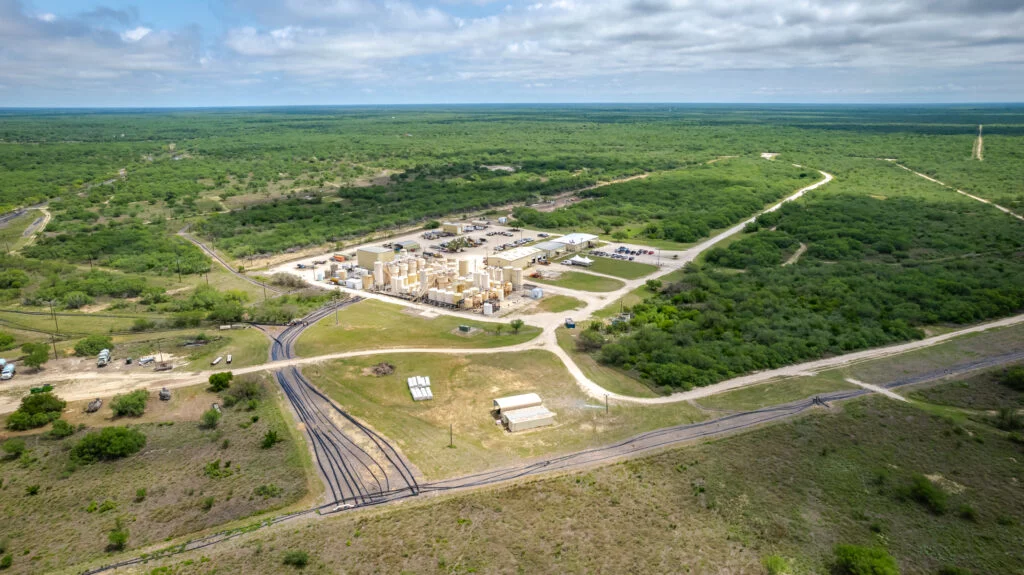
enCore Energy Corp. (NASDAQ: EU, TSXV: EU) is positioning itself for what could become a significant production expansion as the U.S. nuclear industry faces growing demand for domestically sourced uranium.
We sat down with enCore Energy Executive Chair William M. Sheriff and discussed the rapidly changing uranium market, U.S. government procurement requirements, utility contracting, production plans in Texas, the development of Alta Mesa East and Dewey Burdock, permitting challenges, production costs, uranium supply-chain bottlenecks, the strategic spinout of New Mexico assets into Verdera Energy and enCore's approach to mergers and acquisitions.
The interview comes at an important point for the company.
enCore has already demonstrated that it can produce uranium through its South Texas in-situ recovery operations. The company now wants to expand that production base through additional well fields, Alta Mesa East and eventually Dewey Burdock in South Dakota.
The central issue, according to Sheriff, is not a shortage of uranium resources, personnel, drilling equipment or technical expertise.
It is permitting.
That distinction could be extremely important for investors.
enCore's current corporate strategy explicitly emphasizes improving operating performance, accelerating permitting, controlling costs, developing its premier long-life assets and pursuing accretive mergers and acquisitions. The company has specifically identified Alta Mesa East and Dewey Burdock as major assets in its growth pipeline.
One of the most important themes from Sheriff's discussion was the disconnect between the uranium spot market and the underlying contracting market.
The uranium spot market has been relatively quiet compared with previous periods of extreme volatility.
For investors watching uranium equities, that can create the impression that the uranium market itself has stalled.
Sheriff strongly disagrees with that interpretation.
According to him, the real uranium business is increasingly being driven by the long-term contracting market, where utilities are securing future supply.
And that market, he argues, has been much stronger.
"The vast majority of uranium transacts on the term market."
That distinction is critical.
Uranium is unlike many commodities where the spot price provides a relatively complete picture of market conditions. Nuclear utilities need reliable fuel supplies years in advance, and nuclear reactors cannot simply stop operating because a utility failed to secure uranium.
Consequently, long-term contracting is arguably more important for uranium producers than short-term spot-market movements.
Sheriff believes the market is beginning to recognize this.
According to Sheriff, utilities around the world have historically approached uranium security differently.
He described U.S. utilities as generally more comfortable maintaining approximately two or three years of supply coverage.
China takes a considerably longer-term approach, while Japan has historically placed substantial emphasis on long-term security of supply.
But Sheriff believes the U.S. is now beginning to change.
The shift is gradual rather than dramatic.
U.S. utilities are becoming increasingly willing to lock in longer-term uranium contracts and, importantly, are showing greater flexibility regarding pricing structures.
That suggests utilities may be becoming increasingly concerned about future availability.
The key issue is not necessarily whether uranium prices are high today.
The issue is whether sufficient uranium will be available several years from now.
For a nuclear utility, being unable to secure fuel can be vastly more expensive than paying a higher uranium price.
One of the most important points raised in the interview was the U.S. government's emerging requirement for domestic uranium.
Sheriff discussed a request for information issued by the U.S. National Nuclear Security Administration during the World Nuclear Association meetings.
According to Sheriff, the government is seeking approximately 4 million pounds of uranium per year beginning in 2030, potentially for as long as three decades.
There is a critical condition attached to that requirement:
The uranium must be U.S.-origin material.
It cannot simply be uranium produced overseas by an American company.
This is particularly significant because the United States is attempting to rebuild its domestic nuclear fuel cycle and reduce dependence on foreign supply chains.
The requirement is primarily connected to military nuclear applications, particularly the fuel requirements associated with the U.S. Navy's nuclear-powered aircraft carriers and submarines, with potential additional demand from future generations of vessels.
Sheriff's point is simple:
2030 may sound far away.
For a uranium producer developing new capacity, it is not.
Developing uranium production is not something that can happen overnight.
A new project can require:
That means a requirement beginning in 2030 creates pressure on the industry today.
Sheriff believes there is currently no domestic producer capable of immediately supplying the entire potential government requirement.
That could create a significant opportunity for companies such as enCore that already have operating experience, permitted infrastructure and advanced projects.
Interestingly, Sheriff does not argue that the uranium industry necessarily needs massive amounts of government money.
His position is that the industry needs the government to get out of the way and accelerate the regulatory process.
This is where the FAST-41 permitting system becomes important.
Sheriff praised FAST-41 extensively, pointing to enCore's South Dakota permitting progress as an example of what can happen when federal agencies coordinate effectively.
The federal government, in his view, is no longer necessarily the main obstacle.
The bigger problem is often at the state level.
Some state agencies have not permitted uranium projects for decades.
As a result, the people currently responsible for permitting may have little or no practical experience with modern uranium projects.
That can create delays even when the regulations themselves are relatively straightforward.
Sheriff repeatedly returned to one theme during the interview:
Permitting is the primary constraint on enCore's production growth.
He does not believe the company lacks uranium resources.
He does not believe the company lacks technical personnel.
He does not believe the company lacks drilling capacity.
And he does not view working capital as the primary near-term constraint.
Instead, the company needs permits to activate infrastructure that has already been constructed.
This point is supported by enCore's current operating update.
The company reported that several South Texas projects were already substantially developed and awaiting final permits, including Alta Mesa Wellfield 3 Extension and the Upper Spring Creek Wellfield and Satellite IX Plant.
Sheriff suggested that a normalized Texas production profile could approach approximately one million pounds per year, based on historical performance.
Importantly, this was not presented as formal company guidance.
It was an indication of what management believes the existing Texas platform can achieve under normalized operating conditions.
enCore's South Texas platform provides the company with an important advantage because it is not starting from scratch.
The company already has processing infrastructure, experienced employees and operating knowledge.
That creates the potential for relatively low incremental capital requirements when compared with building an entirely new uranium operation.
One of the most important assets discussed in the interview is Alta Mesa East.
Alta Mesa East extends the existing Alta Mesa project to the east.
The geological roll fronts that have been exploited at Alta Mesa continue into the extension area.
enCore has been drilling Alta Mesa East, and Sheriff said the company has been pleased with the results.
The project could ultimately become an important contributor to the company's future production profile.
But again, the key issue is permitting.
An aquifer exemption is required, and Sheriff described this as the longest part of the permitting process.
Consequently, Alta Mesa East is not expected to become a major production contributor immediately.
The potential timing discussed in the interview points toward 2028–2029.
Current company disclosures similarly identify Alta Mesa East as a major growth asset and report that exploration drilling is ongoing, with initial permitting underway.
One of the most interesting aspects of enCore's Texas strategy is that some of the required infrastructure is already in place.
According to Sheriff, several well fields have effectively been paid for.
For example, the Upper Spring Creek project has a remote ion-exchange plant already installed.
The well field itself has also been developed.
Similarly, the Alta Mesa Wellfield 3 Extension has been installed and connected to the existing processing infrastructure.
The remaining step is regulatory approval.
That means the economics of bringing these projects online are very different from those of constructing an entirely new uranium operation.
The company has already incurred much of the capital expenditure.
Once permits are obtained, the infrastructure can potentially be activated without the same level of capital spending required for a greenfield project.
Sheriff indicated that Texas production costs had previously been in the $30s per pound when operations were running normally.
He does not expect costs to increase materially and suggested they could initially decline as already-built infrastructure is brought online.
That is an important point for investors.
The economics of uranium production depend heavily on realized uranium prices versus production costs.
If enCore can return toward its historical production-cost profile while uranium term prices remain elevated, incremental production could potentially carry attractive margins.
However, actual future costs will depend on production rates, well-field performance, inflation, labor, energy costs and other operating variables.
Another important point from the interview is that enCore has significant institutional knowledge in U.S. uranium production.
Sheriff said the company has enough experienced personnel to operate multiple plants, although additional staffing would be required as production expands.
The drilling fleet is also flexible.
The company previously had to dramatically increase drilling activity when uranium recovery rates exceeded expectations.
Now that some well fields are substantially complete, enCore has been able to reduce the number of active drilling rigs.
This can lower costs in the short term.
As additional well fields move toward development, the company can increase drilling activity again.
The second major growth asset discussed in the interview is Dewey Burdock in South Dakota.
The project is particularly important because it represents a major long-life uranium development opportunity in the United States.
And the permitting situation has moved substantially forward.
In June 2026, the U.S. Bureau of Land Management approved the project and authorized enCore to begin infrastructure construction. enCore subsequently received a 20-year renewal of the Source Materials License, meaning the project has received its necessary federal permits.
The remaining major hurdle discussed by Sheriff is state permitting.
The company entered the South Dakota state permitting process in June 2026.
enCore's current disclosures state that the company anticipates development in 2028, subject to receiving the necessary state permits.
Sheriff's caution regarding Dewey Burdock is understandable.
South Dakota has not permitted uranium development on this scale in decades.
Even if regulations technically allow a process to be completed within approximately one year, practical experience matters.
Sheriff believes approximately 18 months is a realistic working assumption.
But he also acknowledges that nobody can know exactly how the process will unfold until the agencies actually undertake it.
This is perhaps the biggest risk to the company's 2028 development timeline.
Sheriff indicated that Dewey Burdock could ultimately add approximately one million pounds per year to enCore's production profile.
That would be a significant addition to the company's existing Texas operations.
But the bigger opportunity is the long-term resource base.
Sheriff described Dewey Burdock as containing approximately 17 million pounds, with surrounding satellite opportunities potentially increasing the broader production base beyond 20 million pounds and potentially toward 25 million pounds with additional drilling.
The importance of this is that a large, long-lived resource can support predictable annual production for many years.
That is precisely the type of asset that can become increasingly valuable in a uranium market where utilities are looking for security of supply.
Dewey Burdock also illustrates the capital intensity of uranium infrastructure.
Sheriff estimated that constructing a new central processing plant could cost approximately $100 million, with the ultimate cost potentially reaching $150 million or more depending on the project.
That makes existing processing infrastructure particularly valuable.
And enCore may have another option.
Sheriff discussed three processing plants within approximately 100 miles of Dewey Burdock that are currently underutilized.
If an agreement could be reached to use one of these facilities, enCore could potentially avoid some of the capital expenditure and development time associated with building an entirely new plant.
No final decision had been made at the time of the interview.
The discussion about processing plants also highlights a broader point about the U.S. uranium sector.
Permitted uranium infrastructure is extremely difficult to replace.
A new processing plant requires:
And the process can take years.
Sheriff estimated that a new central plant would realistically cost at least around $100 million, with potentially much higher costs depending on capacity and circumstances.
This creates potential strategic value for existing uranium infrastructure.
It is one reason why consolidation could become increasingly important in the U.S. uranium sector.
The company also has an interesting advantage when it comes to the uranium industry's chemical supply chain.
enCore's in-situ recovery operations do not depend on sulfuric acid as their primary lixiviant.
Instead, the company uses oxygen, with small amounts of carbon dioxide or baking soda to adjust pH.
Sheriff said the company is therefore not experiencing the sulfuric-acid supply problems affecting some other uranium operations.
The bigger supply-chain issues, in his view, remain further down the nuclear fuel cycle.
Even if uranium mining increases substantially, uranium still needs to move through conversion and enrichment before it becomes reactor fuel.
Sheriff identified these stages as areas where the U.S. nuclear fuel cycle continues to face bottlenecks.
Government support is increasingly being directed toward these areas.
From enCore's perspective, the implication is that uranium mining and processing capacity could eventually expand at the same time as the downstream fuel-cycle infrastructure improves.
That would remove one of the major potential bottlenecks facing the U.S. nuclear industry.
Another major subject of the interview was enCore's New Mexico assets and their transfer to Verdera Energy Corp.
The transaction was strategically important because enCore chose to separate assets that require a different development approach from the company's core production strategy.
The transaction was completed in September 2026, with enCore distributing 35 million Verdera common shares to its shareholders as a special dividend.
Sheriff explained that enCore's strength is production.
The company specializes in:
New Mexico, however, requires a significant amount of work in areas such as:
Sheriff's view was that building an entirely separate organization inside enCore to handle those challenges would not be the most efficient approach.
Instead, Verdera is being structured specifically around those requirements.
The spinout does not mean enCore has completely abandoned the New Mexico opportunity.
Sheriff said enCore retains approximately 15% ownership in Verdera and intends to maintain a technical relationship with the company.
That could ultimately create a situation in which enCore provides production expertise while Verdera focuses on permitting, community and political development.
In other words, the two companies can potentially specialize rather than duplicating the same capabilities.
Sheriff described New Mexico as one of the most heavily endowed uranium states in the United States.
He said Verdera could have approximately 88 million pounds of uranium resources, primarily across four deposits, although some of the resource base is historic.
The historical database is potentially valuable.
Sheriff referenced historical work conducted by major companies such as Gulf Oil, Phillips Petroleum and Kerr-McGee.
Verdera also has access to a large historical exploration database containing more than 250,000 original drill logs, according to Sheriff.
That type of historical data could help identify areas where additional drilling may quickly generate new resources.
But once again, the challenge is not simply finding uranium.
The challenge is permitting and developing it.
Sheriff remains strongly supportive of consolidation in the uranium sector.
He believes there are few industries where the case for consolidation is as compelling.
However, enCore's acquisition criteria are very specific.
The company is not interested in buying uranium simply because it has a large resource estimate.
The reason is time.
A resource in the ground may require four or five years of additional exploration, permitting, construction and development before becoming a producing asset.
That does not fit enCore's current strategy.
Sheriff's acquisition philosophy can essentially be summarized by one question:
Can the acquisition add meaningful production within approximately two years?
If the answer is no, the opportunity becomes much less attractive.
Potential targets could therefore include:
This approach fits with the company's stated strategic commitment to accretive M&A. enCore's April 2026 corporate-renewal announcement specifically highlighted renewed commitment to mergers and acquisitions alongside cost management, permitting and development of Alta Mesa East and Dewey Burdock.
Another important aspect of the interview was enCore's uranium delivery commitments.
Because production has not always matched the company's original schedule, enCore has had to defer some deliveries.
Sheriff said the company deferred some deliveries in 2026 and 2027 and effectively spread them into 2028 and 2029.
The company is not currently adding additional contracts for the near term.
This is a deliberate decision.
Management does not want to add additional long-term obligations until it has greater certainty about future production.
Sheriff said enCore has approximately 14 contracts with seven to nine different utilities.
That provides the company with an important degree of flexibility.
Not every utility has the same inventory position.
Some may have several years of uranium available.
Others may need deliveries more urgently.
That allows enCore to have discussions with individual customers about delivery timing.
The key is maintaining credibility.
If a producer can demonstrate that a delay is caused by permitting rather than technical failure, utilities are generally better positioned to understand the situation.
Sheriff believes enCore's production track record supports that credibility.
One of the more interesting comments from Sheriff concerned enCore's older contracts.
Several contracts were signed years ago when uranium prices were substantially lower.
At that time, a price ceiling around $65 per pound could have looked attractive.
Today, it looks very different.
Fortunately, Sheriff said those legacy contracts represent a relatively small portion of the overall contract book.
The last of the particularly restrictive contracts is expected to expire in 2027.
That could remove an important drag on the company's future realized pricing.
Sheriff made an interesting point when asked what uranium price environment enCore needs.
His answer was essentially that the company does not necessarily require a major increase in uranium prices from current levels.
Instead, the company needs:
This is an important distinction.
An investor can potentially build a bullish thesis around rising uranium prices.
But enCore's potential upside does not necessarily depend entirely on uranium prices rising dramatically.
Operational improvement itself could be a major driver.
Sheriff's comments suggest a two-stage development story.
Management expects 2027 to be better than 2026, but not necessarily spectacular.
The focus is on:
The picture becomes considerably more interesting in 2028.
Alta Mesa East could begin contributing.
Dewey Burdock could potentially move into development and possibly production depending on permitting.
The company could begin moving toward a much larger production profile.
This is why Sheriff views 2028 as potentially transformative.
Sheriff also disclosed that he and his wife purchased approximately $250,000 of enCore shares across three separate trading days.
That is obviously not a guarantee of future performance.
But it does demonstrate management's stated confidence in the company's prospects.
Sheriff believes the damage caused by previous permitting disputes has largely been repaired.
He specifically acknowledged that some of the company's permitting problems had been self-inflicted.
The new management team's approach has been different.
Instead of fighting regulators over every requirement, enCore has focused on cooperation and building relationships.
That change could prove important.
enCore's story ultimately cannot be separated from the larger U.S. nuclear renaissance.
The United States wants more nuclear generation.
Utilities need reliable fuel.
The government wants greater domestic control over the nuclear fuel cycle.
The military needs secure nuclear fuel.
And existing domestic uranium production remains well below the levels required to fully satisfy future demand.
This creates a potentially favorable environment for companies capable of bringing domestic uranium production online.
enCore's advantage is that it is not merely an exploration company.
It already operates uranium production assets.
It has processing infrastructure.
It has an experienced technical team.
It has advanced projects.
And it has identified a pathway toward additional production.
The investment thesis ultimately comes down to execution.
The company needs to convert its existing assets into higher production.
That requires several things to happen.
First, permitting needs to continue improving.
The current management team has made permitting a central priority.
Second, Texas production needs to normalize.
Existing infrastructure provides the potential for relatively rapid improvement once permits are received.
Third, Alta Mesa East needs to advance.
The exploration results are encouraging according to management, but the project still has a permitting timeline.
Fourth, Dewey Burdock needs to clear the South Dakota permitting process.
Federal approvals are now in place, leaving state permitting as the major hurdle.
Fifth, uranium contracting needs to remain strong.
If utilities continue securing long-term supply at increasingly attractive prices, producers with reliable future production should benefit.
Sixth, the company needs to maintain cost discipline.
The current management team's cost-cutting strategy is designed to improve the economics of existing operations.
The bullish case should not obscure the risks.
Permitting can take longer than expected.
Dewey Burdock's state approval process remains a critical uncertainty.
Alta Mesa East still requires additional permitting.
Production can fluctuate.
Uranium recovery rates can change.
Contract obligations can create financial exposure.
Capital requirements for new infrastructure can be substantial.
And uranium prices themselves can be volatile.
There is also the broader risk that the expected nuclear buildout takes longer than anticipated.
For those reasons, investors should distinguish between management's targets and guaranteed outcomes.
The most important message from Bill Sheriff's interview may be surprisingly simple:
enCore does not need to discover its future. It needs to execute it.
The company already has uranium resources.
It already has production experience.
It already has processing infrastructure.
It has advanced development projects.
It has a significant U.S. asset base.
And it operates in a jurisdiction where domestic uranium is becoming increasingly strategically important.
The bottleneck is permitting and execution.
If management can continue improving relationships with regulators, obtain the required permits and activate already-developed infrastructure, production could increase materially.
Then Alta Mesa East and Dewey Burdock could provide another layer of growth.
Sheriff's most optimistic point in the interview was his view of 2028.
He believes 2027 could be a rebuilding year.
But 2028 could be very different.
By then, assuming permitting proceeds according to plan, enCore could potentially have:
And potentially, a much larger production runway.
The strategic importance of that cannot be underestimated.
The U.S. government is increasingly focused on domestic nuclear fuel security.
Utilities are becoming more conscious of future uranium availability.
Long-term contracting is strengthening.
And nuclear power is becoming increasingly important to U.S. energy and national-security policy.
enCore's challenge is to turn that macro opportunity into actual pounds produced.
The enCore Energy story is entering an important phase.
The company has acknowledged that it experienced permitting and operational challenges, including problems that Sheriff describes as partially self-inflicted.
But management believes those relationships have been repaired.
The company has also implemented cost reductions and placed renewed emphasis on operational efficiency and permitting.
The next phase is about execution.
If Texas operations return toward normalized production, Alta Mesa East advances successfully and Dewey Burdock receives its remaining state approvals, enCore could enter the second half of the decade with a substantially larger production profile.
At the same time, the broader uranium market may be moving in the company's favor.
The spot price alone does not tell the whole story.
Long-term contracting is becoming increasingly important.
U.S. utilities appear to be reassessing their inventory strategies.
The U.S. government may require millions of pounds of domestic uranium annually for national-security applications.
And the rebuilding of the American nuclear fuel cycle could create a premium for reliable domestic production.
That is the bigger opportunity for enCore.
The company is not simply betting on a higher uranium price.
It is betting that U.S. uranium production will become strategically more valuable — and that enCore can be one of the companies positioned to supply it.
The next major test is permitting.
And if management is right about the timeline, 2027 could be the rebuilding year, while 2028 could mark the beginning of a much larger chapter for enCore Energy.
enCore Energy Corp. trades on the Nasdaq and TSX Venture under the ticker EU.
Sign up to our free monthly newsletter to recieve the latest on our interviews and articles.
By subscribing you agree to receive our newest articles and interviews and agree with our Privacy Policy.
You may unsubscribe at any time.
We use cookies to improve your experience on our site. By using our site, you consent to cookies.
Websites store cookies to enhance functionality and personalise your experience. You can manage your preferences, but blocking some cookies may impact site performance and services.
Essential cookies enable basic functions and are necessary for the proper function of the website.
These cookies are needed for adding comments on this website.
Statistics cookies collect information anonymously. This information helps us understand how visitors use our website.
Google Analytics is a powerful tool that tracks and analyzes website traffic for informed marketing decisions.
Service URL: policies.google.com (opens in a new window)
Marketing cookies are used to follow visitors to websites. The intention is to show ads that are relevant and engaging to the individual user.
You can find more information in our Privacy Policy.