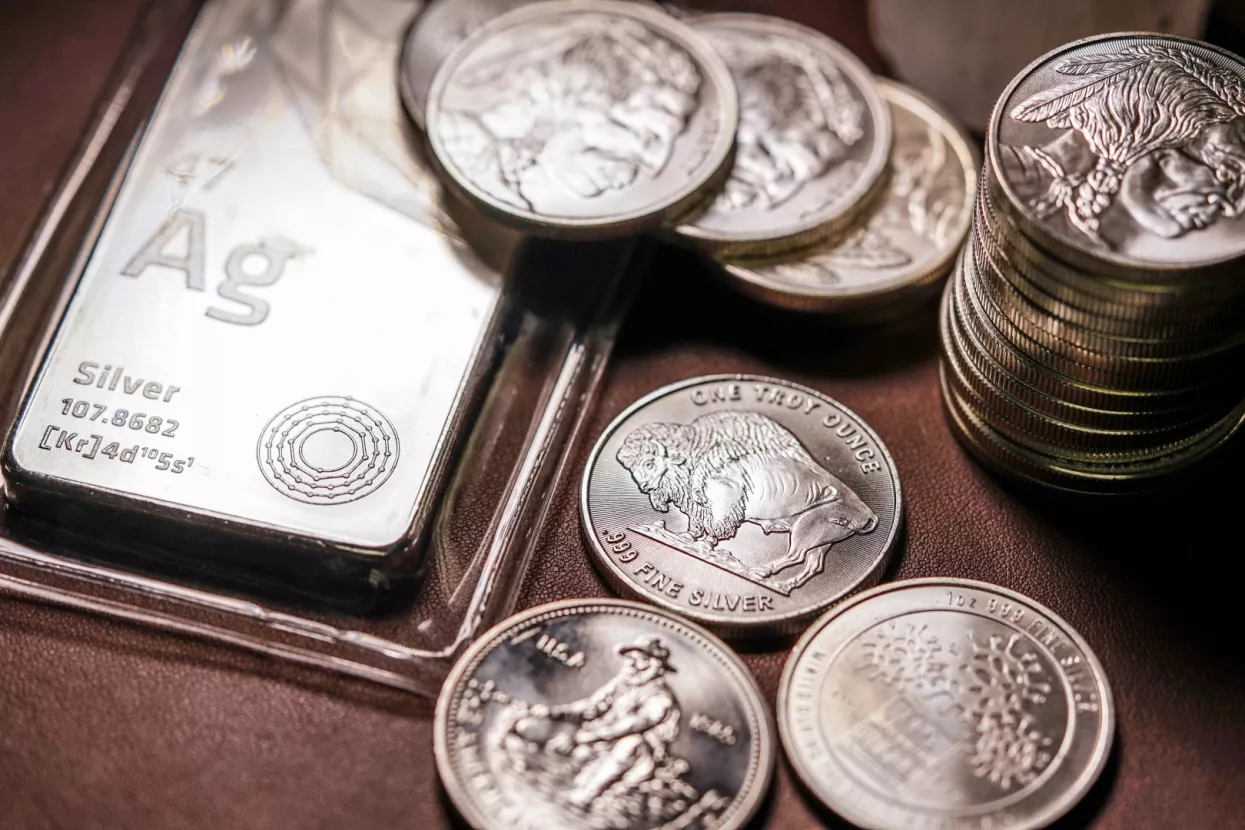
For precious metals investors, few years have been as emotionally exhausting as the current cycle.
Silver surged to an astonishing $120 per ounce, igniting speculation that the long-awaited supercycle had finally arrived. Yet within months, the market reversed sharply, cutting prices in half and leaving many investors questioning whether the bull market had ended almost as quickly as it began.
In a recent talk, veteran precious metals analyst David Morgan offered a very different perspective. Rather than viewing today's weakness as evidence of failure, he argues that the current correction fits the historical behavior of silver almost perfectly—and could ultimately become one of the best buying opportunities of the cycle.
His message is simple: ignore the short-term noise and focus on the structural forces driving the market.
Investors constantly search for a simple reason behind every price move.
When silver falls, commentators quickly point to a stronger U.S. dollar, interest rate expectations, recession fears or changes in Federal Reserve policy.
Morgan cautions against this oversimplification.
Markets rarely move because of one event. Instead, prices reflect countless individual decisions happening simultaneously. One investor sells because a stop-loss order is triggered. Another needs liquidity. Institutions rebalance portfolios. Speculators exit leveraged positions. Industrial users delay purchases.
The only objective reality is that selling pressure temporarily exceeds buying pressure.
While macroeconomic headlines certainly influence sentiment, Morgan believes investors often overestimate their importance compared to simple market mechanics.
Morgan surprised many listeners by admitting that silver could still decline toward $50 per ounce.
Rather than seeing this as bearish, he views it as perfectly normal.
Commodity markets frequently revisit major breakout levels before resuming their advance.
Silver spent decades unable to break above the historic $50 resistance, first established in 1980 and revisited in 2011.
When that barrier finally gave way, prices accelerated dramatically.
According to Morgan, markets often "kiss the breakout point" before continuing higher.
A temporary return to $50 would therefore represent technical confirmation rather than structural weakness.
The same logic applies to gold.
Although gold recently slipped below $4,000, Morgan identifies approximately $3,500 as the major long-term support zone—the previous breakout level.
Should prices revisit that area, he expects buying demand to emerge rapidly.
Perhaps Morgan's strongest message concerns investor psychology.
When silver traded above $100, investors rushed into the market.
Now, with prices nearly cut in half, many of those same investors have become convinced the sector is finished.
Morgan describes this as classic herd behavior.
Humans naturally feel safest moving with the crowd.
When everyone is buying, buying feels comfortable.
When everyone is selling, selling feels equally rational.
Unfortunately, successful investing often requires doing precisely the opposite.
History repeatedly shows that the greatest opportunities emerge when sentiment reaches pessimistic extremes.
Morgan argues today's precious metals market increasingly resembles those conditions.
One of the more practical lessons from the interview concerns portfolio management.
Many investors struggle with one critical question:
When should I sell?
Morgan advocates scaling out of positions rather than attempting to identify the exact market top.
Instead of selling everything at one price, investors can gradually reduce exposure.
For example:
This approach eliminates much of the emotional pressure associated with trying to perfectly time markets.
As Morgan puts it:
You never go broke taking a profit.
The real question then becomes how those profits should be redeployed—whether into other assets, debt reduction, real estate or simply cash reserves.
One of the biggest debates in precious metals revolves around the persistent supply deficit.
Industry estimates now point to six consecutive annual silver deficits, with hundreds of millions of ounces drawn from above-ground inventories.
Many investors assume such shortages must inevitably produce dramatically higher prices.
Morgan offers important historical context.
Between 1990 and 2005, the silver market experienced fifteen consecutive years of supply deficits.
During that period, approximately 1.5 billion ounces disappeared from above-ground stockpiles.
Yet prices barely moved.
This historical precedent demonstrates that supply deficits alone do not guarantee immediate price appreciation.
Today's market differs because silver has already experienced a major price breakout.
Nevertheless, Morgan warns investors against assuming deficits automatically translate into higher prices.
Instead, they should monitor actual buying pressure.
If deficits are not enough, what could drive silver dramatically higher?
Morgan believes the answer lies in government buying.
Silver has become an increasingly important strategic industrial metal.
It is indispensable for:
If governments begin treating silver similarly to oil or rare earth elements by building strategic stockpiles, the impact could be enormous.
Even relatively modest official purchases could create a powerful floor beneath prices.
China already provides an important example.
Morgan believes Chinese physical buying played a significant role in the previous rally.
Should that buying resume, he expects another major move.
Interestingly, Morgan pays little attention to many of the statistics commonly discussed by retail investors.
Instead, he focuses primarily on two indicators.
If inventories begin flowing into Chinese exchanges again, Morgan views that as evidence of renewed industrial and investment demand.
Because China remains one of the world's largest consumers of silver, its purchasing behavior carries enormous weight.
Lease rates reveal something very different.
They measure urgency.
When lease rates remain low, physical silver is readily available.
When lease rates spike, industrial users are effectively saying:
"We need silver immediately—and we're willing to pay whatever it takes."
Morgan considers rising lease rates one of the strongest signals that physical supply is tightening.
Historically, precious metals equities often moved before the metals themselves.
In recent years, however, that relationship weakened.
Gold outperformed silver.
Physical metals outperformed miners.
Morgan believes that could change.
Mining companies currently trade at historically depressed valuations despite elevated metal prices.
Institutional investors, quantitative funds and industry insiders may begin accumulating mining shares well before retail investors recognize the opportunity.
If that occurs, mining stocks could become one of the earliest indicators of the next bull market phase.
Morgan remains committed to one of his long-standing market principles:
Ninety percent of a bull market's gains often occur during the final ten percent of its duration.
He argues that financial markets typically end with explosive momentum fueled by widespread public participation.
Should broader financial conditions deteriorate through:
precious metals could become one of the few remaining destinations for capital.
Because silver is an exceptionally small market, relatively modest inflows could produce dramatic price appreciation.
Morgan therefore would not be surprised to witness another rapid acceleration similar to the recent move toward $120.
The conversation concluded with an intriguing discussion about digital currencies.
Unlike many analysts, Morgan does not necessarily expect central banks to dominate the future of digital money.
Instead, he envisions competition between private financial institutions and potentially even asset-backed digital payment systems.
He believes tokenized gold-backed currencies could eventually coexist alongside government-issued digital currencies.
While governments may attempt to limit their use within regulated banking systems, private peer-to-peer commerce could still create meaningful demand for precious metal-backed digital assets.
Such competition, Morgan argues, would preserve some monetary freedom even within an increasingly digital financial landscape.
Despite the recent correction, David Morgan remains fundamentally optimistic about the long-term outlook for precious metals.
His thesis does not depend on daily price movements or headline-driven explanations. Instead, it rests on structural trends:
Most importantly, Morgan believes today's pessimism may ultimately prove to be one of the strongest bullish indicators available.
For investors willing to think independently rather than follow the crowd, periods of maximum uncertainty have historically produced the greatest long-term opportunities.
Whether silver first revisits $50 or immediately resumes its advance, Morgan's broader message remains unchanged: successful investing requires patience, discipline, and the willingness to act when others are doing the opposite.
Watch the interview here: https://youtu.be/1X1KUSi7pfE?si=gP1oiw_J7o1oRkRL
Sign up to our free monthly newsletter to recieve the latest on our interviews and articles.
By subscribing you agree to receive our newest articles and interviews and agree with our Privacy Policy.
You may unsubscribe at any time.

We use cookies to improve your experience on our site. By using our site, you consent to cookies.
Websites store cookies to enhance functionality and personalise your experience. You can manage your preferences, but blocking some cookies may impact site performance and services.
Essential cookies enable basic functions and are necessary for the proper function of the website.
These cookies are needed for adding comments on this website.
Statistics cookies collect information anonymously. This information helps us understand how visitors use our website.
Google Analytics is a powerful tool that tracks and analyzes website traffic for informed marketing decisions.
Service URL: policies.google.com (opens in a new window)
Marketing cookies are used to follow visitors to websites. The intention is to show ads that are relevant and engaging to the individual user.
You can find more information in our Privacy Policy.