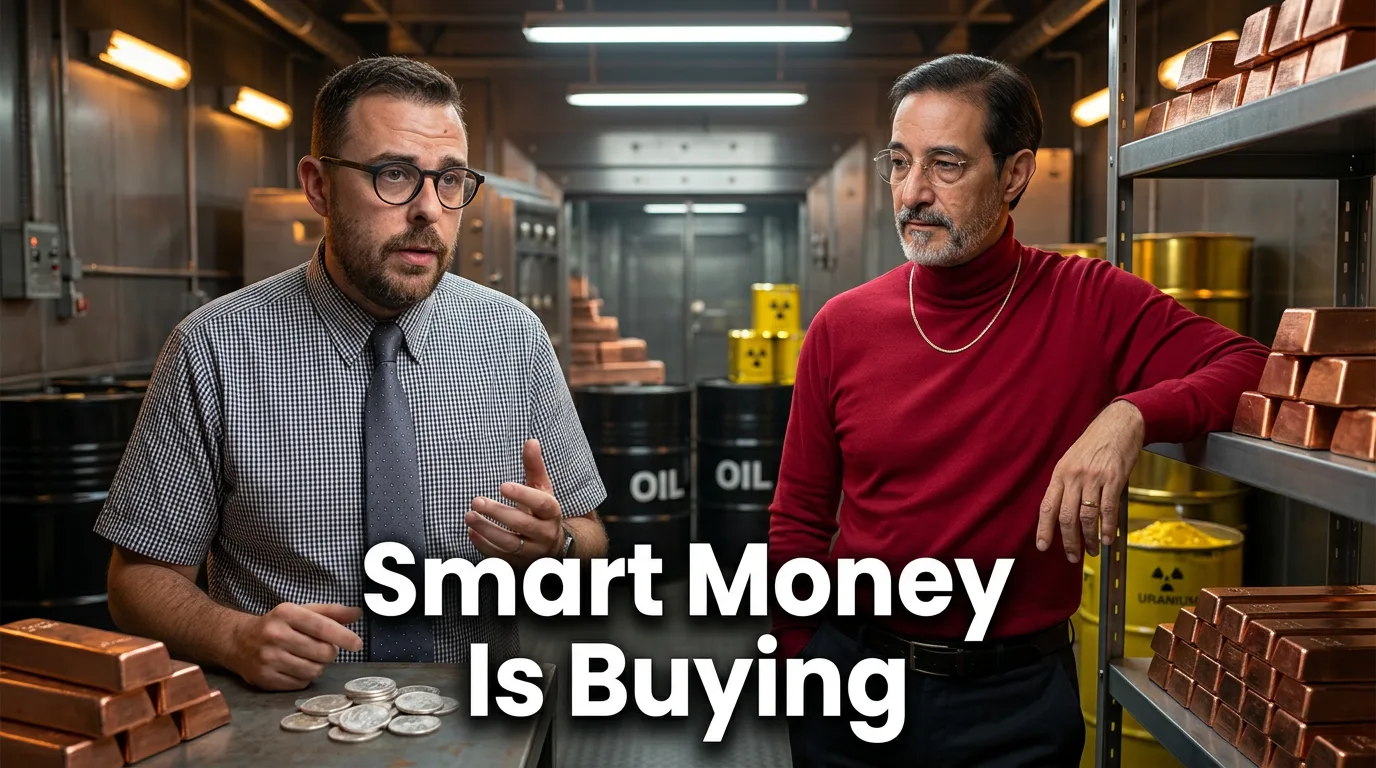
Most investors think that being bullish means buying. Lobo Tiggre doesn't.
Despite believing that commodities are entering one of the most compelling long-term bull markets of his career, the veteran resource investor is sitting on roughly 80% cash, patiently waiting for the right opportunities instead of chasing headlines.
It may sound contradictory, but that's exactly what has made Lobo one of the most respected voices in the natural resources sector. While much of the market is focused on predicting tomorrow's price moves, he is concentrating on something far more important: identifying moments when high-quality resource companies become genuinely undervalued.
Yet despite these powerful tailwinds, many experienced investors remain patient. Rather than chasing momentum, they are waiting for market dislocations that could offer exceptional entry points.
Retail investors often focus on short-term price movements, but institutional capital typically looks years ahead. According to Tiggre, conversations with fund managers and sophisticated investors reveal growing confidence in the commodity sector.
The reasons are becoming increasingly difficult to ignore.
Artificial intelligence alone requires an enormous physical infrastructure. Massive data centers consume tremendous quantities of copper, silver, steel, aluminum, energy, and specialized construction materials. Even if expectations surrounding AI eventually prove overly optimistic, those facilities still have to be built before the market discovers whether excess capacity exists.
This distinction is critical.
Demand for metals is driven by construction today—not by the eventual profitability of AI applications tomorrow.
Beyond AI, governments worldwide continue investing in:
Each of these trends independently supports commodity demand. Together, they create what may be one of the strongest demand environments seen in decades.
One of Tiggre's broader macroeconomic arguments centers on inflation.
Rather than viewing recent inflation as a temporary post-pandemic event, he believes the world is entering a prolonged period characterized by higher government spending, persistent deficits, geopolitical fragmentation, and increased investment in physical infrastructure.
Governments can print currencies.
They cannot print copper.
They cannot print uranium.
They cannot print oil.
Nor can they manufacture economically viable mineral deposits overnight.
This growing imbalance between financial assets and scarce physical resources strengthens the investment case for commodities over the coming decade.
Few commodities illustrate today's investment thesis better than copper.
Copper has always been considered the world's economic thermometer—earning the nickname "Dr. Copper" because of its close relationship with global industrial activity.
Today, however, a new demand source has emerged.
Artificial intelligence.
Every hyperscale data center requires enormous quantities of copper wiring, transformers, cooling systems, power infrastructure, and transmission lines.
Then there is electrification.
Electric vehicles require significantly more copper than internal combustion vehicles.
Renewable energy installations are copper intensive.
Power grids require upgrades.
Transmission networks need expansion.
Battery storage consumes additional metals.
Demand continues expanding across nearly every major industrial sector simultaneously.
Meanwhile, new world-class copper discoveries remain exceptionally rare.
Major mines take well over a decade to permit, finance, and construct.
Existing mines are aging.
Ore grades continue declining.
This creates a structural supply challenge that cannot be solved quickly, even if prices rise substantially.
Perhaps the interview's most surprising revelation is Tiggre's current cash position.
Despite being extremely bullish on commodities, approximately 80% of his portfolio remains in cash.
At first glance, this appears contradictory.
In reality, it reflects disciplined investing.
Rather than attempting to predict market direction, Tiggre prefers purchasing quality companies during periods of temporary weakness.
He recently purchased only one oil company after identifying what he believed was a uniquely oversold opportunity.
Everything else remains on his watchlist.
His philosophy is simple:
Buy low—not merely because prices may continue rising.
This patience separates professional speculators from emotional investors.
One particularly interesting observation involves the recent inverse relationship between oil and copper.
Geopolitical events affecting the Middle East often push oil prices sharply higher while simultaneously increasing fears surrounding global economic growth.
Copper frequently weakens under those circumstances.
Rather than trying to forecast geopolitical events, Tiggre watches for whichever market becomes temporarily oversold.
If oil rallies dramatically, copper stocks may become attractive.
If tensions ease and oil falls, energy companies may provide better value.
Instead of predicting headlines, he prepares to exploit emotional overreactions.
This approach emphasizes valuation over forecasting.
Although fundamentally bullish, Tiggre acknowledges that markets rarely move in straight lines.
Several developments could temporarily pressure copper prices:
Importantly, he distinguishes between temporary price weakness and deteriorating fundamentals.
Even if copper fell toward $4 per pound, he believes the underlying supply-demand imbalance would remain intact.
Such declines could create outstanding opportunities in mining equities rather than invalidate the long-term thesis.
Uranium remains another major conviction.
Unlike many investors, Lobo does not believe uranium equities have fully bottomed.
Investor sentiment has weakened.
Prices have corrected.
Many developers and explorers have suffered substantial declines.
Yet the industry's long-term fundamentals remain exceptionally strong.
Nuclear power is experiencing a global renaissance.
Countries seeking reliable, carbon-free electricity increasingly recognize nuclear energy as an essential component of future power generation.
Artificial intelligence further strengthens this case.
Large data centers require dependable baseload electricity.
Intermittent renewable energy alone cannot reliably meet those demands.
Nuclear energy provides one of the few scalable solutions.
One particularly important uranium observation concerns pricing dynamics.
Spot uranium prices have largely moved sideways, while long-term contract prices continue climbing.
Historically, these two markets eventually converge.
If long-term contracts remain significantly higher, spot prices often catch up—and sometimes overshoot.
For investors, this relationship suggests that the next meaningful move in uranium could still be higher.
That scenario would likely benefit uranium mining companies.
No commodity generates as much debate as silver.
Price manipulation has been discussed for decades.
Tiggre takes a nuanced position.
He does not deny manipulation exists.
Instead, he argues that manipulation exists across virtually every financial market.
The critical question is not whether manipulation occurs.
The important question is whether investors can still profit despite it.
History suggests they can.
Silver has experienced enormous rallies despite repeated accusations of suppression.
Instead of allowing conspiracy theories to dictate investment decisions, Lobo prefers focusing on price action, fundamentals, and valuation.
Markets occasionally become irrational.
That creates opportunities.
Although cautious in the short term, Lobo remains optimistic regarding gold and silver over the longer horizon.
Persistent monetary expansion.
Government deficits.
Currency debasement.
Geopolitical instability.
These forces continue supporting precious metals.
However, he also stresses an important investing principle:
Do not confuse the inevitable with the imminent.
Long-term bullishness does not eliminate the possibility of significant corrections.
Disciplined investors prepare for both outcomes.
One of the interview's most interesting shifts involves platinum group metals (PGMs).
Historically viewed primarily as industrial metals, platinum and palladium have recently demonstrated stronger relationships with precious metals than many investors expected.
That change has caught Tiggre's attention.
While not yet aggressively buying the sector, he now intends to add meaningful PGM exposure during the next favorable buying opportunity.
Sometimes the best investment ideas emerge not from new discoveries but from changing market behavior.
Diamonds represent one of the few sectors where Lobo remains decisively pessimistic.
The rapid growth of lab-grown diamonds has fundamentally altered the industry's economics.
Consumers increasingly accept synthetic diamonds because they:
Traditional diamond producers face increasing competition that may permanently reshape the market.
Unlike gold or silver, diamonds lack the same monetary characteristics and liquidity.
This structural shift makes the industry far less attractive from an investment perspective.
Portfolio construction remains another major theme.
Rather than concentrating exclusively on speculative exploration companies, Lobo prefers a "barbell" strategy.
On one side sit established producers capable of generating cash flow and providing greater stability.
On the other sit carefully selected junior explorers or developers offering substantial upside.
He intentionally avoids allocating heavily to companies in the middle.
The objective is balancing risk with asymmetric return potential.
Importantly, he emphasizes that portfolio construction depends on individual circumstances.
A young investor pursuing aggressive growth may favor explorers.
A retiree seeking income and stability may prefer royalty companies, ETFs, or large producers.
There is no universal formula.
Perhaps the interview's most valuable lesson has little to do with commodities themselves.
It concerns psychology.
Many investors become fearful during market declines.
Experienced speculators often react differently.
Falling prices can create opportunity.
Rather than asking, "Why is my portfolio down?"
Successful investors ask:
"Has this created a buying opportunity?"
This mindset requires emotional discipline.
Buying quality assets when others panic has historically generated some of the market's greatest returns.
Taken together, Tiggre's outlook paints a compelling picture.
The world is entering an era defined by:
These trends appear structural rather than cyclical.
Commodity markets may experience significant volatility.
Corrections remain inevitable.
Geopolitical events will continue influencing prices.
Yet the long-term direction increasingly favors ownership of scarce physical resources.
The next commodity bull market is unlikely to unfold in a straight line.
There will be sharp corrections, periods of pessimism, and headlines that temporarily shake investor confidence.
However, beneath that volatility lies an unmistakable reality.
Modern civilization is becoming more resource-intensive, not less.
Artificial intelligence requires data centers.
Data centers require electricity.
Electricity requires copper, uranium, silver, steel, and countless other commodities.
Governments continue spending.
Supply remains constrained.
New discoveries grow increasingly difficult.
Against this backdrop, patience may become an investor's greatest competitive advantage.
Rather than chasing rallies, disciplined investors are building watchlists, preserving capital, and preparing to act when markets inevitably overreact.
As Lobo Tiggre's approach demonstrates, the strongest conviction is not expressed through constant buying—it is expressed through the willingness to wait for the right opportunity.
For investors willing to think beyond the next quarter, the commodity story may still be in its early chapters rather than approaching its conclusion. The coming decade could reward those who recognize that the world's transition toward greater electrification, technological advancement, and geopolitical realignment will ultimately depend on one indispensable foundation: the raw materials that make it all possible. The interview transcript supporting these themes discusses institutional sentiment, commodity demand drivers, portfolio positioning, and sector-specific views in detail.
Sign up to our free monthly newsletter to recieve the latest on our interviews and articles.
By subscribing you agree to receive our newest articles and interviews and agree with our Privacy Policy.
You may unsubscribe at any time.
We use cookies to improve your experience on our site. By using our site, you consent to cookies.
Websites store cookies to enhance functionality and personalise your experience. You can manage your preferences, but blocking some cookies may impact site performance and services.
Essential cookies enable basic functions and are necessary for the proper function of the website.
These cookies are needed for adding comments on this website.
Statistics cookies collect information anonymously. This information helps us understand how visitors use our website.
Google Analytics is a powerful tool that tracks and analyzes website traffic for informed marketing decisions.
Service URL: policies.google.com (opens in a new window)
You can find more information in our Privacy Policy.