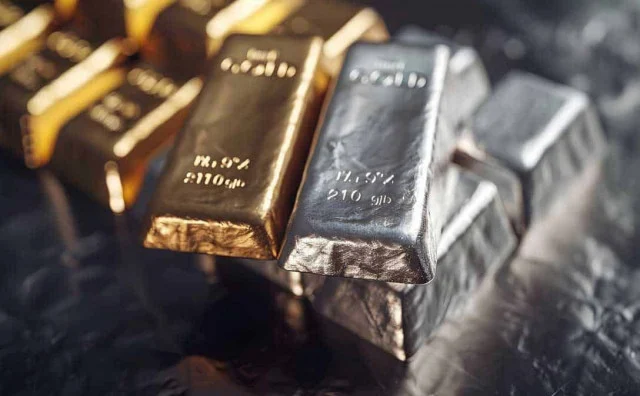
After an extraordinary rally that pushed precious metals to record highs, gold and silver have entered a sharp correction. While many investors interpret declining prices as a warning sign, veteran precious metals analyst Jeff Clark sees something entirely different: one of the best buying opportunities of the current bull market.
According to Clark, corrections are not only normal but necessary. Every major bull market experiences periods of consolidation that shake out speculative investors before the next advance begins. Rather than signaling the end of the trend, these pullbacks often create the foundation for much stronger future gains.
Clark compares today's correction with some of the largest declines witnessed during the 2008 Global Financial Crisis and the 2020 COVID market crash. From his perspective, the magnitude of the decline suggests that the market is approaching an important bottom rather than the beginning of a prolonged bear market.
His investment philosophy is remarkably simple:
Buy quality assets when fear dominates the market—not when enthusiasm reaches its peak.
That contrarian approach has produced some of his largest investment gains over several decades in the mining sector.
Financial markets rarely move in straight lines.
Bull markets consist of powerful advances followed by periods of correction that allow valuations to normalize and speculative excess to disappear.
The recent decline in gold prices has naturally reduced enthusiasm among investors, particularly in mining shares that typically experience greater volatility than the underlying metal. However, Clark believes these periods create opportunities rather than reasons for panic.
History shows that some of the strongest rallies begin when investor sentiment is at its weakest.
Instead of attempting to predict the exact bottom, Clark prefers gradually accumulating positions while prices remain depressed.
His philosophy reflects one of investing's oldest principles:
Buy when others are fearful and sell when others become excessively optimistic.
Although gold receives most of the attention, Clark believes silver may ultimately deliver stronger percentage returns during the current precious metals cycle.
Historically, gold tends to lead the early stages of a bull market.
Silver usually follows later—but often with explosive momentum.
One of the indicators supporting this view is the gold-to-silver ratio, which remains well above its long-term historical average.
When the ratio is elevated, it means silver is relatively inexpensive compared to gold.
Previous precious metals bull markets have shown a consistent pattern:
For investors without any exposure to silver, Clark believes today's market presents an attractive opportunity to begin building positions before the next major advance begins.
During the past several years, institutional investors, hedge funds and family offices significantly increased their exposure to precious metals.
One of the clearest signs was the dramatic increase in financing activity across junior mining companies.
Exploration firms that once struggled to raise a few million dollars suddenly attracted far larger investments.
However, the recent correction has temporarily slowed that activity.
Mining companies are understandably reluctant to issue new shares while their stock prices remain depressed, since doing so would create unnecessary shareholder dilution.
Despite the slowdown, Clark emphasizes that many companies remain well-funded.
Exploration drilling continues.
Development projects continue.
Construction decisions continue.
The industry's pipeline of future discoveries has not stopped simply because prices corrected.
Institutional money may be waiting for renewed momentum before aggressively returning, but the underlying projects continue progressing.
One of the biggest surprises during the current cycle has been the relatively muted performance of mining equities compared to bullion.
Gold reached historic highs.
Many producers generated record profits.
Yet mining stocks never experienced the kind of speculative frenzy seen during previous commodity booms.
Clark believes several factors explain this.
Most importantly, investors have had plenty of alternatives.
Technology stocks, artificial intelligence companies and major growth businesses have continued attracting enormous amounts of capital.
As long as those sectors continue producing attractive returns, many institutional investors remain comfortable allocating capital outside precious metals.
Eventually, however, market leadership changes.
Should broader equity markets weaken significantly, investors searching for new opportunities may begin rotating capital into commodities and mining stocks.
Given the relatively small size of the mining industry compared to global equity markets, even modest inflows of institutional capital could have an outsized impact on share prices.
Perhaps one of Clark's most compelling observations concerns valuations within the mining sector.
Major producers constantly face one unavoidable challenge:
Every ounce of gold they mine today must eventually be replaced.
Building new mines from scratch requires enormous capital, lengthy permitting processes and significant execution risk.
As a result, many senior producers choose to acquire promising junior companies instead.
Clark notes that acquisition valuations today remain dramatically below levels seen during the previous major precious metals bull market.
This suggests the industry has not yet entered a speculative phase.
Instead, many development companies remain surprisingly inexpensive despite significantly higher gold prices.
Companies possessing large, long-life and economically attractive deposits may therefore become increasingly appealing takeover targets.
For investors, identifying those projects before acquisition announcements can produce exceptional returns.
While gold prices have corrected sharply, mining companies continue generating healthy operating margins.
Although production costs have increased because of inflation, today's gold prices remain substantially above industry-wide all-in sustaining costs.
That means producers continue earning robust profits despite recent weakness.
Strong margins improve cash flow, strengthen balance sheets and provide companies with greater flexibility to expand exploration, develop new projects or return capital to shareholders.
This financial strength also supports continued merger activity as larger companies seek growth through acquisitions.
Clark focuses primarily on junior mining companies rather than large producers.
His strategy concentrates on four distinct stages of company development.
These companies have not yet made a significant mineral discovery.
They represent the highest-risk category but also offer extraordinary upside if exploration proves successful.
Only a small portion of an investment portfolio should be allocated here because outcomes remain highly uncertain.
These companies have already identified promising mineralization but have not yet defined an official resource estimate.
As drilling expands the discovery, investors often begin recognizing the project's potential long before formal resource calculations are published.
These companies already possess established resources and are focused on dramatically increasing them.
A deposit that doubles or triples in size becomes significantly more valuable, especially if it attracts the attention of major producers searching for acquisition targets.
Perhaps Clark's favorite category.
Once a company officially commits to constructing a mine, much of the technical uncertainty has already been eliminated.
Construction represents a major value-creation phase, often leading to substantial appreciation before commercial production begins.
Despite his enthusiasm for mining shares, Clark believes every investor should own physical precious metals.
Mining stocks offer leverage to rising gold prices.
Physical gold provides financial insurance.
Unlike shares in a mining company, physical bullion carries no operational risk, management risk or counterparty exposure.
During periods of economic uncertainty or financial instability, direct ownership of gold continues serving as one of the most reliable stores of wealth available.
Clark argues that investors should treat physical gold as a long-term foundation before seeking higher returns through mining equities.
While precious metals remain Clark's primary focus, he also sees compelling opportunities in uranium and copper.
Both commodities benefit from powerful long-term supply-demand dynamics.
Demand continues rising while new supply remains constrained.
Governments increasingly recognize uranium's importance for clean electricity generation and energy security.
Likewise, copper has become indispensable for electrification, renewable energy infrastructure and artificial intelligence data centers.
Political support, growing industrial demand and limited mine development create a constructive long-term outlook for both commodities.
As with gold, Clark prefers investing in carefully selected exploration and development companies capable of delivering outsized growth rather than simply purchasing established producers.
Perhaps the most valuable lesson from Clark's interview has little to do with geology or commodity prices.
It concerns investor psychology.
Markets constantly tempt investors to buy after prices have already risen and sell after prices have already fallen.
This behavior repeatedly destroys long-term investment performance.
Successful investors reverse that instinct.
They purchase quality assets during periods of pessimism.
They remain patient while markets recover.
They gradually reduce exposure only after widespread optimism returns.
That discipline requires emotional control, but history repeatedly demonstrates its effectiveness.
The recent correction in gold and silver has undoubtedly tested investor confidence.
Yet Jeff Clark believes the broader precious metals bull market remains very much alive.
Strong mining margins, historically attractive acquisition valuations, healthy exploration activity and long-term monetary uncertainty continue supporting the investment case for precious metals.
Silver appears positioned to outperform later in the cycle.
Junior mining companies continue offering substantial upside.
Meanwhile, uranium and copper present additional opportunities driven by structural supply shortages.
Whether Clark's optimistic outlook proves correct remains to be seen. However, his central message is clear:
Market corrections should not automatically be feared.
For disciplined, patient investors willing to think long term, they often represent the very moments when the greatest opportunities emerge.
Sign up to our free monthly newsletter to recieve the latest on our interviews and articles.
By subscribing you agree to receive our newest articles and interviews and agree with our Privacy Policy.
You may unsubscribe at any time.
We use cookies to improve your experience on our site. By using our site, you consent to cookies.
Websites store cookies to enhance functionality and personalise your experience. You can manage your preferences, but blocking some cookies may impact site performance and services.
Essential cookies enable basic functions and are necessary for the proper function of the website.
These cookies are needed for adding comments on this website.
Statistics cookies collect information anonymously. This information helps us understand how visitors use our website.
Google Analytics is a powerful tool that tracks and analyzes website traffic for informed marketing decisions.
Service URL: policies.google.com (opens in a new window)
Marketing cookies are used to follow visitors to websites. The intention is to show ads that are relevant and engaging to the individual user.
You can find more information in our Privacy Policy.