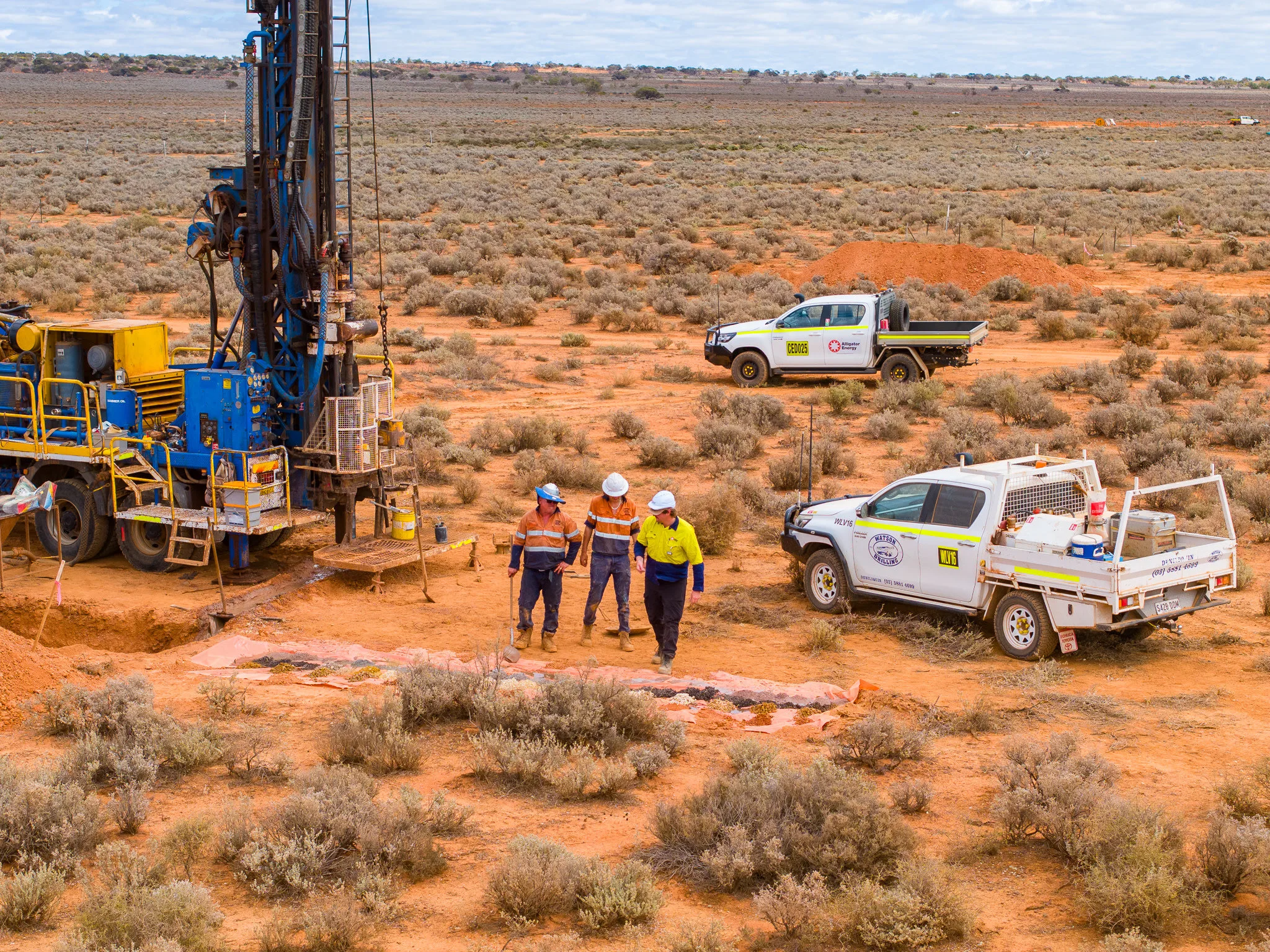
The global uranium market continues to strengthen as governments accelerate nuclear power development, utilities prepare for long-term contracting, and investors increasingly focus on companies capable of delivering production later this decade. Against that backdrop, Australian uranium developer Alligator Energy has reached a major milestone, expanding the mineral resource at its flagship Samphire Uranium Project by 67%, while simultaneously advancing the project towards bankable feasibility and eventual production.
In a recent interview, Alligator Energy CEO Andrea Marsland-Smith discussed the company's latest achievements, the outlook for the uranium market, and why project execution will separate future winners from the rest of the sector.
Marsland-Smith believes the uranium market remains fundamentally strong over the next several years despite the likelihood of short-term price volatility.
With approximately 440 nuclear reactors currently operating worldwide, around 80 under construction, and more than 120 additional reactors in planning, uranium demand continues to expand as countries pursue energy security and decarbonization goals.
Rather than focusing on daily movements in the spot uranium price, Marsland-Smith argues investors should pay closer attention to three long-term drivers:
She emphasized that long-term uranium prices—not spot prices—ultimately determine project economics and company valuations. Companies capable of supplying uranium during the 2029-2033 period are likely to attract increasing attention from utilities and investors.
Another increasingly important factor is jurisdiction.
Countries such as Australia, Canada, the United States, and Namibia are becoming more valuable sources of future uranium supply because of their geopolitical stability and reliability.
However, Marsland-Smith believes execution will ultimately determine which companies succeed.
Many projects announced today may never reach production on schedule, making permitting, financing, construction, and operational execution critical differentiators for investors evaluating uranium developers.
One of Alligator Energy's biggest recent achievements was increasing the Samphire Mineral Resource by 67%.
The company previously defined an 18-million-pound uranium resource at its Blackbush deposit. The latest update adds approximately 12 million pounds from the nearby Plumbush deposit, bringing the total resource close to 30 million pounds.
According to Marsland-Smith, the increase represents much more than simply adding pounds to the resource.
For nearly three years, Alligator negotiated access to the Mullaquana Crown Lease where Plumbush is located. Securing unrestricted access now allows the company not only to incorporate Plumbush into future mine planning but also to explore significant surrounding areas that could host additional uranium mineralization.
The additional resource also extends the project's development potential.
Blackbush currently supports an estimated 12-year mine life. Incorporating Plumbush creates opportunities to lengthen that mine life and potentially optimize future production rates.
Interestingly, the new resource estimate surpassed management's own expectations.
Following reinterpretation of the geology using knowledge gained at Blackbush, the technical team initially expected Plumbush might contribute around five million pounds.
Instead, the updated Mineral Resource Estimate added roughly 12 million pounds.
Marsland-Smith described the result as an important first step towards realizing the company's broader exploration target, which was outlined in 2023 and has an upper potential of approximately 75 million pounds.
Although Blackbush and Plumbush are separated by roughly five kilometers, Alligator increasingly views them as components of one much larger mineralized system.
The company has already deployed drilling rigs onto newly accessible ground south of Blackbush while simultaneously testing extensions around Plumbush.
According to Marsland-Smith, both deposits remain open, creating substantial exploration upside beyond the current 30-million-pound resource base.
Geophysical surveys indicate both deposits lie within the same palaeochannel system, which the company refers to as the Blackbush-Plumbush Corridor.
Even more importantly, only about 30% of the entire regional channel system has been drill tested.
Much of the historical drilling focused only on Blackbush and Plumbush themselves, leaving large portions of the prospective corridor unexplored.
This provides considerable opportunity for additional discoveries as exploration continues.
A distinguishing feature of Samphire is that the entire reported Mineral Resource is considered amenable to In-Situ Recovery (ISR).
Marsland-Smith explained that the company deliberately excludes uranium mineralization that would be difficult to recover using ISR techniques.
Although additional uranium exists above the currently reported resource, management prefers to report only pounds that can realistically be mined economically using ISR.
This disciplined approach ensures that the resource reflects future production potential rather than simply maximizing headline resource numbers.
Following the successful resource update, Alligator has commenced an extensive 300-hole drilling campaign across its newly secured lease.
The immediate objective is straightforward:
Discover additional uranium that can be incorporated into the ongoing Bankable Feasibility Study.
The company plans to complete drilling before a November cutoff, allowing sufficient time to prepare an updated Mineral Resource Estimate for inclusion in the BFS.
Success could both extend mine life beyond the current 12 years and potentially increase planned production rates later in the mine schedule.
Alligator is now entering an important new stage of corporate development.
Marsland-Smith believes the recently completed Field Recovery Trial has significantly de-risked the Samphire Project.
The trial demonstrated that key ISR performance metrics either met or exceeded industry peer standards, confirming the project's technical viability.
As a result, management now considers Samphire to be moving from an exploration project into early-stage development.
Following completion of the Bankable Feasibility Study, financing discussions are expected to become the next major step towards construction.
Several important catalysts remain on the horizon.
Near-term investors can expect:
Technical work is now increasingly focused on optimization rather than proving the project's viability.
This includes refining reagent mixes to reduce operating costs, improving recovery efficiencies, advancing engineering studies, and completing infrastructure planning around power and water.
While Samphire remains the company's flagship asset, Alligator continues advancing its Big Lake Project in South Australia.
Unlike Samphire, Big Lake is an earlier-stage greenfield ISR exploration project.
Marsland-Smith explained that the geology resembles Kazakhstan's large sandstone-hosted uranium systems associated with hydrocarbon basins.
After several years securing land access, Alligator completed its first drilling campaign and intersected encouraging sandstone thicknesses together with anomalous uranium.
Management believes Big Lake has the potential to evolve into an entirely new uranium province in South Australia and eventually become Alligator's next major development project.
Alligator is also expanding its expertise beyond uranium through a 15% ownership stake in ViroCopper.
The investment focuses on applying ISR technology to stranded oxide copper deposits throughout Australia.
ViroCopper is currently conducting its own Field Recovery Trial at the historical Kapunda copper mine north of Adelaide.
According to Marsland-Smith, many of the key technical requirements for successful ISR remain the same regardless of commodity, including rock permeability, recovery rates, reagent optimization, and economic grades.
This creates valuable operational synergies while diversifying Alligator's exposure beyond uranium.
One concern for ISR operators globally has been sulfuric acid availability following geopolitical disruptions affecting international supply chains.
Marsland-Smith noted that South Australia is well positioned in this regard.
Local sulfuric acid production facilities located less than 100 kilometers from the project provide secure regional supply, reducing potential logistical risks.
Looking ahead, investors should expect a steady stream of announcements over the coming months.
The company expects to release:
With drilling ongoing, exploration expanding, technical risks steadily declining, and development work advancing, Alligator Energy appears to be entering one of the most active periods in its history.
Alligator Energy is steadily transitioning from an exploration company into a future uranium producer.
The 67% increase in the Samphire resource, expanding access across the Mullaquana lease, extensive new drilling, successful ISR field testing, and advancing feasibility work collectively mark important milestones in reducing project risk.
At the same time, the broader uranium market continues to benefit from rising nuclear demand, growing emphasis on secure supply chains, and increasing utility contracting activity.
If Alligator can continue executing on its development timeline while expanding resources across the Blackbush-Plumbush corridor, the company could be well positioned to capitalize on the next phase of the uranium market as utilities increasingly seek reliable production later this decade.
Sign up to our free monthly newsletter to recieve the latest on our interviews and articles.
By subscribing you agree to receive our newest articles and interviews and agree with our Privacy Policy.
You may unsubscribe at any time.

We use cookies to improve your experience on our site. By using our site, you consent to cookies.
Websites store cookies to enhance functionality and personalise your experience. You can manage your preferences, but blocking some cookies may impact site performance and services.
Essential cookies enable basic functions and are necessary for the proper function of the website.
These cookies are needed for adding comments on this website.
Statistics cookies collect information anonymously. This information helps us understand how visitors use our website.
Google Analytics is a powerful tool that tracks and analyzes website traffic for informed marketing decisions.
Service URL: policies.google.com (opens in a new window)
You can find more information in our Privacy Policy.