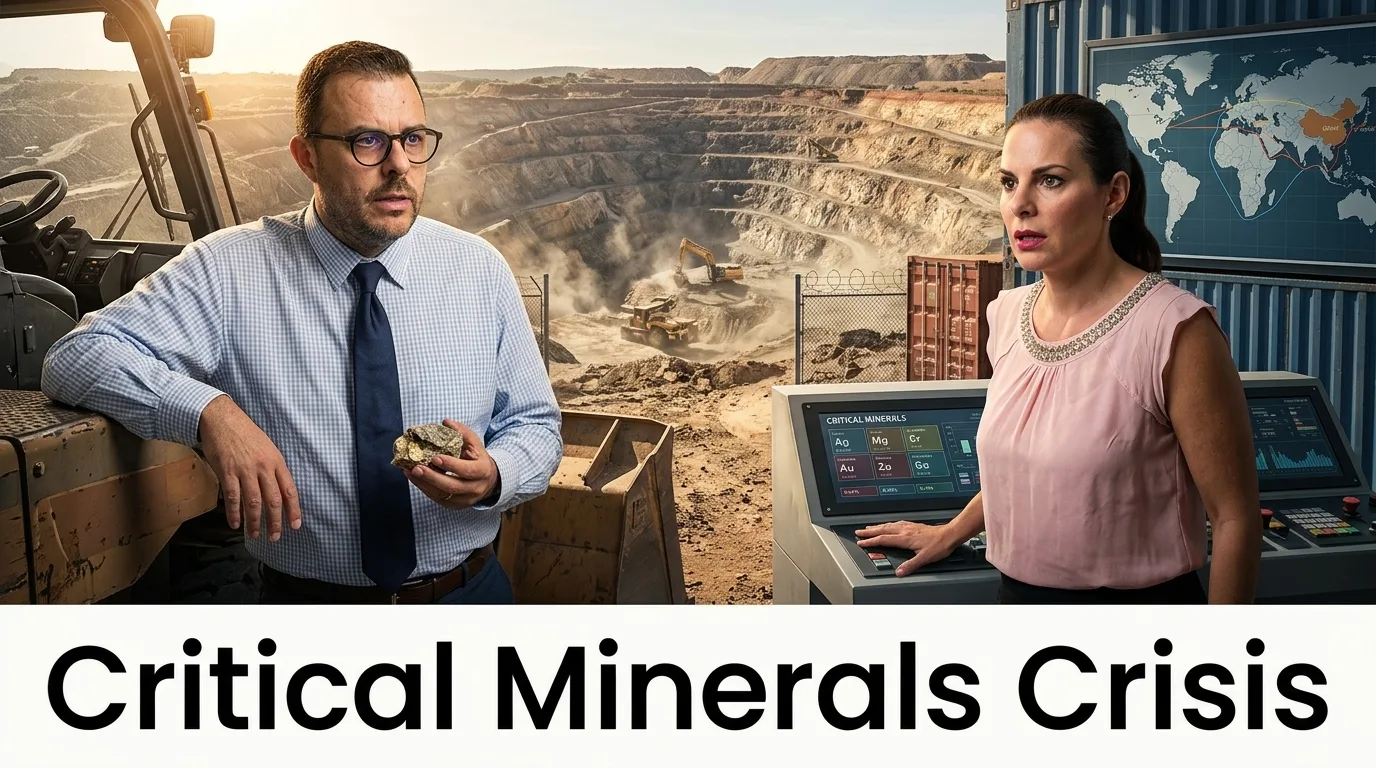
For decades, the Western world largely operated under a simple assumption: if a mineral could be bought somewhere in the world at a competitive price, there was little reason to worry about where it came from.
That assumption is now being challenged.
The growing importance of critical minerals, rising geopolitical tensions, fragile global supply chains and increasing demand for everything from artificial intelligence infrastructure to defense systems, electric vehicles and energy infrastructure are forcing governments to rethink how they secure the raw materials their economies depend on.
According to mining and investment professional Amanda van Dyke, who has more than 25 years of experience across mining, finance, public markets, private equity and critical minerals, the central issue is not necessarily whether the world has enough minerals underground.
The problem is whether those minerals can actually be produced, processed and delivered through a secure supply chain.
As she put it during the interview:
“Knowing that you have resources in the ground means, in my opinion, absolutely zero.”
That distinction could reshape the mining industry for decades.
There are more than 60 minerals on the U.S. critical minerals list, but what makes a mineral "critical" can differ from one country to another.
A mineral becomes strategically important not simply because it is rare, but because a country may lack a secure supply chain for it.
That supply chain can extend through numerous stages: exploration, mining, processing, refining, manufacturing components and ultimately incorporating those components into sophisticated products.
A fighter jet or an AI chip may depend on a surprisingly long chain of suppliers and materials.
The vulnerability becomes obvious when even one relatively small component becomes unavailable.
Van Dyke points to an example involving rare earth permanent magnets. When China restricted exports of permanent rare earth magnets, Volkswagen was reportedly forced to shut down two EV production lines for more than six months because it could not obtain one small but essential component.
The lesson was bigger than rare earths themselves.
“If you can't get enough of anything, your production of the next thing on the supply chain is going to go down.”
That is the fundamental problem facing modern industrial economies.
A mineral does not need to be scarce in geological terms to be strategically critical.
It only needs to be controlled by a small number of suppliers.
Rare earths naturally attract attention because they are associated with advanced technology, permanent magnets, robotics, computers, wind turbines and military systems.
But Van Dyke argues that the critical minerals story extends far beyond the headline commodities.
One example is potash.
The United States has access to substantial supplies of potash through Canada, which has supplied American farmers for roughly a century. Geologically, North America does not necessarily have a potash shortage.
But the U.S. does not produce enough potash domestically.
That creates a different kind of vulnerability.
The issue is not whether potash exists.
It is whether the United States can guarantee access to potash if its relationship with a major supplier becomes strained.
Van Dyke's broader argument is that countries are increasingly asking a different question:
What happens if we suddenly cannot buy this mineral from our traditional supplier?
As she explained:
“Criticality isn't necessarily how much we have, but how much we can get in a secure supply chain that we can depend on.”
That distinction is increasingly becoming central to government policy.
China's dominance in rare earths provides perhaps the clearest example of the geopolitical significance of critical minerals.
Van Dyke notes that China produces roughly 70% of rare earths and processes around 90%.
That concentration gives Beijing enormous leverage.
But the important point is not simply that China has the resources.
China demonstrated that mineral supply itself can be used as a geopolitical tool.
When exports were restricted, the immediate economic consequences were felt far beyond the mining industry.
For companies building electric vehicles, electronics, military equipment or other sophisticated products, the loss of a single critical input can stop production.
Van Dyke's conclusion is blunt:
“Critical minerals have become geopolitical weapons.”
And once governments understand that vulnerability, their priorities change.
One of Van Dyke's most important arguments concerns the economics of mining.
For much of the past generation, Western investors generally wanted projects that promised attractive financial returns.
That meant the highest-grade, lowest-cost and most profitable deposits tended to be developed first.
Lower-quality deposits could remain untouched if they did not generate sufficiently attractive returns.
The problem is that critical minerals are not always highly profitable businesses over the entire life cycle of a mine.
Commodity prices can occasionally spike and generate enormous profits, but over the long term many mining and processing businesses produce relatively steady, modest returns.
That was not particularly attractive to Wall Street.
Van Dyke argues that this created a major strategic blind spot.
“In the last 50 years in the West, we didn't develop the boring deposits that weren't going to make us a sufficient return on investment.”
China, meanwhile, was willing to take a much longer-term view.
The emerging U.S. approach is different.
The strategic value of having a secure domestic supply chain can exceed the direct financial return of the project.
That creates what Van Dyke calls a strategic premium.
“A value that isn't tangible in money, but is intangible in the optionality it gives governments.”
That optionality could become one of the defining concepts of the new critical-minerals economy.
The new U.S. strategy is not necessarily about eliminating foreign suppliers.
It is about preventing dependence on a single supplier from becoming an existential vulnerability.
Potash provides a good example.
The United States may continue to import the majority of its potash from Canada. But having a domestic production base could provide insurance in the event of a trade dispute, geopolitical crisis or supply interruption.
The objective is not necessarily complete self-sufficiency.
It is strategic minimum capacity.
Van Dyke describes the philosophy simply:
“The best way to go into a negotiation is not where two people have a gun to their head.”
The idea is that a country should have enough domestic supply that another country cannot simply cut it off and bring an entire industry to a standstill.
This is why projects that previously might have looked merely average from a financial perspective can suddenly become strategically valuable.
Japan experienced this vulnerability earlier.
Van Dyke points to the 2010 dispute between Japan and China, when China restricted rare earth exports to Japan following a diplomatic confrontation.
For Japan, the consequences were potentially enormous because of its sophisticated electronics industry and dependence on rare earth materials.
The Japanese response was not simply to hope that the geopolitical relationship would improve.
Japan began building alternative supply chains and developing domestic processing capacity.
It also established mechanisms designed to strengthen its strategic mineral security, including JOGMEC.
The objective was not necessarily to become completely independent of the global rare earth market.
It was to ensure that Japan could maintain critical industrial activity even during an emergency.
As Van Dyke explains, Japan developed the ability to produce and process enough material domestically to provide a strategic fallback.
That is essentially the model she sees the United States now pursuing across a broader range of minerals.
The same argument applies to uranium.
There is no shortage of uranium resources in the geological sense. But knowing that uranium exists underground does not mean that it can supply a nuclear reactor tomorrow.
Between discovering a deposit and actually producing uranium can be decades.
This creates a fundamental mismatch.
Demand can increase rapidly, but supply cannot respond quickly if permitting, financing, construction and development take decades.
Van Dyke argues that, across North America and much of the Western world, taking a mineral project from discovery to production has frequently required 20 to 25 years.
“If you can't... it takes, look in North America or in the West generally, it's been taking 20 to 25 years to develop projects from finding them to actually selling ore. That's too long.”
She sees this as one of the greatest structural weaknesses in the Western mining system.
For Van Dyke, one of the most important changes that needs to occur in Western mining is a dramatic reduction in development timelines.
She argues that the industry did not always operate on 20- to 25-year development cycles.
There was a time when experienced mining professionals could move from discovery to production much more quickly.
China, she argues, demonstrates that much faster development remains possible.
The key is not necessarily abandoning environmental or safety standards.
It is removing unnecessary delays and giving projects political and financial backing.
Van Dyke believes the industry could return to a much faster development model.
“You can build a good, solid, safe, environmentally secure mine in five years if you want to, if you have the money and the wherewithal and the intelligence to do it.”
If that happens, the implications for the mining industry could be enormous.
The shift underway represents something much larger than a mining-sector reform.
It is a fundamental change in economic philosophy.
For decades, globalization encouraged companies to locate production wherever costs were lowest.
Inventories were minimized.
Suppliers were optimized.
Production was concentrated.
Shipping networks connected the world.
The system was extremely efficient when everything worked.
But efficiency came at the expense of resilience.
The new philosophy is increasingly based on:
Van Dyke argues that the old globalization model has effectively failed.
“That globalization methodology... has failed. We all now realize how incredibly vulnerable it's made us.”
The new mantra, she says, is diversification, stockpiles, domestic production and stronger allied corridors.
The critical minerals issue does not exist in isolation.
The same geopolitical instability that threatens mineral supply chains also threatens the movement of commodities around the world.
The Strait of Hormuz is an obvious example.
Van Dyke describes global shipping lanes as increasingly valuable strategic arteries that can potentially be held hostage by geopolitical actors.
For more than 75 years, the United States has played an important role in maintaining freedom of navigation on the world's oceans.
That role can be expensive, but Van Dyke compares it to insurance.
“You don't remember the value of insurance until Hormuz happens.”
The implication is clear.
Globalization depends not only on mines, factories and ships, but on geopolitical stability.
Venezuela represents another example of the difference between potential resources and actual production.
The country has enormous oil resources, but years of underinvestment and deteriorating infrastructure have severely constrained production.
Van Dyke believes production can gradually recover as existing infrastructure is repaired.
The key distinction is between rebuilding an existing system and developing an entirely new one.
“Brownfield is always easier than greenfield.”
That could allow Venezuelan production to increase faster than some market participants expect, although she does not expect the country to return immediately to its historical peak.
There is another connection between energy and critical minerals that is often overlooked.
Heavy oil and sour gas can produce sulfur as a byproduct.
Sulfur is essential for producing sulfuric acid, which in turn is critical to numerous industrial processes.
Sulfuric acid plays an important role in the production of phosphate fertilizer and in the processing of minerals including nickel and copper.
That means energy markets and mineral markets are not separate systems.
They are deeply interconnected.
Van Dyke emphasizes this point:
“It's a massively interrelated system.”
That interconnectedness is precisely why supply-chain diversification has become so important.
Few countries are better positioned to benefit from the critical minerals era than Canada.
Van Dyke argues that Canada has the geological resources, engineering expertise, financial sector and mining professionals necessary to become an energy and metals superpower.
Yet she believes Canada has failed to fully capitalize on that advantage.
The irony is that Canadian mining professionals are among the most experienced in the world.
Canadian geologists, engineers, financiers and mining executives routinely work on major projects around the globe.
But many of those same professionals find it significantly harder to develop projects in Canada.
The problem, according to Van Dyke, is bureaucracy.
“Canada has always had the ability to be an energy and minerals superpower.”
But turning that potential into production requires regulatory reform, infrastructure investment and political willingness.
Canada's energy industry faces another structural problem: its infrastructure has historically been designed around supplying the United States.
Pipelines make the U.S. the natural market for Canadian oil and gas.
Selling to other markets is possible, but it requires additional investment.
Canada would need more LNG facilities, pipelines to the coast, rail infrastructure and potentially additional refining capacity.
Those investments could cost billions of dollars and take many years to develop.
That creates a paradox.
Canada wants to diversify its exports and reduce dependence on the United States.
But the infrastructure necessary to achieve that diversification does not currently exist at the required scale.
And building it takes time.
Van Dyke also challenges the idea that Indigenous communities are inherently opposed to mining development.
Based on her experience reviewing and working on hundreds of projects, she argues that constructive relationships are often possible when companies engage communities properly.
In her view, the larger problem is the regulatory system.
She is particularly direct on this point:
“They are not a block to mineral development. The block to mineral development is the system in Canada which is highly inefficient.”
For companies willing to engage openly and responsibly, she believes agreements with Indigenous communities are achievable in the large majority of cases.
The same tension between ideology, economics and energy security is playing out in Europe.
Germany's nuclear policy is perhaps the most obvious example.
Van Dyke believes Germany and other countries are beginning to recognize the limitations of previous energy strategies.
She argues that countries with idle nuclear capacity will increasingly look for ways to restart it.
Her assessment is blunt:
“I think Germany will turn it all back on.”
Whether that happens quickly is another question, but she sees the shift as part of a broader European reassessment of energy policy.
Europe continues to depend heavily on natural gas, but domestic supply is limited.
There are resources in the North Sea and elsewhere, but developing them has become increasingly difficult and expensive.
The UK provides an obvious example.
The country has domestic gas resources while simultaneously importing gas from abroad.
Yet energy companies remain cautious about investing billions in new production because of the regulatory and tax environment.
The result is a contradiction.
Europe needs reliable energy.
But the policies surrounding domestic energy production can make companies reluctant to invest in exactly the infrastructure Europe says it needs.
Van Dyke believes Europe is beginning to recognize this contradiction.
There are signs of a shift.
Countries are reconsidering nuclear power.
The UK is reassessing the North Sea.
Energy security is receiving greater attention.
But she believes the transition is happening slowly.
“Europe is having a bit of a reality check and moving back in the right direction, but it's not happening very quickly.”
That may ultimately be the central challenge facing European energy policy: reconciling political ambitions with the physical requirements of a modern industrial economy.
The common thread running through the entire discussion is that the world is moving away from the assumption that supply will always be available.
For decades, companies optimized for efficiency.
They sourced from the cheapest producer.
They reduced inventories.
They concentrated production.
They relied on international shipping.
And they assumed geopolitical relationships would remain stable enough for the system to function.
That model is now being challenged.
The new model is built around resilience.
Governments want domestic production.
Companies want diversified suppliers.
Countries want allied supply chains.
Strategic inventories are becoming more important.
And deposits that previously looked merely average from a financial perspective can suddenly become highly valuable if they provide a country with supply-chain security.
Perhaps the most important idea emerging from Van Dyke's analysis is that governments are increasingly willing to pay for something that traditional financial models struggle to quantify.
That something is optionality.
If a country has multiple sources of supply, it has negotiating power.
If it has domestic production, it has an emergency option.
If it has processing capacity, it can keep industries operating during disruptions.
If it has strategic inventories, it can absorb temporary shortages.
And if it has strong relationships with allied producers, it is less vulnerable to geopolitical coercion.
None of those benefits necessarily appear directly in a project's net present value.
But they have real economic and strategic value.
If governments are willing to provide strategic support, the economics of mining could change.
Projects no longer have to be judged solely by their ability to maximize shareholder returns.
They may also be evaluated according to what they contribute to national security.
A domestic potash project can be valuable because it reduces dependence on foreign supply.
A rare earth project can be valuable because it provides an alternative to Chinese processing.
A copper project can be valuable because copper is essential to electrification and industrial infrastructure.
A uranium project can be valuable because nuclear energy requires reliable fuel supply.
A domestic oil project can be valuable because it reduces exposure to unstable international markets.
This does not mean every critical minerals project will succeed.
Geology, economics, infrastructure, permitting, financing and execution still matter.
But the definition of value is changing.
Van Dyke's idea of a strategic premium may ultimately prove to be one of the most important concepts in the new commodity cycle.
The West spent decades asking whether a mining project could generate sufficiently high financial returns.
Governments are increasingly asking a different question:
What is the cost of not having this supply?
That changes the investment equation.
A project that produces modest financial returns but prevents a country from becoming completely dependent on a foreign supplier may be worth far more strategically than its traditional valuation suggests.
This could unlock a new generation of mines, processing facilities and infrastructure across North America and allied countries.
But time remains the biggest challenge.
Demand for uranium, copper, rare earths, potash and other critical materials is increasing, while new supply can take years or even decades to develop.
The countries that recognize this mismatch early — and act before the next crisis arrives — will have a significant advantage.
The critical minerals problem is not simply that the world might run out of minerals.
It is that modern economies have become dependent on highly concentrated, complex and vulnerable supply chains.
China demonstrated the geopolitical power of controlling those supply chains.
The United States and its allies are now trying to respond by rebuilding domestic capacity, diversifying suppliers and strengthening allied mineral corridors.
Japan has already demonstrated the value of maintaining strategic alternatives.
Canada has enormous potential but faces a major infrastructure and regulatory challenge.
Europe is beginning to reconsider energy policies that have left it dependent on imported energy.
And across all of these regions, one lesson is becoming increasingly difficult to ignore:
“Knowing that you have resources in the ground means... absolutely zero” if you cannot turn those resources into secure supply.
In a world of geopolitical uncertainty, a mine is no longer just a mine.
It can be infrastructure.
It can be insurance.
And increasingly, it can be national security.
Sign up to our free monthly newsletter to recieve the latest on our interviews and articles.
By subscribing you agree to receive our newest articles and interviews and agree with our Privacy Policy.
You may unsubscribe at any time.

We use cookies to improve your experience on our site. By using our site, you consent to cookies.
Websites store cookies to enhance functionality and personalise your experience. You can manage your preferences, but blocking some cookies may impact site performance and services.
Essential cookies enable basic functions and are necessary for the proper function of the website.
These cookies are needed for adding comments on this website.
Statistics cookies collect information anonymously. This information helps us understand how visitors use our website.
Google Analytics is a powerful tool that tracks and analyzes website traffic for informed marketing decisions.
Service URL: policies.google.com (opens in a new window)
You can find more information in our Privacy Policy.