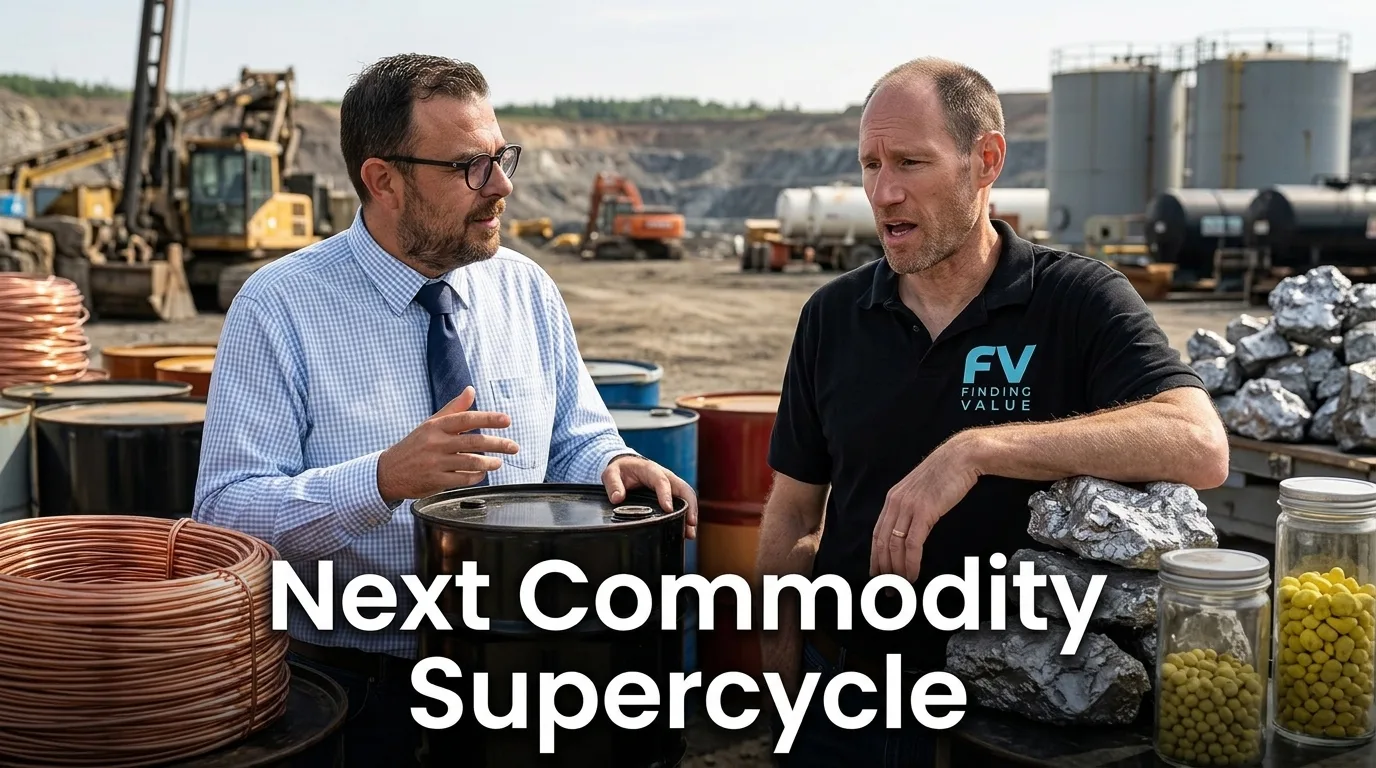
Finding Value Finance’s Andy joined me few days a go to discuss inflation, rising bond yields, commodities, copper, oil, uranium, AI, silver and the growing energy constraints facing the global economy. His central thesis is straightforward: the world may be approaching a period in which energy and mineral scarcity become the defining economic constraints—and traditional financial assets may be increasingly vulnerable to that reality.
The S&P 500 and Nasdaq remain close to record highs, but beneath the surface, the macroeconomic environment is becoming increasingly complicated.
Inflation remains persistent. Bond yields are rising. Government debt continues to expand. Fiscal concerns are becoming more difficult to ignore. At the same time, the world is demanding unprecedented quantities of electricity, copper, uranium, oil, natural gas and other raw materials to support electrification, artificial intelligence, infrastructure and economic growth.
Against this backdrop, Andy from Finding Value Finance believes investors should be looking beyond the major stock indices and toward commodities and natural resources.
His argument is not simply that commodities are cheap.
It is that the world may not have enough energy and minerals to satisfy the demands being placed upon the global economy.
And if that is correct, the consequences could be enormous.
Andy’s commodity thesis began around 2020.
At the time, he believed fundamental valuation ratios indicated that commodities were reaching an important long-term bottom. The sector offered what he considers one of the most attractive characteristics an investor can find: asymmetry.
The idea is simple.
If an asset is already extremely cheap relative to historical valuations and fundamentals, the downside may be more limited while the potential upside can be substantial.
Andy believes that dynamic is still present in parts of the commodity complex.
The contrast with the broader equity market is particularly important.
While the S&P 500 and Nasdaq can continue moving higher, Andy argues that their valuations make the risk-reward equation less attractive than it was in the commodity sector.
He does not necessarily expect an immediate collapse in equities. Instead, he sees increasing headwinds as interest rates and inflation remain elevated.
His key level is the U.S. 10-year Treasury yield.
According to Andy, a move above approximately 5% could become a significant headwind for major equity indices.
If yields move substantially beyond that level, investors may increasingly question the valuations assigned to long-duration growth assets.
At the same time, commodities could benefit from capital rotation.
One of the most important themes running throughout the interview is the relationship between interest rates, inflation and commodities.
Andy had previously expected Treasury yields to break decisively above 5%, triggering significant pressure on equities and potentially ushering in what he described as a “lost decade” for the S&P 500.
That scenario did not materialize when he originally expected it.
Yields approached 5%, stopped just below it and subsequently consolidated.
But Andy now believes the underlying setup is returning.
His argument is that if inflation continues pushing rates higher, financial markets could eventually reach a point where the valuation of equities becomes increasingly difficult to justify.
This is where he expects commodities to potentially diverge from traditional financial assets.
Rather than viewing rising rates exclusively as negative, Andy believes the reason rates are rising matters enormously.
If rates are rising because inflation is accelerating, commodities such as oil, fertilizers, coal and other energy-related assets could benefit.
That creates an unusual environment:
Higher rates can be bearish for financial assets while simultaneously becoming bullish for real assets.
Andy does not believe investors necessarily need to abandon commodities that have already performed well.
In fact, he says owning a broad commodity exposure can still make sense.
But he believes the different commodity sectors could perform very differently depending on the direction of interest rates and inflation.
His current preference is particularly strong toward:
Precious metals and copper remain attractive in his framework, but he sees an important distinction.
If inflation accelerates while interest rates rise alongside it, energy commodities could outperform initially.
If policymakers instead intervene to suppress yields through measures such as yield-curve control or quantitative easing, the outcome could be dramatically different.
In that scenario, Andy believes precious metals and copper could surge.
The crucial question, therefore, is not simply:
“Are rates going up?”
It is:
“Why are rates going up—and what will policymakers do when they become uncomfortable with the consequences?”
Copper is one of the strongest long-term themes in Andy’s investment framework.
He believes the copper market is moving toward structural deficits that could persist for years.
The problem is not simply that demand is increasing.
The bigger issue is that new supply is becoming increasingly difficult to find and develop.
Historically, the mining industry could respond to rising commodity prices by discovering and developing large, high-grade deposits.
Andy believes that dynamic has changed.
New discoveries are becoming more difficult.
Large Tier-1 deposits are increasingly rare.
And the deposits being developed can have substantially lower ore grades.
That matters because lower-grade ore requires significantly more material to be mined and processed to produce the same quantity of metal.
The result is a potentially dangerous feedback loop:
Lower grades → more material moved → more energy required → higher costs → higher commodity prices.
And that brings copper directly back to energy.
For Andy, energy is the foundation of the entire commodity thesis.
Copper shortages cannot simply be solved by opening more mines if those mines require enormous amounts of energy.
The same problem applies to uranium, nickel, cobalt, iron ore and other commodities.
The world wants more minerals.
But producing those minerals requires energy.
And the lower the ore grade, the more energy-intensive the process can become.
This creates what Andy describes as a potentially “hockey stick” increase in energy requirements.
The implications extend far beyond mining.
Artificial intelligence requires enormous amounts of electricity.
Electrification requires electricity.
Electric vehicles require electricity.
Data centers require electricity.
Renewable energy infrastructure requires huge quantities of minerals.
Transmission infrastructure requires copper and aluminum.
And expanding mining production requires even more energy.
The question therefore becomes:
Where does all of that energy come from?
Andy is particularly bullish on oil and energy.
One of his arguments is that oil remains extremely cheap when measured against financial assets such as equities or gold.
He believes that relative valuation is important because commodity prices should not be viewed exclusively in nominal terms.
An oil price can appear high in dollars while simultaneously being historically cheap relative to other assets.
His preferred exposure at the moment is not necessarily concentrated in the largest oil producers.
Instead, he sees particularly attractive opportunities in energy-service companies, as well as smaller and mid-cap exploration and production companies.
He notes that some of the best opportunities in smaller and mid-cap producers may have occurred during 2025, when price-to-book ratios were exceptionally low.
But he still believes parts of the energy-service sector offer attractive asymmetry.
One of Andy’s longer-term concerns is the future supply of oil.
He questions how the global oil industry will satisfy demand several years into the future if current production trends become increasingly difficult to maintain.
He believes U.S. shale production could be approaching a peak.
At the same time, he is skeptical that Venezuela can simply become the enormous future source of oil that some market narratives suggest.
His broader point is that the market may be underestimating the difficulty of bringing new energy supply online.
The problem becomes even more significant when declining ore grades and increasing energy requirements are considered simultaneously.
The future economy may require vastly more energy precisely at the moment when obtaining additional energy and minerals becomes more difficult.
This is perhaps the most important part of Andy’s macroeconomic argument.
He views the global economy through the relationship between debt and energy.
His analogy is that GDP functions somewhat like income relative to debt.
If debt continues growing, the economy must generate enough income to support that debt.
But economic production ultimately requires energy.
If energy production cannot grow quickly enough, Andy believes the economic system can encounter a structural imbalance.
That creates the possibility of persistent inflation.
And if policymakers attempt to solve the problem by creating additional money and expanding debt, the imbalance could become even more pronounced.
His concern is therefore not simply inflation in the conventional sense.
It is a potential situation in which:
Debt grows faster than the real economy’s ability to produce additional energy and resources.
In that environment, he believes currencies and bonds could become increasingly vulnerable.
And that leads directly to precious metals.
Andy views precious metals as more than simply commodities.
He sees them as a potential hedge against problems in currencies and sovereign bond markets.
If governments continue expanding debt while real resource constraints prevent the economy from expanding rapidly enough, the pressure to maintain liquidity could increase.
And Andy believes policymakers would ultimately respond with additional monetary expansion.
That could be particularly bullish for gold and silver.
But he believes silver could dramatically outperform gold during the later stages of such a cycle.
Silver occupies a unique position because it has both monetary and industrial demand.
Andy believes that combination could create extraordinary upside during a major inflationary cycle.
He expects silver to outperform gold substantially over the long term.
However, he does not necessarily expect a straight-line move.
In his scenario, silver could initially struggle if interest rates rise rapidly and markets begin anticipating an economic slowdown.
Oil could potentially move first.
Andy describes a hypothetical scenario in which oil breaks above approximately $120 per barrel and potentially advances substantially beyond that level.
Eventually, such an inflationary impulse could contribute to a slowdown or recession.
And this is where Andy believes silver could really accelerate.
If policymakers respond to an economic downturn by cutting rates and creating significant amounts of money, precious metals could experience another powerful leg higher.
In an extreme monetary crisis, Andy believes silver could reach prices far beyond historical norms.
He does not attempt to give a precise ultimate price target, but he suggests the potential upside could be extraordinarily large.
Silver is not the only precious metal Andy likes.
He also highlights platinum.
His argument is based partly on historical precedent.
He points to periods of extreme inflation when platinum traded at multiples of the gold price.
Under another highly inflationary environment, he believes platinum could potentially experience an extraordinary revaluation.
His preference is therefore not limited to gold.
He particularly likes the setup for silver and platinum.
Few themes are more important to Andy’s long-term thesis than uranium.
He believes the world could be entering the beginning of the largest nuclear expansion in history.
And his reasoning is fundamentally different from simply saying nuclear power is clean or reliable.
His argument is based on resource efficiency.
Natural gas and coal have physical and supply constraints.
Solar and wind require large amounts of minerals and extensive infrastructure.
Electricity generated remotely has to be transmitted through enormous networks.
Those transmission networks require copper and aluminum.
And if copper becomes structurally scarce, expanding transmission infrastructure could become increasingly expensive.
This changes the economics of the energy system.
Andy believes the future energy market may eventually stop asking:
“What is the cheapest source of electricity in dollar terms?”
Instead, it may begin asking:
“How much energy can we generate per unit of mineral input?”
That is a fundamentally different metric.
And under that framework, Andy believes uranium and nuclear power become extremely attractive.
Nuclear energy can generate enormous quantities of electricity from relatively small quantities of fuel.
If mineral scarcity becomes a major constraint, that characteristic becomes increasingly valuable.
Andy believes small modular reactors could become particularly important.
The reason is not simply reactor size.
It is location.
If electricity can be generated closer to where it is needed, the world may need fewer massive transmission networks.
That could reduce demand for copper and aluminum in the electricity grid.
It could also make nuclear power more attractive for data centers, industrial facilities and other energy-intensive applications.
Andy believes the market may take several years to fully recognize this.
He suggests that perhaps within approximately five years, investors could increasingly realize that connecting massive amounts of renewable generation through enormous copper-intensive transmission networks presents a fundamental resource challenge.
If that happens, he expects nuclear power to become much more attractive.
And potentially:
Nuclear could “go berserk.”
This is where Andy becomes considerably more cautious.
He is confident about the direction of travel toward nuclear power.
But he is less certain about which companies will capture the greatest value.
Higher uranium prices do not automatically mean every uranium explorer becomes successful.
Mining costs can rise.
Infrastructure can become expensive.
Projects can face permitting and development challenges.
And lower-grade deposits can require significantly more energy.
Therefore, the eventual winners may not necessarily be the companies with the largest resources.
They may be the companies capable of producing uranium economically, reliably and at scale.
Andy also raises a more unconventional possibility: uranium extraction from seawater.
The concept would theoretically provide access to uranium without having to develop individual mines in geographically and politically sensitive locations.
He acknowledges that the economics and technology need to improve substantially before such a model becomes commercially compelling.
But his larger point is that extremely high uranium prices could incentivize technologies that appear uneconomic today.
Artificial intelligence is another major source of commodity demand.
Andy believes AI is likely to transform the economy.
But that does not mean AI-related assets cannot enter a speculative bubble.
His comparison is the dot-com era.
The internet fundamentally changed the world.
But that did not prevent internet stocks from becoming dramatically overvalued during the late 1990s.
Eventually, the bubble burst.
Yet the technology continued transforming the global economy for decades afterward.
Andy believes AI could follow a similar trajectory.
In other words:
The technology can be real while the investment valuation is wrong.
AI companies and infrastructure projects are particularly sensitive to interest rates because many valuations are based on expectations of enormous future cash flows.
When interest rates rise, the present value of those future cash flows declines.
That means a 5%+ interest-rate environment could create substantial pressure on extremely expensive growth assets.
Andy therefore expects the possibility of a significant AI-related correction.
But he does not view such a correction as evidence that AI itself is a failure.
Instead, it could represent the normal boom-bust process associated with transformative technologies.
The long-term AI infrastructure buildout could continue even after a major market correction.
And ironically, that continued buildout could intensify demand for exactly the commodities Andy favors.
AI may therefore create an unusual investment chain:
AI → Data centers → Electricity demand → Power generation → Grid infrastructure → Copper, aluminum, uranium, natural gas and other commodities.
The problem is that every step requires physical resources.
AI may be digital.
But the infrastructure supporting it is extremely physical.
Data centers need land, electricity, cooling systems, transformers, transmission capacity and construction materials.
And the electricity must ultimately come from somewhere.
This is why Andy believes AI could become an important driver of commodity demand even if AI stocks themselves eventually experience a major correction.
The final part of the interview addresses one of the biggest questions facing investors today:
What happens if markets crash?
Andy says he does not currently hold a large cash position.
Instead, he has deployed capital into areas where he believes valuations are exceptionally attractive.
Among them:
His philosophy is not to constantly attempt to predict the next correction.
Instead, he focuses on valuation and entry points.
If something becomes sufficiently cheap and the technical setup begins improving, he is willing to buy—even if the broader market remains uncertain.
This philosophy is particularly important.
Andy believes market crashes can be temporary.
If a liquidity crisis occurs, policymakers may respond with monetary stimulus.
That could initially push commodity and mining stocks lower.
But if the underlying structural problems remain—energy scarcity, mineral shortages, debt expansion and inflation—the longer-term commodity thesis could remain intact.
Therefore, he does not want to sell everything simply because a correction might occur.
His position is essentially:
A temporary drawdown is preferable to missing a potentially historic commodity bull market.
Rather than relying on a single indicator, Andy looks at several markets simultaneously.
At the time of the interview, he pointed to several developments he considers important.
The two-year, 10-year and 30-year Treasury yields have been moving higher and breaking upward.
Andy interprets this as evidence that inflation expectations are becoming increasingly embedded in the bond market.
Oil is showing signs of breaking higher.
For Andy, this reinforces the inflationary scenario.
Copper is also breaking higher rather than lower.
That suggests demand and supply constraints remain important.
Gold and silver are also showing strength.
Taken together, these markets provide a broader signal.
Andy does not currently see the classic recession setup.
Andy argues that if a major recession were approaching, investors would typically begin moving into government bonds.
That would push bond prices higher and yields lower.
But that is not what he is seeing.
Instead, yields are rising.
He also watches the yield curve.
An eventual recessionary environment would, in his framework, be accompanied by a significant change in the yield curve and increased demand for bonds.
He is not seeing enough evidence of that yet.
That does not mean a recession cannot happen.
It simply means that the market signals he watches are not yet confirming it.
Ultimately, Andy’s thesis is much bigger than a simple bet on oil, copper, uranium or silver.
It is a thesis about the transition from a world of relative resource abundance to one of increasing scarcity.
For decades, the global economy was able to expand by discovering new resources, developing large mines and increasing energy production.
Andy believes that model is becoming increasingly difficult.
The next generation of mines may be lower grade.
The next generation of infrastructure may require more copper.
The next generation of AI may require vastly more electricity.
The next generation of data centers may require nuclear power.
The next generation of energy infrastructure may require enormous quantities of steel, aluminum, uranium and other minerals.
And all of this has to be built while governments are carrying historically large debt burdens.
That combination creates the central tension in Andy’s thesis:
The financial system wants continuous economic growth, but the physical economy may increasingly struggle to supply the energy and minerals required for that growth.
If Andy is correct, the winners of the next decade may look very different from the winners of the previous decade.
The biggest opportunities may not necessarily be found in the most popular technology stocks.
They could be found upstream.
In the companies providing the raw materials required to build the infrastructure of the future.
That means energy.
Oil.
Natural gas.
Coal.
Uranium.
Copper.
Silver.
Platinum.
Fertilizers.
Iron ore.
And the companies that provide services to the industries extracting them.
The paradox is that the more the world embraces electrification, AI and advanced technology, the more dependent it becomes on physical resources.
The digital economy still needs mines.
The question facing investors may therefore not be whether the world will need more commodities.
It almost certainly will.
The more important question is:
Can supply grow quickly enough to meet demand?
Andy believes the answer is increasingly no.
And if supply cannot respond, prices become the mechanism through which the market attempts to restore balance.
Higher prices incentivize exploration.
Higher prices incentivize new mines.
Higher prices encourage substitution.
Higher prices encourage technological innovation.
But all of these solutions take time.
And if the supply deficit is sufficiently large, the adjustment may require much higher prices than investors are currently expecting.
The interview with Andy ultimately comes back to one fundamental idea:
Energy is the foundation of the entire economy.
Debt can grow.
Money can be printed.
Technology can advance.
AI can revolutionize industries.
Electrification can accelerate.
Renewable capacity can expand.
But none of it happens without physical resources and energy.
If energy supply fails to keep pace with financial and technological expansion, inflationary pressure could intensify.
That could create a difficult environment for bonds and expensive financial assets while simultaneously creating extraordinary opportunities in commodities.
Andy believes we may be approaching such a period.
His strongest current preferences are concentrated around energy, fertilizers, coal and selected energy-service companies, while maintaining a highly bullish long-term outlook for copper and uranium.
He believes silver could eventually dramatically outperform gold, particularly if a future recession triggers another enormous wave of monetary expansion.
And perhaps most importantly, he believes the world will eventually be forced into a massive nuclear expansion—not because it necessarily wants to, but because it may have no other realistic way to satisfy its growing energy requirements within increasingly severe mineral constraints.
Whether that scenario unfolds exactly as Andy expects remains uncertain.
But the investment question he raises is difficult to ignore:
What happens to the global economy when the financial system demands exponential growth, while the physical world struggles to provide the energy and minerals required to support it?
If that becomes the defining macroeconomic problem of the next decade, investors may look back at today’s commodity prices very differently.
The great commodity bull market may not be ending.
It may only be beginning.
Sign up to our free monthly newsletter to recieve the latest on our interviews and articles.
By subscribing you agree to receive our newest articles and interviews and agree with our Privacy Policy.
You may unsubscribe at any time.

We use cookies to improve your experience on our site. By using our site, you consent to cookies.
Websites store cookies to enhance functionality and personalise your experience. You can manage your preferences, but blocking some cookies may impact site performance and services.
Essential cookies enable basic functions and are necessary for the proper function of the website.
These cookies are needed for adding comments on this website.
Statistics cookies collect information anonymously. This information helps us understand how visitors use our website.
Google Analytics is a powerful tool that tracks and analyzes website traffic for informed marketing decisions.
Service URL: policies.google.com (opens in a new window)
You can find more information in our Privacy Policy.