This is a sponsored content! We have received compensation from First Phosphate for conducting the interview and publishing this article!
First Phosphate (NASDAQ: PHOS | CSE:PHOS | OTCQX:FRSPF ) CEO John Pasalacqua says the company’s Nasdaq listing, growing government support and rapidly expanding demand for lithium iron phosphate batteries could position its Quebec phosphate project at the center of an emerging North American battery supply chain.
First Phosphate is entering what CEO John Pasalacqua describes as a potentially transformative period for the company, following its listing on the Nasdaq Global Market, increased institutional investor access and a series of government-backed initiatives aimed at establishing more resilient critical-mineral supply chains in North America.
At the heart of the company's strategy is phosphate—not as a traditional fertilizer commodity, but as a critical input for lithium iron phosphate, or LFP, batteries.
In the recent talk, Pasalacqua outlined the company's plans to develop an integrated phosphate-to-battery-material supply chain in Quebec, discussed the rapidly growing LFP market, highlighted the strategic importance of reducing Western dependence on China and provided an update on First Phosphate's financing, resource base, development timeline and potential downstream expansion.
The CEO's central argument is straightforward: LFP batteries are becoming increasingly important in electric vehicles and stationary energy storage, while the overwhelming majority of the global LFP supply chain remains concentrated in China.
For First Phosphate, that combination could create a significant strategic opportunity.
First Phosphate's Nasdaq listing represented more than simply another stock-market milestone for Pasalacqua.
The CEO described the experience of ringing the Nasdaq opening bell as personally transformative, reflecting on his background as an entrepreneur and the opportunity to build a company capable of participating in North America's emerging critical-minerals economy.
But beyond the symbolism, the Nasdaq listing has already had a measurable impact on the company's trading activity.
Pasalacqua said First Phosphate had spent roughly a year exploring access to U.S. capital markets after receiving feedback from American investors that an OTC listing was insufficient for some institutional investors.
The company ultimately pursued a Nasdaq listing without conducting a concurrent capital raise.
That decision appears to have had a significant effect on liquidity.
According to Pasalacqua, First Phosphate experienced a dramatic increase in trading volume following its U.S. roadshow and Nasdaq debut, with the company at times seeing between approximately US$5 million and US$20 million of shares traded per day.
He characterized the development as a fundamental change in the company's market profile.
The Nasdaq listing also comes with higher regulatory and compliance requirements, which Pasalacqua acknowledged. But from the company's perspective, the principal objective was to make First Phosphate more accessible to U.S. and international investors.
The timing is particularly significant because the company is attempting to position itself within a critical-minerals supply chain increasingly viewed through the lens of national security.
While phosphate is traditionally associated with fertilizer, First Phosphate's investment thesis is centered on its role in lithium iron phosphate batteries.
LFP chemistry has become increasingly important in both electric vehicles and stationary energy-storage systems.
Pasalacqua believes the stationary storage market alone could generate enormous additional demand.
As renewable energy generation from solar and wind expands, the intermittency of those energy sources creates a fundamental requirement for storage.
Solar power is generated primarily during daylight hours, while wind generation depends on weather conditions. Battery storage can help bridge the gap between when electricity is generated and when it is consumed.
According to Pasalacqua, China's stationary energy-storage battery market has been growing at approximately 25% to 30% quarter over quarter, illustrating the speed at which the sector is expanding.
The numbers become particularly important when looking at the composition of an LFP battery.
Pasalacqua estimates that the cathode represents roughly half of a battery, with phosphate accounting for approximately 60% of the cathode material.
That creates a potentially enormous addressable market for phosphate.
He pointed to estimates suggesting that Chinese phosphate demand for battery applications has risen dramatically—from approximately one million tonnes per year toward levels exceeding five million tonnes, with projections potentially reaching around 30 million tonnes annually by 2030–2032.
Those figures, if realized, would represent a fundamental shift in the global phosphate market.
The implication for First Phosphate is that phosphate demand may increasingly be driven not only by agriculture, but also by electrification, grid storage and battery manufacturing.
The other side of the equation is supply.
According to Pasalacqua, China currently dominates virtually every important component of the LFP battery supply chain.
That concentration creates a strategic vulnerability for North America and Europe.
Pasalacqua pointed to the broader geopolitical relationship between China and the West as evidence of why governments are increasingly focused on supply-chain diversification.
He highlighted rare earths, microprocessors and LFP battery technology as examples of areas that have become strategically important.
His argument is not that Western countries need to eliminate Chinese participation in the global economy.
Instead, the objective is to establish sufficient domestic and allied production capacity to avoid excessive dependence on a single country.
This is particularly relevant to the G7's critical-minerals strategy.
Pasalacqua said the G7 has established a goal that, by 2030, no single country or geographic region should account for more than 60% of a critical supply chain.
Against that backdrop, the concentration of LFP battery production in China becomes particularly significant.
First Phosphate believes its Quebec project can contribute to building an alternative North American supply chain.
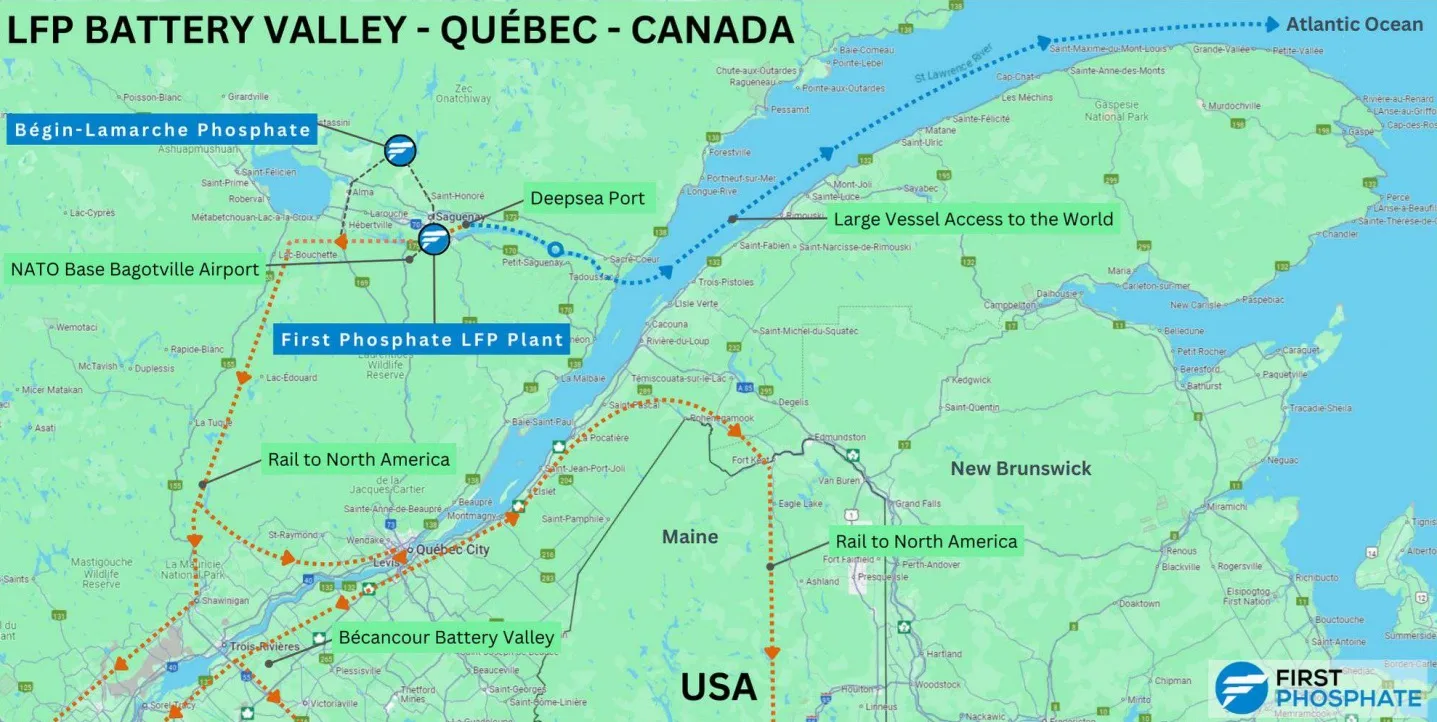
First Phosphate's flagship project is located in the Saguenay–Lac-Saint-Jean region of Quebec, approximately two and a half hours north of Quebec City.
The company describes its deposit as an igneous phosphate rock deposit, meaning the phosphate occurs within volcanic rock.
According to Pasalacqua, one of the key advantages of the deposit is its relatively clean composition.
The phosphate is contained within rock at a density that allows it to be separated efficiently, with the company producing a high-purity phosphate concentrate.
The resulting concentrate is expected to contain more than 40% P₂O₅, according to Pasalacqua.
This is an important part of First Phosphate's strategy because the company does not want to stop at mining.
Its objective is to move further downstream into the production of purified phosphoric acid and ultimately LFP cathode active material.
Just days after this interview was recorded, First Phosphate provided an important update that adds further weight to Pasalacqua's comments about the scale and longevity of the Bégin-Lamarche project.
On August 24, 2026, the company filed an updated NI 43-101 technical report for its Bégin-Lamarche igneous phosphate deposit in Quebec. The report, prepared by independent consultants P&E Mining Consultants, confirmed a 378% increase in indicated mineral resources compared with the company's initial September 2024 resource estimate.
The updated pit-constrained resource now includes:
The deposit also remains open at depth, leaving room for further resource expansion.
The company's proposed supply chain can be broken down into several stages.
First, phosphate-bearing rock is mined and crushed.
The company then uses a solventless process to remove minerals including ilmenite and magnetite, leaving a highly concentrated phosphate product.
The phosphate concentrate is subsequently processed using sulfuric acid to produce phosphoric acid.
The next step is purification.
The purified phosphoric acid can then be combined with iron powder to produce iron phosphate.
Finally, lithium is added to the iron phosphate to create lithium iron phosphate, or LFP, cathode active material.
That material becomes part of the cathode inside an LFP battery cell.
In simplified form, First Phosphate's proposed value chain is:
Phosphate rock → phosphate concentrate → phosphoric acid → iron phosphate → LFP cathode active material → battery cell
That distinction is critical to the company's investment thesis.
First Phosphate is not positioning itself merely as another mining company.
The broader objective is to become part of an integrated North American battery-material supply chain.
One of the more significant claims made by Pasalacqua concerns the company's development work with its partners.
According to the CEO, First Phosphate has helped develop what he described as the first LFP batteries produced in North America in approximately 25 years using North American critical minerals, including phosphate.
The historical context is important.
Pasalacqua said LFP battery technology was originally developed in North America but subsequently moved to China, where the industry developed at enormous scale.
Today, China dominates LFP battery production and associated technologies.
The company believes the combination of technology, partnerships and access to phosphate resources can allow that supply chain to be rebuilt in North America.
Pasalacqua emphasized that First Phosphate's partnerships are commercial rather than purely research-and-development relationships.
That distinction is important because the company is attempting to move from laboratory-scale development toward an actual industrial supply chain.
First Phosphate's latest resource estimate has materially increased the size of the company's mineral resource base.
Pasalacqua described the increase in indicated resources as approaching 400%, saying the expansion demonstrates both continuity and scalability of the deposit.
However, the company does not necessarily intend to increase production proportionally with the resource.
Instead, management currently expects production of approximately 900,000 tonnes of phosphate concentrate per year, potentially increasing toward one million tonnes annually.
The larger resource therefore provides an opportunity to extend the potential mine life rather than necessarily building a much larger mine.
Pasalacqua said the resource base is already larger than what was required for the company's previously projected 23-year mine life.
That gives the company additional flexibility.
Rather than maximizing production at all costs, management is attempting to develop a project that fits the requirements of its customers, financiers and the surrounding region.
Pasalacqua repeatedly emphasized that First Phosphate is trying to build a project appropriate for Saguenay–Lac-Saint-Jean rather than simply constructing the largest possible mining operation.
The proposed mine is being designed around several constraints:
The current estimated capital requirement is approximately US$400 million to US$450 million, according to Pasalacqua.
He contrasted that with other critical-mineral projects that can require billions of dollars in initial capital.
Keeping the capital requirement within a more manageable range could potentially make the project easier to finance and execute.
Government support has become an increasingly important component of First Phosphate's development strategy.
In March 2026, the Canadian government provided the company with a C$16.7 million non-refundable, non-dilutive contribution toward the mine, concentrator and feasibility work.
More recently, the company secured an additional C$4.8 million contribution related to road infrastructure and electricity transmission.
These investments are strategically important because mining projects require far more than a mineral deposit.
They require roads, power, processing infrastructure and transportation networks.
The C$4.8 million contribution therefore represents an important step toward addressing the infrastructure needed to bring the project into operation.
Pasalacqua sees the government funding as potentially more than a one-off contribution.
He suggested that successful completion of the feasibility and development stages could create the opportunity for additional participation from Canadian government institutions.
Potential sources could include the Canada Growth Fund, Canada Infrastructure Bank, Export Development Canada and other government-backed financing initiatives.
The company's objective is therefore to combine equity capital with what Pasalacqua describes as "friendly" non-dilutive or government-supported capital.
Another major component of First Phosphate's financing strategy is support from Denmark's export credit agency.
Pasalacqua said the Danish government-related financing institution is at the table for approximately C$275 million against a total project requirement of approximately C$650 million.
That would represent roughly 40%–45% of the project's estimated financing requirement.
The significance is not simply the amount of capital.
Government-backed financing can potentially reduce pressure on the company to fund the entire project through conventional equity markets.
It can also provide a strategic alignment between the project and governments seeking to secure access to critical minerals.
Pasalacqua described these institutions as "friendly lenders," emphasizing that their objectives extend beyond purely financial returns.
Their interests can include supply-chain security, employment, industrial development and national strategic objectives.
For First Phosphate, that could be particularly valuable as the company moves toward a final investment decision.
First Phosphate also says it has access to more than US$50 million of capital to advance the project toward the final investment decision.
Importantly, Pasalacqua emphasized that the company currently has no debt and considers its capital structure relatively clean.
The company has approximately 189 million common shares outstanding, with its Nasdaq-listed American Depositary Receipts representing 10 common shares per ADR.
Management and the board collectively own approximately 20% of the company, according to Pasalacqua, with the CEO personally holding approximately 10%.
The company estimates that roughly 40% of the shares are freely trading in the market, while another significant portion remains with management, board members, family, friends and investors from previous financings.
Pasalacqua also highlighted the fact that he is compensated substantially through equity rather than relying solely on cash compensation.
That structure, in management's view, creates alignment with shareholders.
When asked about technical risks over the next two years, Pasalacqua offered an unusually direct answer.
He said that six months earlier he could have identified a long list of technical and development risks.
Today, he believes the primary remaining risk is execution.
The company has the resource.
It has developed the processing pathway.
It has commercial partners.
It has government support.
It has access to capital.
And it is progressing through feasibility and permitting.
The challenge now is putting all those components together and executing the project on schedule.
That represents an important transition for First Phosphate.
The company is gradually moving away from being primarily an exploration and development story toward becoming an infrastructure, processing and manufacturing story.
The company's most important published milestone is its feasibility study.
Pasalacqua expects the feasibility study to be completed no later than the first quarter of 2027, while indicating that completion could potentially occur earlier, possibly before the end of 2026.
Following the feasibility study, the company expects to progress through permitting and toward a final production decision.
Management has stated a target of reaching a go-to-production decision by the end of 2027.
The ultimate objective is an operating mine by approximately 2029.
That creates a potentially important sequence of catalysts for investors:
2026: Continued development, financing, partnerships and feasibility work
Late 2026 / Q1 2027: Completion of feasibility study
2027: Permitting and final investment decision
2028–2029: Construction and development
2029: Targeted start of mining operations
These timelines remain forward-looking targets and depend on successful execution, financing, permitting and construction.
Although First Phosphate has several additional phosphate properties, management appears focused on advancing the flagship project before aggressively expanding elsewhere.
The company already controls additional phosphate resources in the Saguenay–Lac-Saint-Jean area, including another property at the PEA stage.
The immediate priority is therefore to establish the first project.
Once that infrastructure and processing capability exists, however, those additional resources could become strategically more valuable.
The potentially more significant expansion opportunity may actually be downstream.
Pasalacqua said the company is evaluating opportunities to expand further into the LFP supply chain through acquisitions or partnerships.
That could include processing assets or other downstream components.
The CEO emphasized that First Phosphate would not pursue acquisitions simply for the sake of getting larger.
His stated philosophy is that any transaction should be meaningfully synergistic and potentially highly accretive.
In his words, the objective is not for one plus one to equal two.
The ambition is for the combination to create substantially more value than the individual assets could generate independently.
One of the most bullish parts of Pasalacqua's argument concerns what he believes is currently missing from the market's valuation of First Phosphate.
He said the company is largely valued on the basis of its mining project rather than its potential downstream activities.
According to Pasalacqua, First Phosphate was trading at approximately 20%–25% of the net present value of the mine at the time of the interview.
But management believes the downstream opportunity could be substantially larger.
If phosphate concentrate can be converted into phosphoric acid, then iron phosphate, then LFP cathode active material, the company could potentially participate in several stages of the battery-material value chain.
That optionality is difficult to quantify today.
It depends on successful technical execution, financing, partnerships, permitting, customer agreements and market conditions.
But if the LFP market continues expanding at the rates suggested by the company, the potential addressable market could be significant.
Perhaps the most important macroeconomic argument in First Phosphate's story is that LFP demand is not dependent exclusively on electric vehicles.
Stationary energy storage could become an equally important—or potentially even larger—driver of battery demand.
The growth of solar and wind power creates a structural need for energy storage.
As renewable generation expands, the ability to store electricity when production exceeds immediate demand becomes increasingly valuable.
LFP batteries are well suited to many stationary-storage applications because of their characteristics, including cost, safety and cycle life.
If global grid-storage deployment continues accelerating, the resulting demand for LFP cathode materials could translate into substantial additional phosphate demand.
This is why First Phosphate sees itself as more than an EV-related investment.
Its potential market exposure includes electric vehicles, stationary storage and other applications using LFP technology.
The company's investment thesis ultimately comes down to a combination of geology, technology and geopolitics.
North America has phosphate resources.
North America has battery technology.
North America has capital.
North America has industrial infrastructure.
What is missing is sufficient scale across the entire supply chain.
At the same time, China has developed enormous capacity in LFP battery materials and manufacturing.
Governments in Canada, the United States and Europe are increasingly attempting to diversify critical-mineral supply chains.
First Phosphate believes its Quebec project can become one component of that diversification.
The company has already received support from Canada and the broader G7 framework, while European government-linked institutions are also participating in financing discussions.
That combination could provide First Phosphate with access to a pool of capital and strategic partnerships that would not necessarily be available to a conventional junior mining company.
First Phosphate is attempting to position itself at the intersection of three major trends:
Critical minerals.
Battery electrification.
North American supply-chain security.
The company's Quebec resource provides the upstream foundation.
Its processing strategy creates the potential for additional value capture.
Its LFP technology partnerships provide a path toward the battery-material market.
And government support potentially reduces some of the financing and geopolitical risks associated with developing a new domestic supply chain.
But significant execution risk remains.
The company still needs to complete its feasibility study, secure the remaining financing, obtain permits, build infrastructure, construct the mine and processing facilities, and ultimately demonstrate that its integrated business model works at commercial scale.
Those steps will determine whether the company's ambitious vision becomes a producing operation.
For investors following First Phosphate, the next several milestones could be particularly important.
The feasibility study should provide a much clearer picture of project economics, capital requirements, operating costs, production assumptions and expected returns.
The transition from feasibility to permitting will be a critical development stage.
Management is targeting a production decision by the end of 2027.
Additional participation from Canadian government institutions could further reduce financing risk.
The company says it already has significant offtake support and expects to advance definitive bankable offtakes.
Potential agreements involving phosphoric acid, iron phosphate or LFP cathode active material could materially expand the company's strategic positioning.
With a stronger market capitalization, management believes it may have greater flexibility to pursue highly synergistic downstream acquisitions.
First Phosphate's story is increasingly becoming about much more than extracting phosphate from the ground.
The company's ambition is to develop an integrated North American supply chain stretching from Quebec phosphate rock to battery-grade materials.
That strategy is being pursued at a time when governments are increasingly concerned about critical-mineral dependencies and when LFP battery demand is expanding rapidly.
Pasalacqua argues that the opportunity is potentially enormous because the West needs domestic and allied sources of phosphate and LFP materials while China's dominance of the existing supply chain creates strategic vulnerabilities.
Whether First Phosphate can capture that opportunity will ultimately depend on execution.
The company has set an ambitious roadmap: complete feasibility, obtain permits, reach a final investment decision and target mine production around 2029.
For investors, the key question is therefore no longer simply whether First Phosphate has a phosphate resource.
The more important question is whether the company can successfully transform that resource into a commercially viable, vertically integrated North American LFP battery-material supply chain.
If it can, management believes the mine could be only the beginning.
The comments and projections discussed above are based on statements made by First Phosphate CEO John Pasalacqua during the interview. Production targets, timelines, market-growth estimates, financing plans and potential downstream opportunities are forward-looking and may not ultimately be achieved. Investors should conduct their own due diligence and consult a qualified financial adviser before making investment decisions. The interview itself also included a disclaimer that it was not a recommendation to buy or sell securities or other products.
Sign up to our free monthly newsletter to recieve the latest on our interviews and articles.
By subscribing you agree to receive our newest articles and interviews and agree with our Privacy Policy.
You may unsubscribe at any time.
We use cookies to improve your experience on our site. By using our site, you consent to cookies.
Websites store cookies to enhance functionality and personalise your experience. You can manage your preferences, but blocking some cookies may impact site performance and services.
Essential cookies enable basic functions and are necessary for the proper function of the website.
These cookies are needed for adding comments on this website.
Statistics cookies collect information anonymously. This information helps us understand how visitors use our website.
Google Analytics is a powerful tool that tracks and analyzes website traffic for informed marketing decisions.
Service URL: policies.google.com (opens in a new window)
You can find more information in our Privacy Policy.