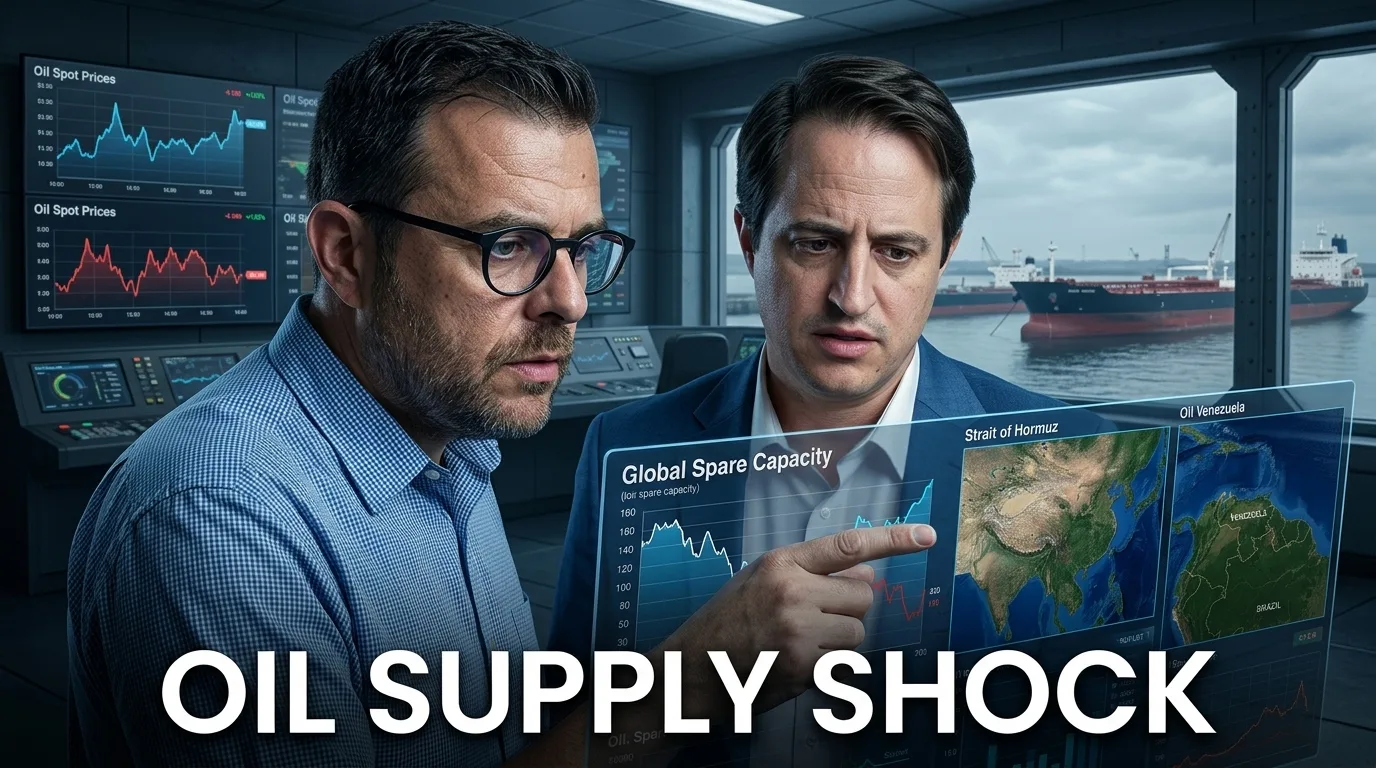
The global oil market may be approaching a far more consequential supply-demand imbalance than current headlines suggest.
That is the central argument of energy investor Josh Young, founder and chief investment officer of Bison Interests, who sees several structural forces converging at the same time: disruption around the Strait of Hormuz, the possibility of a renewed surge in Chinese crude imports, inadequate global reserve replacement, declining productivity across mature U.S. shale assets, limited genuine spare production capacity, and years of insufficient investment in new drilling.
In an interview with Triangle Investor Interviews, Young argued that investors may be focusing too heavily on the immediate geopolitical crisis while overlooking a deeper problem developing underneath the market.
His thesis is straightforward but potentially consequential: the oil industry may not be replacing enough of the barrels it consumes, while the world's ability to rapidly increase production is becoming increasingly constrained.
If that assessment is correct, the consequences could extend well beyond the next few months. Oil prices could remain elevated for longer than the market currently expects, while some of the most attractive investment opportunities may sit not necessarily in the largest producers, but in the companies providing the infrastructure required to drill and maintain future production.
“We are setting up for a huge oil supply demand imbalance,” Young argues, unless there is substantially more exploration and development activity or oil demand collapses.
The Strait of Hormuz remains one of the world's most important chokepoints for energy markets.
Young's concern is not simply that oil shipments through Hormuz could be disrupted temporarily. The bigger issue is what happens if restrictions persist while alternative export routes and major importers are already operating under pressure.
Over the preceding months, the market experienced periods of severe restriction followed by periods of greater flows. During those disruptions, significant volumes of oil accumulated on tankers before eventually moving through the system.
But Young believes the situation becomes dramatically more serious if restrictions persist while demand begins to recover.
One of the key variables is China.
According to Young, Chinese oil imports had been running substantially below previous levels, creating an unusual situation in which the market was already dealing with a major demand-side distortion. He pointed to reports of China suddenly increasing its crude purchases and hiring a very large number of tankers over a short period.
That development, in his view, could be more important than the market initially appreciated.
Supply disruptions are generally easier for markets to understand because they can often be anticipated and modeled. A sudden acceleration in demand from the world's largest oil importer is different.
Young estimates that Chinese imports had been running approximately 5–8 million barrels per day below previous levels over the preceding six months, making a significant recovery potentially transformative for the physical market.
If those barrels return to the market at precisely the moment when shipping through Hormuz is constrained, the result could be severe.
The ability of Gulf producers to redirect exports becomes critical in this scenario.
Young specifically highlighted Saudi Arabia's western export infrastructure and the Bab el-Mandeb Strait, which connects the Red Sea with the Indian Ocean.
If substantial volumes can continue moving through alternative routes, the impact of a Hormuz disruption can be partially mitigated.
But if alternative routes are themselves constrained, the equation changes rapidly.
Young argues that the combination of recovering Chinese imports and insufficient alternative export capacity could create what he describes as a potentially catastrophic supply shortage.
The key point is that the number of barrels physically produced is only part of the equation.
Where those barrels are located, how they are transported, which routes remain open and which buyers need them can be just as important.
One of the most important questions in any oil crisis is how much production can actually be brought online quickly.
Official estimates of spare capacity can create the impression that the world has a substantial buffer.
Young is skeptical.
He argues that genuine immediately accessible spare production capacity may be considerably smaller than headline figures imply, particularly outside the Persian Gulf and Russia.
The problem is that theoretical capacity is not necessarily equivalent to barrels that can reach consumers during a geopolitical crisis.
Production can be constrained by:
Young therefore distinguishes between capacity that exists on paper and capacity that is actually deliverable when the market needs it most.
That distinction could become increasingly important if geopolitical disruptions persist.
Perhaps one of Young's more interesting observations concerns the behavior of U.S. producers during a period of elevated spot oil prices.
Normally, higher oil prices should encourage producers to increase drilling.
But the current market structure creates an unusual incentive.
Young points to the difference between current spot prices and the prices available further along the futures curve.
If producers can sell oil today at substantially higher prices than they can lock in for future delivery, they have a powerful incentive to maximize current production.
That can mean extracting barrels today even if doing so potentially reduces future production.
In Young's example, if spot WTI is around $90 while a future contract is closer to $75–80, a producer faces a significant economic incentive to capture today's higher price.
The result could be a paradox:
high current prices may encourage producers to accelerate production today while simultaneously reducing the productive capacity available several years from now.
Young believes this dynamic may contribute to faster shale depletion.
He also argues that the U.S. drilling response has been surprisingly weak relative to historical cycles.
Instead of hundreds of additional oil rigs returning to the field as might have happened during previous periods of comparable price increases, he estimates the increase has been closer to roughly 50 rigs.
That discrepancy matters because drilling activity today determines production capacity tomorrow.
Beyond the geopolitical headlines lies a much larger structural issue.
The world consumes enormous quantities of oil every day.
Every year, enormous volumes must therefore be replaced simply to prevent long-term production from declining.
Young challenges the frequently cited idea that the industry is discovering approximately five barrels of oil for every barrel consumed.
Depending on how discoveries and reserves are calculated, he argues the replacement rate could actually be substantially worse.
In his view, the industry may be consuming 10 or even 20 barrels for every barrel newly discovered, depending on the methodology used to define discoveries, recoverable resources and reserves.
That would imply a replacement rate potentially below 10%.
The precise number is less important than the broader trend.
If the industry consistently consumes substantially more oil than it replaces through new discoveries and development, the eventual result is unavoidable:
the supply base gets older, smaller and increasingly expensive to maintain.
That creates a long-term bullish setup for oil prices if demand remains resilient.
Young's argument is therefore not simply that today's geopolitical events will cause higher oil prices.
It is that today's events may be exposing weaknesses that have been accumulating for years.
For much of the past decade, U.S. shale was the great counterargument to peak-oil concerns.
The extraordinary growth of unconventional production transformed the global oil market.
But Young believes investors are increasingly making the mistake of assuming shale can continue delivering the same growth indefinitely.
He argues that the shale boom between roughly 2014 and 2020 was itself the consequence of an earlier investment and innovation cycle.
The massive increase in oil prices between approximately 2001 and 2008 created the economic environment that ultimately encouraged technological innovation, capital investment and the development of unconventional resources.
In other words, the shale revolution did not emerge overnight.
It was the delayed consequence of years of investment.
That distinction is important because the market can mistake a technological revolution for a permanent increase in supply responsiveness.
Young believes that the U.S. shale sector is now much further along the maturity curve.
One of the most important concepts in Young's shale thesis is what he calls the Red Queen effect.
The concept refers to a situation in which producers must run faster and faster simply to stay in the same place.
In shale, this means drilling more wells merely to offset declining productivity and depletion from existing wells.
Young argues that production per foot drilled has been deteriorating for almost six years.
If that trend accelerates, the industry could find itself in a peculiar situation:
the number of drilling rigs could increase substantially without generating meaningful growth in total oil production.
That would represent a dramatic change from the shale industry's earlier years.
During the shale boom, additional rigs translated into rapidly increasing production.
In a mature basin, however, additional drilling may increasingly be required just to maintain existing output.
Young sees indications that some of the industry's most productive drilling locations are becoming increasingly scarce.
He points to extremely prolific wells in the Delaware Basin that once produced thousands of barrels per day and argues that some operators are now approaching the end of their inventories of these high-quality locations.
One operator, according to Young, may have only around 10–15 such locations remaining, while another operator that previously drilled similar wells may no longer be able to do so.
This is not necessarily a forecast that shale production collapses.
Rather, the concern is that the cost of maintaining production could rise dramatically.
That leads to one of the more contrarian possibilities in Young's outlook.
He believes the U.S. and Canadian drilling rig count could rise substantially over the next two years.
Yet the increase in drilling activity may not necessarily produce the corresponding increase in oil production that investors historically expect.
The industry could instead enter a period in which more and more rigs are required simply to maintain output.
Young compares the potential dynamic to the 1970s, when high drilling activity did not necessarily translate into sustained production growth.
The implication is profound for oil investors.
If the market begins to realize that more drilling no longer guarantees substantially more supply, the value of existing high-quality reserves could rise.
The market could also place a greater premium on drilling contractors, oilfield service companies and equipment providers.
Venezuela represents another major component of the supply debate.
The country possesses enormous oil resources, and policymakers have increasingly discussed the possibility of bringing Venezuelan production back to the international market.
On paper, the opportunity appears enormous.
In practice, Young believes investors are underestimating the difficulties.
Venezuela's oil industry has experienced years of underinvestment, political instability, nationalization, infrastructure deterioration and operational disruption.
Simply restarting previously shut-in production is not the same as creating new sustainable production capacity.
Young argues that some of the recent production increases attributed to Venezuela essentially represent the restoration of barrels that were previously lost rather than the creation of genuinely new supply.
That distinction is crucial.
If production goes from a depressed level back toward its previous level, the market has not necessarily gained a new million barrels per day of sustainable capacity.
It has simply recovered barrels that had disappeared.
Even if Venezuela has the geological resources, geology is only the first step.
Oil must be drilled, produced, processed, transported and exported.
Young argues that the country's infrastructure has deteriorated significantly and that rebuilding the industry would take years rather than months.
The challenges go beyond physical infrastructure.
Companies operating in Venezuela could face security risks, equipment theft, corruption, political intervention and uncertain contractual conditions.
Workers and contractors also require a functioning security environment.
The combination of these factors means that even if international capital suddenly becomes available, the physical expansion of production would likely be gradual.
Young estimates that reaching something like an additional million barrels per day could potentially take five to ten years, under favorable assumptions.
And even that outcome, in his view, carries substantial political risk.
For Young, Venezuela's history creates another major uncertainty: property rights.
He points to the country's previous nationalizations of foreign-owned oil assets and argues that investors should not assume that a new wave of foreign investment automatically means those investments will remain secure over the long term.
His concern is essentially this:
the same political forces that once undermined private investment could eventually return.
That creates a risk premium for international capital.
An oil company may be willing to invest billions in developing a field if it believes it will receive the economic benefits for decades.
But if investors believe there is a meaningful probability of future expropriation, they may demand much higher returns before committing capital.
That can slow investment dramatically.
And slower investment means slower production growth.
For Young, this is one reason Venezuela should not be treated as an easy or immediate solution to global supply shortages.
The conversation eventually moves from oil fundamentals to the question investors ultimately care about:
Where is the opportunity?
Young's answer is notably different from simply buying the largest oil producers.
He argues that many oil and gas equities have already appreciated substantially, changing their risk-reward profile.
If a producer has already risen 100%, the company may still have upside, but the margin of safety is no longer the same as it was before the rally.
As a result, Young says he has shifted capital toward smaller-cap special situations and selected oilfield-service companies.
But his favorite area is more specific.
Young is particularly bullish on drilling rig companies.
The setup, in his view, combines several characteristics that are attractive to a value-oriented investor:
He describes some rig companies as potentially trading at only a fraction of replacement cost.
At the same time, some could generate free cash flow yields in the range of 20–30% based on forward estimates, according to his framework.
This creates an unusual combination.
A company does not necessarily need a dramatic increase in oil prices to generate attractive returns if its assets are deeply discounted relative to their replacement value and its existing fleet is generating substantial cash flow.
That is the essence of Young's investment argument.
The investment thesis becomes particularly interesting when considering the capital cycle.
Oil producers need to spend money to maintain and grow production.
That spending flows through the oilfield-services industry.
If drilling activity increases, demand rises for:
If the industry has underinvested in these assets for years, service companies can gain pricing power as utilization rises.
This creates a potential feedback loop:
higher oil prices → greater producer cash flow → more drilling → higher rig utilization → stronger service pricing → higher service-company cash flow.
Young believes this dynamic is beginning to emerge.
Asked to make one major oil-market call over the next 12–24 months, Young did not focus primarily on the oil price itself.
Instead, he chose drilling activity.
His prediction is that the combined U.S. and Canadian oil-and-gas rig count could increase by more than 100 rigs over the next 12–24 months.
He considers that a significant increase because it would consume essentially all of the industry's available rig capacity and potentially require additional investment.
Importantly, he sees the increase in drilling activity as investable regardless of the precise direction of oil prices.
If oil prices remain high, producers have the cash flow to drill.
If prices remain moderately strong, service companies can still benefit from increased activity.
Only a severe recession and major collapse in demand, he suggests, would fundamentally derail this investment cycle.
Young also makes an important point for natural-gas investors.
Even when rigs are targeting oil, they frequently produce associated natural gas.
Therefore, an increase in oil-directed drilling can create additional gas supply.
That means some of the bullish assumptions around natural gas could prove overly optimistic if oil drilling accelerates substantially.
The paradox is that a stronger oil investment cycle could simultaneously produce more natural gas.
This could place pressure on gas prices even as drilling contractors benefit from higher activity.
For investors, that is an important reminder that commodity markets are interconnected.
At the end of the interview, Young offered a very different commodity-related idea.
He discussed buying U.S. five-cent coins, or nickels, because of their underlying metal value.
His argument is based on the possibility that the metal contained in the coin could eventually become worth substantially more than its face value.
Young referenced a current melt value of approximately 7.5 cents and suggested that if copper and nickel prices rise substantially, the intrinsic metal value could potentially increase further over a five- or ten-year period.
He emphasized that this is not an institutional investment strategy and that it is impractical to execute at significant scale.
Still, he described the trade as potentially asymmetric: the downside is broadly anchored around the coin's face value, while the theoretical upside comes from its metal content and future changes in U.S. currency policy.
Young said he had personally started with roughly $100 worth of nickels and might increase that amount substantially.
It is perhaps the most unconventional idea discussed in the interview.
But it also fits the broader philosophy running through Young's commodity thesis: look for situations where the downside appears limited relative to the potential upside created by structural scarcity.
Taken together, Young's argument is not simply a bullish forecast for oil.
It is a thesis about the gradual disappearance of the market's traditional shock absorbers.
For years, whenever oil prices rose sharply, investors could point to several mechanisms that would eventually bring additional supply:
Young believes several of these mechanisms are becoming less powerful.
The best acreage is increasingly depleted, productivity growth is slowing and more drilling may be required merely to maintain production.
Geopolitical constraints can prevent nominal capacity from becoming immediately available barrels.
Restoring production requires infrastructure, capital, security and political stability.
The industry continues consuming enormous volumes of oil while new discoveries remain comparatively limited.
Despite higher prices, drilling activity has not increased to the extent historical cycles might suggest.
That combination creates the possibility of a market where supply becomes increasingly inelastic.
Young's argument is deliberately contrarian, but it is not without risks.
The most obvious is demand.
If global oil consumption falls dramatically, supply shortages become less important.
A deep global recession could reduce demand enough to overwhelm the structural supply concerns.
Technological change is another uncertainty.
Efficiency gains, electrification, electric vehicles and alternative energy sources could gradually reduce petroleum demand.
There is also the possibility of a major geopolitical de-escalation.
If shipping through Hormuz normalizes, sanctions ease, Venezuelan production recovers faster than expected and global supply chains stabilize, some of the immediate scarcity premium could disappear.
And, of course, oil prices themselves influence producer behavior.
If prices rise sufficiently, previously uneconomic resources become profitable, encouraging additional drilling and potentially accelerating technological innovation.
The oil market has repeatedly demonstrated an ability to respond to extreme prices.
The question is whether that response can arrive quickly enough.
That ultimately brings the discussion back to the key issue.
How quickly can the global oil industry create new productive capacity?
If the answer is “very quickly,” then a temporary geopolitical shock may produce only a short-lived price spike.
If the answer is “slowly,” then every disruption becomes more dangerous.
Young's thesis is that the industry's response time is becoming longer precisely when the market may need it most.
The result could be an extended period of elevated oil prices, greater volatility and increasing value assigned to existing productive assets.
And that is why he is not simply betting on oil producers.
He is looking further down the chain.
The companies that own the equipment required to develop the next barrels could become increasingly important.
The most important takeaway from Josh Young's outlook is that the next oil cycle may look very different from the previous one.
The shale revolution created a world in which investors became accustomed to the idea that high oil prices would eventually bring enormous amounts of new supply.
That assumption may be weakening.
If shale is approaching maturity, if global discoveries remain insufficient, if geopolitical disruptions limit spare capacity, and if rebuilding major producers such as Venezuela takes many years, the market could enter an environment where additional barrels become increasingly difficult and expensive to produce.
At the same time, drilling activity may rise significantly.
That apparent contradiction — more rigs but potentially less incremental production — could become one of the defining characteristics of the next phase of the oil market.
For investors, Young sees the opportunity not necessarily in chasing companies that have already rerated sharply, but in identifying parts of the industry that remain priced as though the old supply response is still intact.
His favorite example is drilling rigs: assets trading at substantial discounts to replacement cost, potentially generating significant free cash flow, at a time when the industry may need more of them.
The broader message is clear.
The oil market may not be running out of resources. It may be running out of easily accessible, rapidly scalable supply.
And if that is the problem developing beneath the surface, the next major oil bull market may not be driven by a sudden collapse in production.
It may instead be driven by something more subtle:
the realization that replacing every barrel the world consumes is becoming harder, slower and more expensive.
This article is based on an interview with energy investor Josh Young. The market forecasts, estimates and investment opinions attributed to Young represent his views and should not be interpreted as investment advice or independently verified facts. Investors should conduct their own due diligence and consult qualified financial professionals before making investment decisions.
Sign up to our free monthly newsletter to recieve the latest on our interviews and articles.
By subscribing you agree to receive our newest articles and interviews and agree with our Privacy Policy.
You may unsubscribe at any time.

We use cookies to improve your experience on our site. By using our site, you consent to cookies.
Websites store cookies to enhance functionality and personalise your experience. You can manage your preferences, but blocking some cookies may impact site performance and services.
Essential cookies enable basic functions and are necessary for the proper function of the website.
These cookies are needed for adding comments on this website.
Statistics cookies collect information anonymously. This information helps us understand how visitors use our website.
Google Analytics is a powerful tool that tracks and analyzes website traffic for informed marketing decisions.
Service URL: policies.google.com (opens in a new window)
You can find more information in our Privacy Policy.