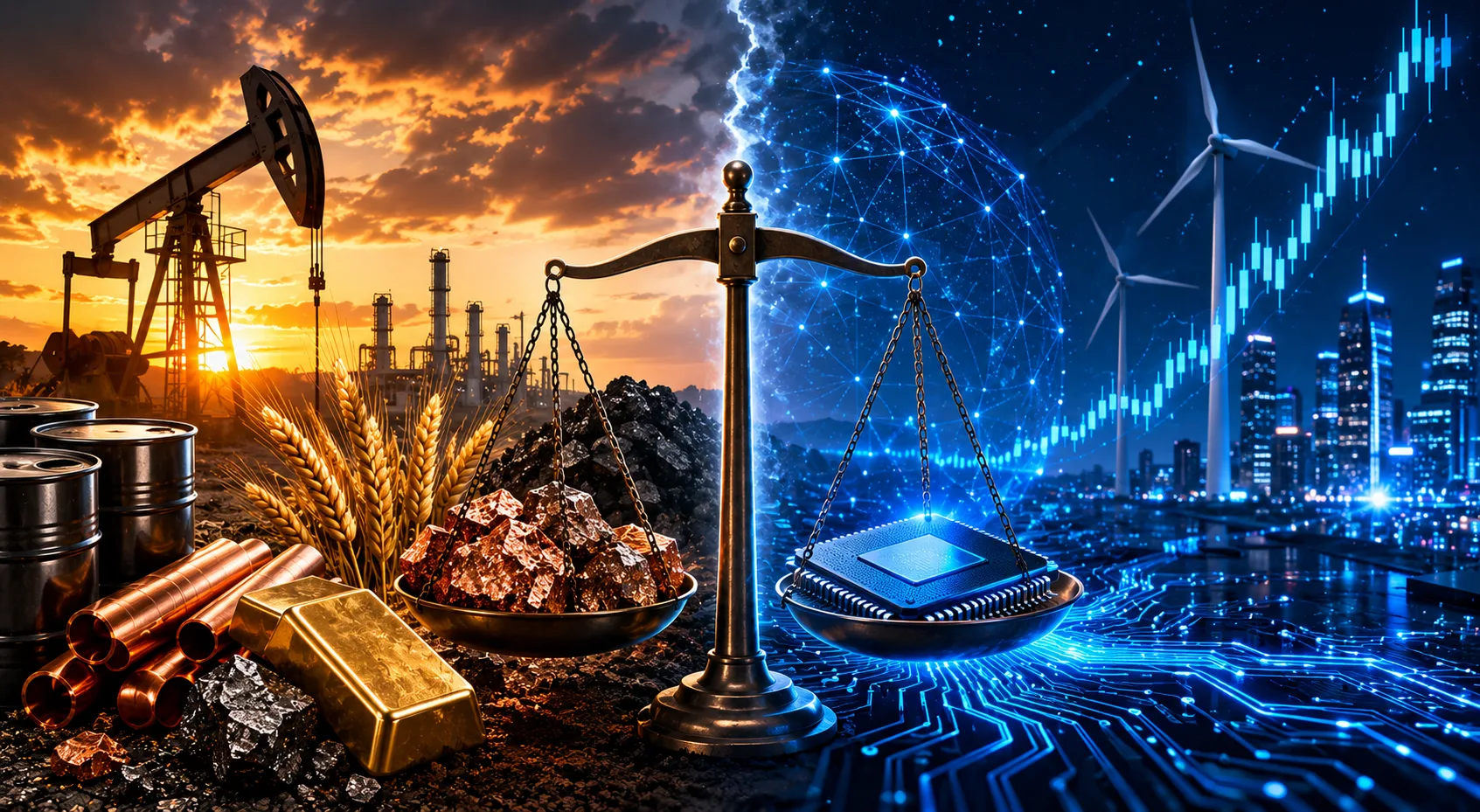
While financial markets remain captivated by artificial intelligence, semiconductor stocks, and the seemingly endless ascent of technology valuations, a different story is unfolding beneath the surface. According to independent investor and market commentator John Polomny, investors may be dangerously underestimating a set of structural forces that could reshape global markets for years to come.
In a recent discussion, Polomny outlined a thesis centered on resource scarcity, geopolitical fragmentation, energy insecurity, and the re-emergence of supply-side constraints. His argument is straightforward but provocative: the next decade will likely be defined less by software and digital innovation and more by the availability of physical resources that make modern civilization possible.
At the center of this thesis lies one of the world's most strategically important chokepoints—the Strait of Hormuz.
Polomny believes investors have become complacent regarding the geopolitical risks emerging from the Middle East. While markets have largely focused on AI spending, chip manufacturing, and monetary policy, he argues that the potential disruption of oil and gas flows through the Strait of Hormuz remains vastly underappreciated.
The Strait serves as a critical artery for global energy markets. A significant portion of the world's oil and liquefied natural gas exports pass through this narrow waterway. Any prolonged disruption would create consequences extending far beyond energy prices.
According to Polomny, many investors fail to appreciate the interconnected nature of modern supply chains. Oil and natural gas are not merely transportation fuels; they are foundational inputs for fertilizers, chemicals, plastics, industrial processes, and countless manufactured products.
Should a substantial portion of these energy flows become permanently constrained, the effects could cascade throughout the global economy.
His concern is not necessarily that the Strait closes entirely forever. Rather, he argues that even a partial and persistent disruption could permanently alter global energy markets by introducing a lasting geopolitical risk premium.
In such a scenario, energy prices would likely establish a significantly higher floor than investors have become accustomed to over the past decade.
One of Polomny's more controversial observations concerns the role of strategic petroleum reserves (SPRs).
He argues that current inventories and reserve drawdowns may be masking the true extent of tightening energy markets. While official inventories continue to provide some buffer against supply disruptions, he believes these reserves are gradually being depleted without solving the underlying structural imbalance.
Several indicators support his concern:
In his view, markets are slowly moving toward a supply crunch without fully recognizing it.
The challenge for investors is timing. Supply shortages often develop gradually before becoming obvious. As Polomny notes, everyone knows there is land somewhere ahead, but nobody knows exactly when the ship will arrive.
The risk is that by the time shortages become visible to the broader market, the investment opportunities may already be gone.
Beyond energy, Polomny sees a much larger phenomenon unfolding: a global shortage of investment in resource extraction.
His argument is not that the world is running out of minerals. Quite the opposite.
The resources exist.
The problem is that years of underinvestment have left the world without enough productive capacity to meet future demand.
Copper serves as perhaps the most important example.
The global transition toward electrification, renewable energy infrastructure, data centers, electric vehicles, and industrial modernization requires enormous amounts of copper. Industry experts have estimated that humanity may need to mine as much copper over the next few decades as has been extracted throughout all previous human history.
Yet new copper projects face several challenges:
These factors suggest that future copper supply growth will be expensive and slow.
The same dynamic applies to numerous critical minerals including:
For investors, this creates what Polomny describes as a generational opportunity.
Governments around the world are now recognizing the strategic importance of critical mineral supply chains. Massive public spending initiatives are being directed toward securing domestic production and reducing dependence on foreign suppliers.
Whether these efforts succeed remains uncertain.
What seems increasingly certain is that enormous amounts of capital will be deployed attempting to solve the problem.
Perhaps Polomny's strongest criticism is reserved for today's AI-driven equity market.
He argues that many semiconductor and AI-related companies exhibit characteristics strikingly similar to the late-1990s internet bubble.
The parallels include:
While acknowledging that artificial intelligence represents a transformative technology, Polomny questions whether investors are adequately considering the economics behind the infrastructure required to support it.
Companies such as Alphabet, Meta, Microsoft, and others are spending hundreds of billions of dollars on:
Historically, these firms enjoyed exceptionally high margins because software scales efficiently. Once software is built, adding new users costs relatively little.
Physical infrastructure is different.
Power plants, transmission lines, gas turbines, substations, and energy procurement are capital-intensive, lower-margin businesses.
As AI spending accelerates, Polomny believes investors may be overlooking how these investments could compress future profit margins.
His preferred approach is not to invest directly in AI winners but rather in the physical resources and infrastructure that every AI competitor requires.
Regardless of which company dominates artificial intelligence, all participants need:
By owning the suppliers rather than the competitors, investors may achieve more attractive risk-adjusted returns.
Polomny also sees a looming agricultural challenge that could become politically explosive.
Modern agriculture depends heavily on hydrocarbons.
Natural gas is essential for nitrogen fertilizer production. Diesel powers farm equipment, transportation networks, and logistics systems.
Rising energy costs inevitably translate into higher food production costs.
Recent reports from agricultural regions suggest many farmers have reduced fertilizer applications due to elevated input costs.
This creates a potentially dangerous dynamic:
Compounding the issue are weather-related risks, including the possibility of adverse climate conditions affecting major growing regions.
Polomny argues that food inflation could ultimately become an even larger political issue than energy inflation.
While consumers may tolerate higher fuel prices for a period, food prices directly affect daily life. History repeatedly demonstrates that food shortages and food inflation have often been catalysts for social unrest and political upheaval.
A recurring theme in Polomny's analysis is the relationship between economic stress and political instability.
As living costs rise, societies become increasingly polarized. Governments face mounting pressure to intervene, often creating additional distortions and unintended consequences.
He believes the coming years may be characterized by:
For investors, volatility should not necessarily be feared.
Rather, volatility creates opportunities for those who recognize long-term structural trends before they become consensus views.
While much of the interview focused on risks, Polomny also highlighted areas of opportunity.
One of his favorite examples is Uzbekistan.
A decade ago, Uzbekistan was largely closed to international capital. Since then, economic reforms, privatization efforts, and increased market openness have transformed investor perceptions.
Several factors make the country attractive:
Polomny views Central Asia as an overlooked region that could benefit significantly from the reconfiguration of global trade routes and supply chains.
More broadly, he seeks opportunities in jurisdictions that are improving politically and economically while remaining ignored by mainstream investors.
This contrarian approach has also led him to monitor countries such as:
His strategy centers on identifying jurisdictions before political and economic improvements become widely recognized.
Taken together, Polomny's outlook suggests a profound shift in investment leadership over the coming decade.
Rather than focusing solely on technology and software, investors may need to consider the physical foundations of economic growth.
Key themes include:
Oil, natural gas, LNG infrastructure, pipelines, storage facilities, and transportation networks.
Copper, uranium, rare earth elements, tungsten, antimony, nickel, and other strategic materials.
Fertilizers, farm infrastructure, agricultural logistics, and food production systems.
Electricity generation, transmission networks, data center power systems, and industrial facilities.
Select emerging economies benefiting from demographic growth and economic reform.
The dominant investment narrative of the past decade was built around abundance—abundant liquidity, abundant globalization, abundant supply chains, and abundant capital.
John Polomny believes that era is ending.
The next phase may be defined by scarcity:
Whether his forecasts prove entirely correct remains to be seen. However, the broader message deserves attention: investors who focus exclusively on digital innovation may be overlooking the physical economy that makes all innovation possible.
If the world is indeed entering an age of structural supply constraints, then the biggest opportunities may not lie in the technologies consuming resources, but in the companies producing them.
Sign up to our free monthly newsletter to recieve the latest on our interviews and articles.
By subscribing you agree to receive our newest articles and interviews and agree with our Privacy Policy.
You may unsubscribe at any time.

We use cookies to improve your experience on our site. By using our site, you consent to cookies.
Websites store cookies to enhance functionality and personalise your experience. You can manage your preferences, but blocking some cookies may impact site performance and services.
Essential cookies enable basic functions and are necessary for the proper function of the website.
These cookies are needed for adding comments on this website.
Statistics cookies collect information anonymously. This information helps us understand how visitors use our website.
Google Analytics is a powerful tool that tracks and analyzes website traffic for informed marketing decisions.
Service URL: policies.google.com (opens in a new window)
You can find more information in our Privacy Policy.