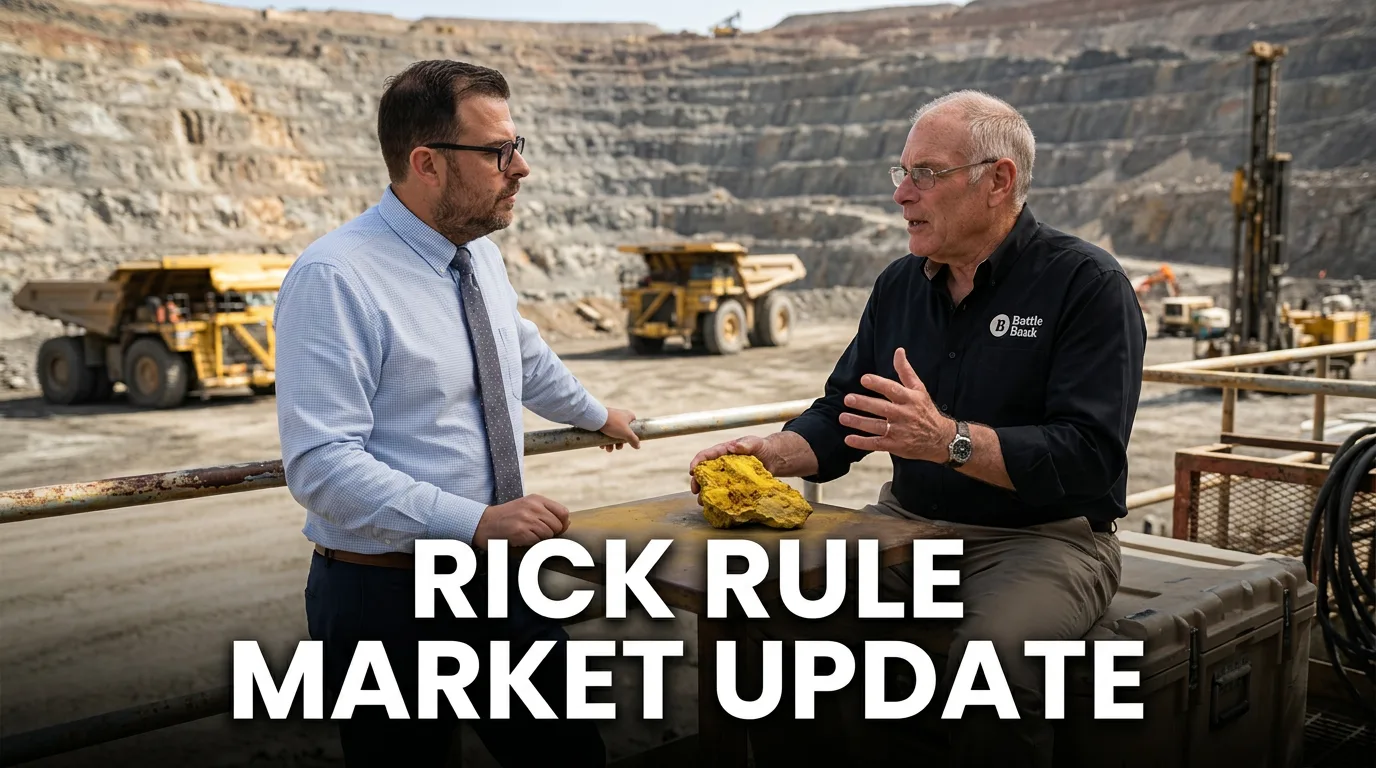
Legendary natural resource investor Rick Rule shared his latest views on uranium, gold, copper, liquidity, global markets, and investing during periods of uncertainty. His message was clear: while volatility is inevitable, structural trends continue to favor disciplined long-term investors who focus on quality assets and ignore short-term market sentiment.
Despite weakness across uranium equities in 2026, Rick Rule believes the market has not yet experienced true capitulation.
While many investors have become discouraged by falling share prices, Rule argues that the underlying fundamentals remain remarkably strong. Importantly, he distinguishes between equity performance and the uranium commodity itself. Uranium prices have held up relatively well, suggesting that the weakness is largely an equity market phenomenon rather than a collapse in industry fundamentals.
According to Rule, investors are overlooking three critical structural developments.
The most important factor is straightforward:
The world continues consuming more uranium than it produces.
Even with long-term uranium prices approaching levels many expected would incentivize new mine development, meaningful new production has failed to materialize.
Rule admits this surprised him.
Historically, higher commodity prices encourage miners to develop new projects. Yet uranium has proven different. Regulatory complexity, permitting delays, financing challenges and operational difficulties have prevented the supply response many expected.
Meanwhile, reactor construction continues globally, widening the imbalance between supply and demand. Every new reactor represents decades of uranium consumption, further tightening the market.
Rule argues many investors still analyze uranium as though it were the same market it was a decade ago.
It isn't.
Historically, uranium pricing depended heavily on the spot market, where daily transactions determined prices.
Today, the market increasingly revolves around long-term contracts.
This change has major implications.
Utilities now secure uranium through multi-year agreements, allowing producers to lock in both pricing and volumes well in advance.
For mining companies, this creates something extremely unusual in the commodity sector:
Rule notes that few, if any, other mining sectors enjoy this level of pricing stability.
Perhaps Rule's most compelling argument centers around geopolitics.
He believes recent instability in the Persian Gulf has fundamentally changed how governments think about energy.
He draws a historical comparison to the 1973 oil embargo, which ultimately accelerated construction of both Japan's and France's massive nuclear fleets.
Today, governments once again face uncomfortable questions about dependence on imported fossil fuels.
Nuclear power offers something unique.
As Rule points out, uranium is extraordinarily energy dense.
Japan can theoretically store enough uranium to operate its electrical grid for roughly five years—something impossible with oil, natural gas or coal.
Looking back a decade from now, Rule believes today's geopolitical instability may be remembered as the catalyst that reignited global nuclear expansion.
Rule emphasized that he is not chasing speculative newcomers.
Instead, he continues focusing on companies with proven assets and attractive risk-reward profiles.
One position he recently added is Denison Mines.
His investment centers almost entirely on Denison's ambitious in-situ recovery (ISR) mining approach at significant depth.
Rule openly acknowledges that the technology carries meaningful execution risk.
If it fails, he estimates the stock could lose roughly 25–30%.
If successful, however, he believes investors could potentially see returns of two to three times today's valuation.
For Rule, the asymmetry justified taking a position despite the uncertainty.
Kazatomprom appears inexpensive on traditional valuation metrics.
Yet Rule remains cautious.
His concern isn't valuation.
It's uncertainty.
He cites operational challenges, including management turnover and production delays, that he does not fully understand.
Rule repeatedly emphasizes one of his core investing principles:
Never invest when you cannot properly identify the source of the risk.
Unknown risks are far more dangerous than known problems that can be quantified and valued.
Perhaps Rule's most controversial uranium view concerns American producers.
Despite expecting companies like Energy Fuels, enCore Energy and Uranium Energy Corp. to continue appreciating, Rule owns none of them.
His reasoning is disciplined.
He prefers deposits that rank in the lowest global cost quartile while generating returns on capital above 25%.
In his view, few U.S. uranium operations currently satisfy those criteria.
Instead, he believes much of the sector's valuation reflects:
He does acknowledge that Energy Fuels has evolved beyond uranium by leveraging its processing facilities to become an integrated rare earth company, creating a more diversified business model.
Discussion then shifted toward broader financial markets.
With U.S. margin debt sitting near record highs, Rule expressed concern—not because leverage guarantees a crash, but because excessive borrowing often reflects investor greed.
Having spent decades running a brokerage firm, Rule says he consistently refused to encourage clients to borrow money for speculation.
While sophisticated investors can sometimes use leverage effectively, he believes most investors use margin because of optimism rather than discipline.
That combination has historically produced painful outcomes.
One of Rule's most valuable observations concerns market crashes.
Many investors assume defensive assets will immediately outperform.
History suggests otherwise.
During liquidity crises, investors don't necessarily sell what they dislike.
They sell whatever they can.
Margin calls force liquidation across nearly every asset class.
Gold itself declined sharply during both the 1987 crash and the 2008 financial crisis.
However, Rule emphasizes the critical distinction:
High-quality assets recover far faster than weak ones.
Governments almost always respond to financial crises with:
Those policies have historically become powerful tailwinds for gold.
Rule revealed that 2009 ultimately became the best investment year of his career—not because 2008 was easy, but because he entered the crisis with abundant liquidity and the confidence to buy while others were forced to sell.
Unlike many investors, Rule considers physical bullion part of his cash allocation.
To him, gold is simply another highly liquid asset.
If better opportunities emerge, he has no hesitation selling some bullion to purchase undervalued investments.
He even jokes that he may be "too liquid," but views liquidity as essential for both financial flexibility and peace of mind.
At 73 years old, he says sleeping well is one of the greatest benefits of maintaining ample liquidity.
Asked whether investors should own bullion or mining shares, Rule declined to offer a universal answer.
Instead, he framed the decision around investor psychology.
Physical gold serves as financial insurance.
Mining stocks offer leverage to rising precious metal prices.
Those willing to perform extensive research and accept company-specific risks may achieve substantially higher returns through equities.
Those seeking protection against currency debasement may prefer owning the metal directly.
The appropriate choice depends entirely on an investor's objectives and temperament.
Rule continues buying select mining companies that he believes could become acquisition targets.
His preferred opportunities include:
He also highlighted established producers such as OceanaGold and B2Gold, arguing they currently trade at meaningful discounts relative to free cash flow.
He believes larger mining companies could acquire these businesses, retain core assets, sell non-core operations and unlock significant value.
For investors unwilling to conduct deep research, Rule recommends simply owning industry leaders such as Franco-Nevada, Wheaton Precious Metals and Agnico Eagle, arguing that outstanding businesses often outperform with considerably less risk.
Rule openly admitted one of his biggest forecasting mistakes.
He expected copper prices to weaken during 2026.
Instead, copper significantly outperformed.
Long term, however, his conviction remains unchanged.
He believes the world has underinvested in copper production for roughly three decades.
Eventually, prices will need to rise enough to ration demand because new supply simply cannot keep pace.
Although macroeconomic uncertainty could still weigh on copper, Rule believes the long-term structural shortage remains firmly intact.
Asked which sector resembles uranium or silver a decade ago, Rule surprised many listeners.
He did not identify another commodity.
Instead, he identified entire countries.
He suggested markets such as Russia, Iran, Bolivia, Congo and, to a lesser extent, Brazil currently trade at significant discounts because of geopolitical concerns.
Rule stressed these opportunities involve enormous risks and require exceptional political understanding, but history has shown that investing where others refuse to go can produce extraordinary returns.
Rule also reflected on previous investments across Southeast Europe.
He described positive experiences in Serbia and Bosnia, noting that although regulatory capacity was sometimes limited, the geological potential—particularly for silver, lead, zinc and volcanogenic massive sulphide deposits—is exceptional.
He indicated he would gladly revisit the region alongside strong local partners and experienced geological teams.
Outside financial markets, Rule has largely exited developed real estate.
He sold most of his property portfolio in 2022, believing four decades of declining interest rates had ended.
He continues holding farmland and timberland, assets he expects to pass to future generations.
He also enjoys collecting art—not for investment returns, but because it enhances his quality of life.
If he relocates to Florida, he expects to begin collecting Latin American and Caribbean art as well.
Rule recently hosted another successful Rule Symposium, attracting approximately 1,000 in-person attendees and over 2,200 online participants.
He cautioned that the audience is hardly representative of the broader investment community.
Most attendees are highly educated resource investors who have experienced multiple commodity cycles.
Rather than viewing declining resource equities as a warning sign, many participants saw weakness as an opportunity.
Rule believes this optimism stems from preparation.
Experienced investors understand volatility is often the price paid for exceptional long-term returns.
Rule concluded by highlighting two free resources available through Rule Investment Media.
First, investors can access dozens of pre-conference interviews with resource companies, providing extensive educational material.
Second, Rule continues offering his popular free portfolio ranking service, where investors can submit their natural resource portfolios for his personal evaluation and commentary.
It remains one of the industry's most unique educational offerings.
Rick Rule's latest outlook reflects the same philosophy that has defined his investing career for decades.
Rather than chasing headlines or reacting emotionally to falling share prices, he focuses on structural trends, disciplined valuation and maintaining liquidity when others become fully invested.
His conviction in uranium remains strong because the industry's supply deficit has not disappeared, long-term contracting continues to strengthen producer economics and energy security has returned as a global priority. At the same time, he reminds investors that every market cycle eventually brings volatility—and those who preserve liquidity and focus on high-quality assets are often the ones best positioned to capitalize when fear creates opportunity.
For Rule, successful investing is not about predicting every market move. It is about understanding value, preparing for uncertainty and having both the patience and the capital to act decisively when exceptional opportunities emerge.
Sign up to our free monthly newsletter to recieve the latest on our interviews and articles.
By subscribing you agree to receive our newest articles and interviews and agree with our Privacy Policy.
You may unsubscribe at any time.
We use cookies to improve your experience on our site. By using our site, you consent to cookies.
Websites store cookies to enhance functionality and personalise your experience. You can manage your preferences, but blocking some cookies may impact site performance and services.
Essential cookies enable basic functions and are necessary for the proper function of the website.
These cookies are needed for adding comments on this website.
Statistics cookies collect information anonymously. This information helps us understand how visitors use our website.
Google Analytics is a powerful tool that tracks and analyzes website traffic for informed marketing decisions.
Service URL: policies.google.com (opens in a new window)
Marketing cookies are used to follow visitors to websites. The intention is to show ads that are relevant and engaging to the individual user.
You can find more information in our Privacy Policy.