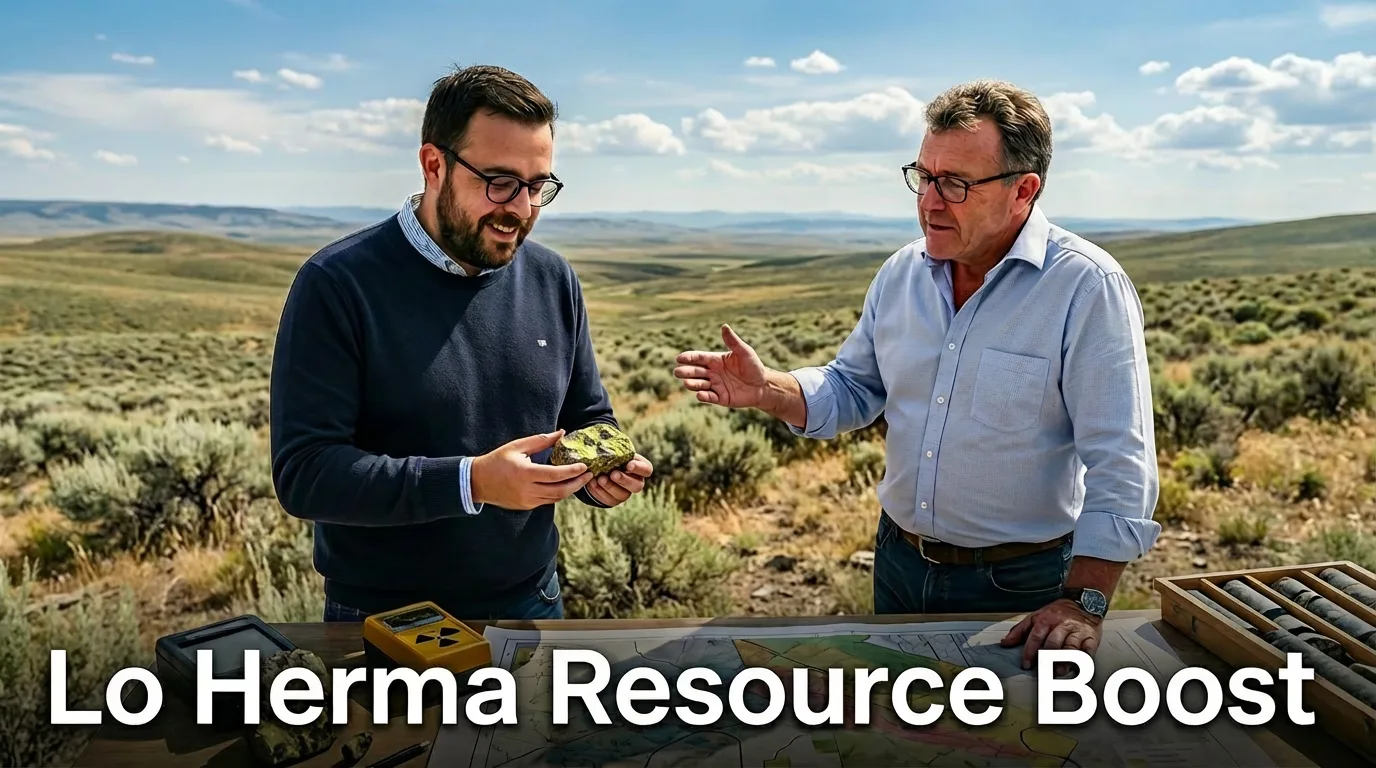
We spoke with Bruce Lane, Executive Director of American Uranium, offering a detailed update on the company’s flagship Lo Herma project in the United States. The conversation covered resource expansion, technical progress, development timelines, and the broader uranium market outlook. What emerges is a company steadily advancing toward development while positioning itself within a strengthening nuclear energy narrative.
One of the most significant updates is the expansion of the Lo Herma resource to approximately 9.45 million pounds of uranium, with 43% classified in the indicated category—a meaningful step toward development readiness.
This growth was not simply about adding volume. The company also improved the average grade from 630 ppm to 720 ppm, reflecting a combination of better targeting and tighter geological modeling. According to Lane, this upgrade resulted from focusing on higher-confidence zones within defined mine units, particularly Mine Units 1 and 2.
Importantly, around 7 million pounds now sit within proposed mining areas, with nearly half categorized as indicated resources. This balance between expanding total resource size and upgrading confidence levels is critical, as it directly supports future economic studies and project financing.
Higher grades also have tangible operational benefits. In in-situ recovery (ISR) mining, better grades can translate into denser wellfield layouts and improved economics, potentially reducing capital intensity and operating costs.
The company is only halfway through its current drilling program, leaving considerable upside potential. The second phase of drilling is expected to be more targeted, benefiting from data gathered in the first phase.
Key objectives of the next drilling phase include:
A notable catalyst is the acquisition of new private mineral rights and claims, totaling roughly 1,500 acres. These areas sit adjacent to existing resource zones and are believed to host extensions of known mineralization. In some cases, previously interpreted resources could now be formally incorporated into future estimates.
Lane emphasized that while geological continuity is strong—thanks to consistent sandstone-hosted systems—the main challenge remains accurately locating high-grade roll-front mineralization. With limited geophysical tools available for this deposit type, success depends heavily on precise drilling.
Currently, about 7 million pounds are considered “under pattern”, meaning they are sufficiently understood to be included in development planning. Additional resources may be ISR-extractable, but require further hydrogeological validation.
To contextualize scale, Lane compared Lo Herma to nearby U.S. ISR projects:
This places the project firmly within the range of commercially viable ISR operations in Wyoming, one of the most established uranium-producing regions in the United States.
Looking ahead, American Uranium has laid out a clear set of milestones for 2026:
Q2 2026
Q3 2026
The scoping study will be a critical inflection point, as it will incorporate updated resource confidence and provide the first comprehensive economic framework for the project.
The company recently raised approximately $2.6 million, with an additional rights issue targeting a similar amount. This funding is expected to:
Post-scoping study, the company will evaluate next steps based on uranium market conditions and project economics.
While Lo Herma is the primary focus, American Uranium holds several additional assets:
These assets provide longer-term optionality but remain secondary to Lo Herma in current capital allocation.
Lane noted a clear increase in institutional interest, driven by two converging themes:
Uranium sits at the intersection of both, making it particularly attractive. Importantly, Lane highlighted a scarcity of advanced ISR projects held by junior companies, which strengthens American Uranium’s positioning.
The uranium market remains complex but broadly supportive:
Lane suggested that the “real” price environment likely sits closer to the higher end, particularly for future delivery contracts.
At the same time, policy momentum—especially in the United States—is accelerating. Plans for new nuclear reactor builds and government-backed initiatives signal strong long-term demand for domestic uranium supply.
American Uranium’s Lo Herma project is transitioning from exploration toward development, supported by:
While risks remain—particularly in drilling precision and hydrogeological validation—the project is increasingly aligned with the scale and characteristics of producing ISR operations.
If execution continues as planned through 2026, the upcoming scoping study could mark a pivotal step in demonstrating the project’s economic viability and unlocking further value.
You can watch the interview on this link: https://youtu.be/IItJDHt3Ahs?si=5x4V0YCqJYDV8TIW
Sign up to our free monthly newsletter to recieve the latest on our interviews and articles.
By subscribing you agree to receive our newest articles and interviews and agree with our Privacy Policy.
You may unsubscribe at any time.
We use cookies to improve your experience on our site. By using our site, you consent to cookies.
Websites store cookies to enhance functionality and personalise your experience. You can manage your preferences, but blocking some cookies may impact site performance and services.
Essential cookies enable basic functions and are necessary for the proper function of the website.
These cookies are needed for adding comments on this website.
Statistics cookies collect information anonymously. This information helps us understand how visitors use our website.
Google Analytics is a powerful tool that tracks and analyzes website traffic for informed marketing decisions.
Service URL: policies.google.com (opens in a new window)
You can find more information in our Privacy Policy.