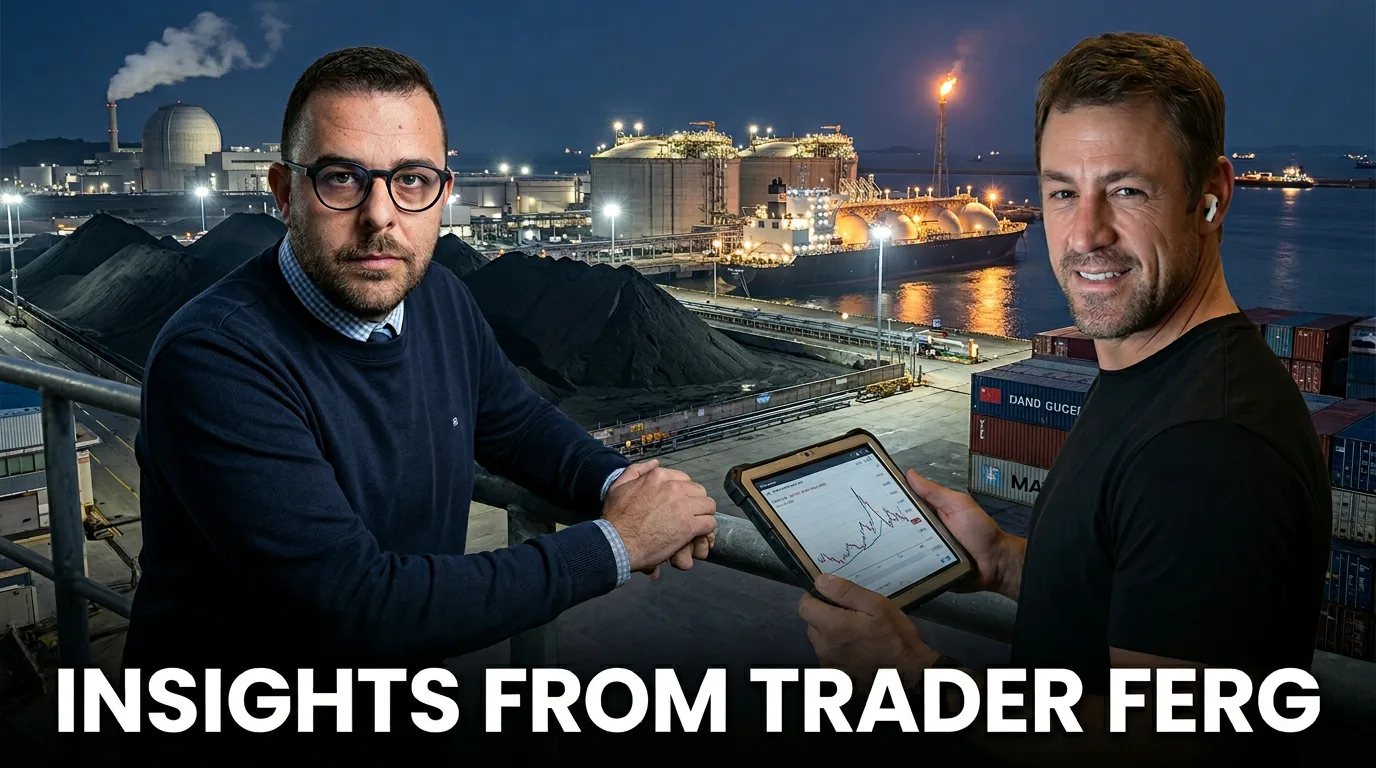
I sat down with macro-focused Fergus Cullen aka Trader Ferg to unpack one of the most complex commodity environments in years. From coal’s unexpected resurgence to LNG supply shocks, fertilizer shortages, uranium volatility, and the outlook for precious metals—this conversation reveals a market shaped by geopolitics, structural constraints, and shifting energy priorities.
This article distills and expands on those insights into a comprehensive analysis of the current commodity supercycle dynamics and what investors and traders should be watching next.
Coal Is Back: Why the Market Is Misreading Energy Reality
For years, coal has been dismissed due to ESG pressures and the global push toward cleaner energy. However, Ferg argues that markets are underestimating coal’s resilience—especially in emerging economies.
Key Drivers Behind Coal’s Comeback
- LNG supply disruptions are forcing countries to revert to coal
- Price sensitivity in Asia favors coal over expensive LNG
- Energy security concerns outweigh environmental commitments
The tipping point comes from a combination of geopolitical shocks and infrastructure bottlenecks—particularly in LNG.
LNG Crisis: The Hidden Catalyst Reshaping Global Energy
One of the most critical insights from the discussion is the structural disruption in LNG markets.
What Happened?
- LNG infrastructure damage (e.g., Ras Laffan disruptions)
- Delays in Qatar’s expansion projects
- Shipping bottlenecks and geopolitical tensions
- LNG carriers unable to transit key routes
Why It Matters
LNG markets were expected to enter a supply glut, which would lower prices and accelerate the transition away from coal. Instead, the opposite is happening:
- Supply is constrained
- Prices remain elevated
- Demand shifts back to coal
Structural Impact
Ferg estimates that instead of a glut, the LNG market could face a multi-year deficit, fundamentally changing global energy expectations.
Asia’s Energy Shift: From LNG Back to Coal (and Solar)
Emerging Asian economies—such as Pakistan and the Philippines—have been hit hardest by LNG volatility.
Why They’re Abandoning LNG
- Inability to compete in global bidding wars
- Repeated supply disruptions (notably since 2022)
- Lack of energy security
What Comes Next?
- Coal (short-term winner)
- Solar (mid-term growth)
- Nuclear (long-term solution)
China, in particular, is accelerating solar production, while countries like Japan and Taiwan are reconsidering nuclear energy.
Europe’s Energy Illusion: Dependency Isn’t Gone
While Europe has reduced reliance on Russian gas, it hasn’t solved its core vulnerability—it has simply shifted it.
Current Risks
- Low energy storage levels
- Increased dependence on LNG markets
- Exposure to Asian demand competition
- Ongoing reliance on Russian LNG (ironically increasing)
Ferg suggests Europe may eventually bend its own regulations to maintain energy stability rather than fully decouple from Russian supply.
Fertilizer Crisis: The Silent Driver of Food Inflation
One of the most overlooked themes is the growing fertilizer shortage and its delayed impact on agriculture.
Key Issues
- Fertilizer shipments stranded in key chokepoints
- Export restrictions from China
- Supply chain disruptions during planting seasons
Second-Order Effects
- Reduced crop yields
- Rising food prices
- Increased volatility in agricultural commodities
Bullish Commodities
Ferg highlights:
- Corn
- Sugar
- Wheat (to a lesser extent)
The combination of supply constraints and biofuel demand creates a strong macro tailwind.
Agriculture vs Energy: Where Is the Better Trade?
While both sectors are attractive, Ferg notes a key distinction:
- Energy trades are clearer
- Agriculture trades are harder to execute
Challenges in agriculture include:
- Margin pressure on farmers
- Difficulty identifying winners
- High volatility due to retail participation
However, the long-term setup remains bullish due to structural shortages.
Uranium and Nuclear Energy: Strong Fundamentals, Hard Timing
Uranium continues to be one of the most compelling long-term trades—but also one of the most volatile.
Ferg’s Positioning
- Heavy allocation to physical uranium
- Focus on greenfield projects
- Avoidance of overpromising ISR producers
Key Concerns
- Overcontracted producers
- Unrealistic production expectations
- Supply chain dependencies (e.g., sulfuric acid shortages)
Structural Bull Case
- Growing nuclear demand
- Supply constraints
- Higher long-term price floor
Germany’s Energy Policy: A System Under Pressure
Germany’s energy transition is highlighted as increasingly fragile.
Key Problems
- Heavy reliance on intermittent renewables (wind, solar)
- Continued use of coal and gas
- Dependence on imported electricity (including nuclear from neighbors)
Potential Outcome
Ferg believes Germany may eventually return to nuclear energy—but only after experiencing sufficient economic and energy stress.
Platinum Group Metals (PGMs): The Supply Crunch Nobody Talks About
PGMs (platinum, palladium, rhodium) stand out as one of Ferg’s strongest convictions.
Why PGMs Are Bullish
- Declining mine supply
- Rising production costs
- Delayed expansion projects
- Lack of new investment
Key Insight
Unlike other commodities, PGMs are facing structural supply contraction, not just cyclical fluctuations.
Gold vs Silver vs PGMs: Where Should Investors Look?
Gold
- Strong long-term hold
- Acts as a savings mechanism
- Potential outperformer in inflationary environments
Silver
- Higher volatility due to retail participation
- Less predictable price behavior
PGMs (Ferg’s Preference)
- Lower retail involvement
- More stable trends
- Strong supply-driven fundamentals
Special Mention: Rhodium
Ferg highlights rhodium as a unique opportunity due to:
- Limited accessibility
- Minimal speculation
- Strong price performance
The Bigger Picture: A Market Driven by Physical Constraints
One of the most important takeaways is that markets are underestimating physical supply constraints.
Current Market Behavior
- “Buy the dip” mentality persists
- Geopolitical risks are being discounted
- Price reactions often disconnect from physical realities
What Could Change Sentiment?
A major realization event—what Ferg calls a “Tom Hanks moment”—where markets fully recognize the severity of supply disruptions.
Conclusion: Positioning for the Next Commodity Cycle
This interview paints a clear picture of a world entering a new phase of commodity dynamics:
Key Themes to Watch
- Energy security over ESG
- Supply constraints over demand narratives
- Geopolitics driving pricing
- Asia as the central demand force
Top Opportunities Highlighted
- Thermal coal (short-term)
- Agriculture (medium-term)
- Uranium (long-term)
- PGMs (structural bull case)
- Gold (store of value)
Final Thoughts
The global economy is transitioning into a period where scarcity, not abundance, defines markets. Investors who understand the interplay between geopolitics, infrastructure, and supply chains will be best positioned to navigate—and profit from—the next commodity supercycle.
As Ferg emphasizes, this isn’t just about trading trends—it’s about understanding the real-world constraints shaping the future of energy and resources.
Watch the interview here: