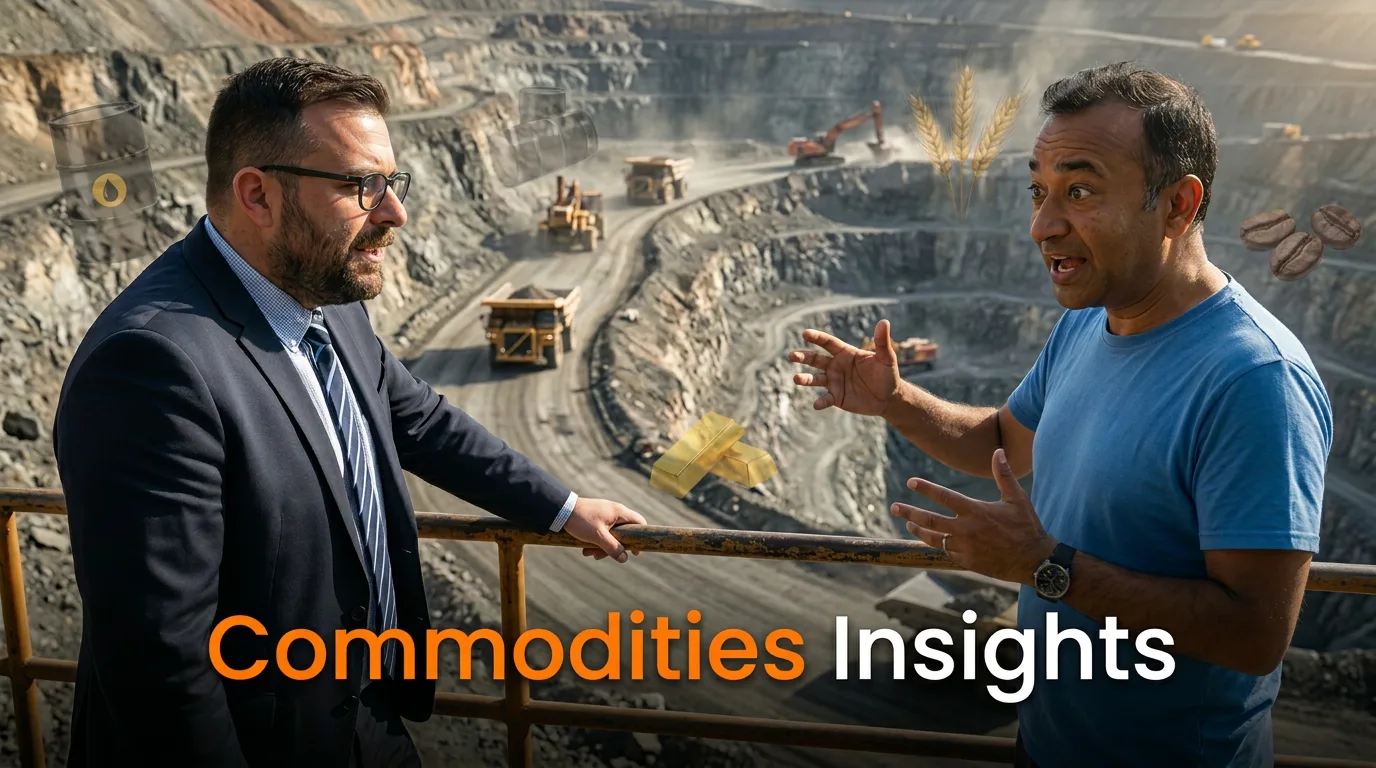
The mining sector has always lived at the intersection of geology, capital, and politics. But according to veteran mining analyst Joe Mazumdar, the industry is now entering a phase where geopolitics may matter as much as ore grades.
In this conversation, Mazumdar—editor and analyst at Exploration Insights—offered a sweeping assessment of today's commodities landscape. His conclusions challenge simplistic narratives about a “commodity supercycle.”
This is not one synchronized boom.
Instead, investors are witnessing a fractured and politically driven restructuring of global supply chains, where some commodities are becoming strategic weapons, others remain structurally constrained, and many mining equities still fail to reflect the bullishness in underlying metals prices.
For investors trying to position themselves in gold, uranium, copper, or critical minerals, Mazumdar's message is clear: the easy assumptions no longer work.
When investors discuss commodity cycles, they often frame them in familiar terms: early recovery, mid-cycle expansion, late-stage exuberance.
Mazumdar believes that the framework misses what is happening.
"Different commodities are reacting differently," he explains. The idea of one global supply-demand equation no longer captures reality because supply chains are fragmenting along geopolitical lines.
Historically, commodity markets functioned with a relatively straightforward logic: production emerged where economics were best, material flowed globally, and prices reflected aggregate supply and demand.
That world is fading.
Now, strategic competition is rewriting the rules.
Copper, rare earths, nickel, antimony, tungsten, lithium—many of these materials are no longer viewed simply as industrial commodities. They are increasingly treated as national security assets.
The critical shift is this: if Western economies deliberately exclude Chinese-controlled supply, then the actual available supply becomes much smaller than headline global production numbers suggest.
That changes everything.
A metal that appears adequately supplied on paper may, in reality, be structurally scarce for US or European buyers.
This explains why metals once considered niche are suddenly commanding strategic attention.
Nickel has moved beyond its stainless-steel identity and into battery and security discussions. Rare earths have become a geopolitical flashpoint. Antimony and tungsten—once ignored by mainstream investors—are back in focus because export restrictions can instantly destabilize downstream manufacturing.
The commodity market is no longer simply about geology.
It's about political access.
Geopolitics does not just affect supply. It affects cost.
Mazumdar points out that mining companies are only beginning to feel the next wave of inflationary pressure.
Energy is central to this story.
Diesel remains one of the largest operating costs for many mining companies, especially large open-pit operations in remote jurisdictions. When oil prices rise sharply, margins compress.
Historically, some miners hedged fuel exposure aggressively. Mazumdar recalls participating in diesel hedging during his time at Phelps Dodge and notes that some major producers once used hedging to reduce volatility.
Today, fewer companies maintain that discipline.
That means inflation hits faster.
The Q1 numbers may not fully show this effect, but Q2 and beyond could.
And rising costs are not confined to fuel.
High-pressure acid leach operations for nickel, leaching deposits in the Central African Copper Belt, remote logistics, and downstream processing all face inflationary pressure.
Ironically, higher costs can become bullish for commodity prices by forcing supply rationalization.
But for equity investors, rising commodity prices do not automatically translate into higher stock prices.
That disconnect is already visible.
Gold has captured investor imagination again.
Financial media talk about it constantly. YouTube channels obsess over it. Retail investors are paying attention.
Yet many gold equities remain frustratingly stagnant.
Why?
Mazumdar argues that investors are asking the wrong question.
The issue is not why "gold stocks" are underperforming.
The issue is which gold stocks investors own.
Major producers have dramatically outperformed many smaller names.
That is because generalist investors—the broad pools of capital now entering the sector—are not looking for speculative exploration upside.
They are looking for cash flow.
Companies like Newmont, Agnico Eagle, Barrick, Kinross, and AngloGold fit that requirement.
These companies offer:
That matters enormously.
A generalist fund manager allocating to gold exposure cannot easily build meaningful positions in illiquid juniors.
They can, however, buy large-cap producers immediately.
This helps explain why some junior or mid-tier names remain stuck at price levels seen when gold traded dramatically lower.
The capital is flowing elsewhere.
Smaller mining companies face a harsher reality.
Even in bullish metals environments, financing remains difficult.
Development-stage companies carry especially acute risk.
The problem is capital intensity.
Underground mining projects, technically complex developments, and infrastructure-heavy assets are increasingly vulnerable to cost overruns.
Mazumdar highlights several examples where project economics deteriorated as capital estimates ballooned.
This creates investor skepticism.
A resource investor may appreciate geological upside.
A generalist investor sees something else:
massive upfront capital requirements, uncertain timelines, execution risk, and potential shareholder dilution.
That is not attractive compared with established producers already generating free cash flow.
This bifurcation explains much of today's valuation disconnect.
The majors are thriving.
Many smaller companies remain stranded.
Gold's macro story remains tied to monetary policy.
Mazumdar emphasizes that real interest rates—not nominal rates—remain central.
If investors expect real rates to rise or stay elevated, gold becomes less attractive.
If they expect flat or declining real rates, gold strengthens.
Geopolitical crises add temporary fuel, but they are often fleeting.
The exception is when crises become continuous.
That appears to be today's environment.
Instead of isolated shocks, markets face rolling instability:
This creates persistent underlying support for precious metals.
But the macro catalyst that matters most remains rates.
Uranium enthusiasm has returned.
Spot prices have strengthened. Long-term contracting remains robust. Nuclear energy has regained legitimacy amid decarbonization and energy security concerns.
Small modular reactors have added another speculative dimension.
But Mazumdar sees substantial risks.
The most immediate is project execution.
Many uranium development projects face enormous capital requirements.
Saskatchewan, despite world-class deposits, presents formidable construction challenges.
Potential buyers may hesitate to acquire developers early.
Why?
Because history is littered with cost overruns.
A rational acquirer may prefer to wait until management teams struggle through development, valuations collapse, and distressed opportunities emerge.
Geopolitics adds another layer.
Niger and other African uranium jurisdictions carry meaningful political risk.
Australia remains cautious regarding Chinese investment.
Canada and the United States are increasingly sensitive to foreign strategic ownership.
This creates a financing dilemma.
China has capital and willingness.
Western governments increasingly resist Chinese participation.
That constrains development.
Meanwhile, Cameco's strategic move into downstream processing highlights a broader lesson.
The real value in many resource sectors may no longer sit at the mine gate.
It's downstream.
This may be Mazumdar's most important insight.
Western investors often focus obsessively on discovering deposits.
But in many strategic commodities, mining is only part of the equation.
Processing is where power lies.
China spent decades building dominance in refining, separation, chemical conversion, and downstream manufacturing.
That lead is immense.
Mazumdar estimates China remains decades ahead in certain technologies.
Rare earths illustrate the challenge perfectly.
Mining ionic clay deposits is relatively straightforward.
Turning material into commercially usable oxides, alloys, and magnets is not.
That expertise is concentrated in China.
This means Western nations may possess mineral endowment without practical supply chain independence.
The same applies in uranium conversion, nickel processing, battery materials, and copper refining.
Owning the rock is not enough.
You must control transformation.
Copper remains one of the most compelling long-term commodities.
Electrification, grid expansion, EV adoption, and infrastructure modernization all support demand.
Yet Mazumdar warns against assuming easy upside.
The industry faces chronic constraints:
Even if more mines get approved, concentrate still requires treatment.
And treatment capacity remains heavily concentrated in China.
Tariff policies further complicate North American supply chains.
Mazumdar suggests a coherent North American copper strategy would integrate:
Instead, fragmentation risks inefficiency.
Supply chains work best when integrated.
Political isolation makes that harder.
Copper remains structurally bullish.
But the path is messy.
Mazumdar sees meaningful improvement in US mining sentiment.
Permitting reform and policy changes have shifted investor perception.
Arizona stands out in copper.
Nevada remains the gold standard—literally and figuratively—for mining friendliness.
Why?
Because mining visibly supports local economies.
Tax revenue funds roads, infrastructure, and public services.
That creates social license.
Idaho is improving.
Minnesota offers opportunity, although environmental sensitivities remain.
Michigan appears more pragmatic in certain cases.
But investors must avoid simplistic assumptions.
Not every project benefits equally from federal policy changes.
Some projects remain structurally controversial regardless of administration.
Jurisdiction still matters at the asset level—not merely the national level.
One of the most nuanced parts of Mazumdar's analysis concerns government intervention.
Subsidized financing helps.
Cheap capital lowers development barriers.
But it does not fix project economics.
A 20-year mine must survive real market prices.
If global oversupply crushes margins, subsidies alone cannot save it.
What miners truly need is pricing certainty.
This is where strategic stockpile concepts become interesting.
If governments—or end users—guarantee minimum pricing for critical materials, project economics become more investable.
That changes the equation.
Mazumdar compares this to regulated utility returns.
Investor's fund infrastructure when returns are visible.
Critical minerals may require similar frameworks.
But implementation remains uncertain.
Asked about the greatest disconnect between commodity prices and equity valuations, Mazumdar points towards areas like nickel.
Prices remain relatively subdued despite strategic importance.
If EV adoption accelerates and supply insecurity worsens, certain assets could rerate dramatically.
But investors must distinguish between resource ownership and viable economics.
Again, downstream capability matters.
Again, geopolitical access matters.
Again, processing matters.
The same recurring theme appears across nearly every commodity.
Joe Mazumdar's worldview is not conventionally bullish or bearish.
It is selective.
His framework rejects simplistic narratives.
The old model said:
Find a deposit. Build a mine. Sell globally.
The new model says:
Can you permit it?
Can you finance it?
Can you process it?
Can you secure downstream buyers?
Can you avoid geopolitical disruption?
Can you generate free cash flow without destroying shareholder value?
That is a much tougher test.
For investors, the lesson is equally clear.
Commodity prices alone are no longer enough.
The winners will be companies that control economics, processing, jurisdiction, and capital discipline—not merely geology.
And in this new resource order, political intelligence may matter just as much as mining expertise.
Sign up to our free monthly newsletter to recieve the latest on our interviews and articles.
By subscribing you agree to receive our newest articles and interviews and agree with our Privacy Policy.
You may unsubscribe at any time.
We use cookies to improve your experience on our site. By using our site, you consent to cookies.
Websites store cookies to enhance functionality and personalise your experience. You can manage your preferences, but blocking some cookies may impact site performance and services.
Essential cookies enable basic functions and are necessary for the proper function of the website.
These cookies are needed for adding comments on this website.
Statistics cookies collect information anonymously. This information helps us understand how visitors use our website.
Google Analytics is a powerful tool that tracks and analyzes website traffic for informed marketing decisions.
Service URL: policies.google.com (opens in a new window)
Marketing cookies are used to follow visitors to websites. The intention is to show ads that are relevant and engaging to the individual user.
You can find more information in our Privacy Policy.