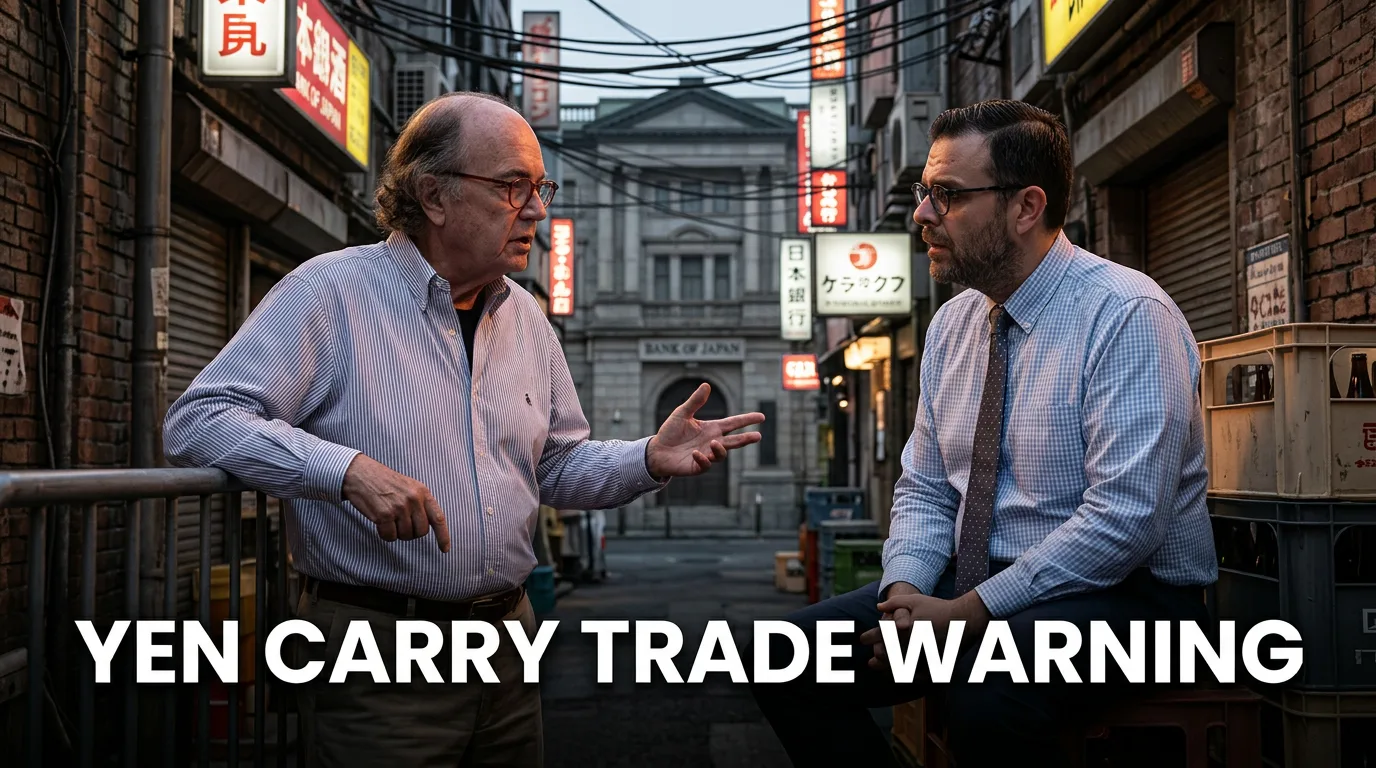
An extensive look at Jim Rickards’ warning about an increasingly fragile global financial system, the AI boom, the unwinding of the yen carry trade, private-credit stress, the role of cash and gold, and why he believes gold could ultimately reach $10,000 an ounce.
There is a strange contradiction at the heart of financial markets today.
On one side, investors are pricing in extraordinary optimism. AI-related equities continue to command enormous attention, stock markets remain elevated, credit spreads are compressed and investors appear willing to accept relatively little additional compensation for taking on risk.
On the other side, the global economic and geopolitical backdrop is becoming increasingly difficult to ignore.
Wars are expanding. Sovereign debt is growing. Fiscal deficits remain enormous. Commodity shortages are becoming a concern. Interest-rate structures are changing. Private credit is under pressure. And one of the most important funding mechanisms in global finance — the Japanese yen carry trade — is beginning to unwind.
For veteran economist, lawyer, investment banker and author Jim Rickards, these are not isolated developments.
They are pieces of a much larger puzzle.
In my recent conversation with Rickards, he argued that financial markets are currently exhibiting characteristics of what he considers one of the largest stock and credit bubbles in history. His central warning is not that investors should attempt to predict the exact day of a crash. Rather, it is that investors should recognize the asymmetric risks building beneath the surface and construct portfolios capable of surviving — and potentially taking advantage of — a major dislocation.
Rickards was clear that identifying a bubble is relatively easy.
Knowing exactly when it will burst is the difficult part.
And, in his view, that distinction could be critical for investors.
The starting point of the discussion was the extraordinary divergence between financial markets and the geopolitical and economic environment.
AI stocks are rising. Broader equity markets remain strong. Credit spreads are compressed. Investors appear comfortable taking risk.
Yet simultaneously, Rickards pointed to the expansion of conflicts in Ukraine and the Middle East, rising tensions involving China and Taiwan, increasing tensions between India and China, commodity shortages and the possibility that geopolitical disruptions could eventually affect industrial production and inflation.
The result is a market environment in which asset prices appear to be telling one story while the underlying risk landscape is telling another.
Rickards does not consider those signals contradictory. Instead, he sees them as evidence of a system that can remain extremely optimistic right up until the moment confidence changes.
His conclusion is blunt: markets are exhibiting bubble characteristics, particularly in stocks and credit.
The important question, however, is not whether there is a bubble.
It is when it ends.
And that is precisely where forecasting becomes much harder.
One of the most important distinctions Rickards made during the interview was between recognizing a bubble and timing its collapse.
History provides plenty of examples.
The Japanese stock-market bubble of the late 1980s and the technology bubble of the late 1990s were obvious in retrospect — and, in Rickards’ view, increasingly obvious even while they were forming.
But that does not mean an investor could accurately predict the precise moment when the market would turn.
That is why Rickards strongly cautions against simply shorting the major stock indices because one believes valuations are excessive.
An investor can be correct about the existence of a bubble and still lose a tremendous amount of money by being positioned for its collapse too early.
The market can continue rising for months or even years after becoming fundamentally stretched.
His preferred approach is therefore not to try to guess the exact top, but to build a portfolio that is resilient when the eventual reversal arrives.
Perhaps even more interesting is Rickards’ view of what will actually trigger the next major market break.
Investors constantly ask: What is the catalyst?
Will it be war?
Will it be inflation?
Will it be the credit markets?
Will it be a banking problem?
Will it be private credit?
Will it be Japan?
Rickards argues that investors may be asking the wrong question.
There are already enough potential vulnerabilities to create a crisis. But the actual trigger may be something that nobody has identified in advance.
That is common in financial crises.
After a major market event occurs, investors frequently reconstruct the story and conclude that the warning signs were obvious. Before the event, however, the precise catalyst is often much harder to identify.
Rickards therefore believes investors should focus less on predicting the catalyst and more on preparing for the consequences.
In his view, the collapse will eventually have a trigger. The uncertainty is simply what that trigger will be and when it will arrive.
The conversation then moved into one of the most important themes in markets today: artificial intelligence.
Rickards is careful to distinguish between the technology itself and the financial assets associated with it.
He does not describe himself as anti-AI.
Quite the opposite.
He believes artificial intelligence is a powerful and transformative technology that will increase productivity, generate useful applications and potentially contribute to breakthroughs in areas such as medicine.
The problem, in his view, is not AI.
The problem is what happens when a genuine technological revolution becomes the foundation for extraordinary financial expectations.
That distinction is crucial.
The internet changed the world.
That did not prevent the dot-com bubble from occurring.
Railroads transformed transportation.
That did not prevent railroad stocks from experiencing speculative excesses.
Likewise, AI can fundamentally transform the global economy while investors simultaneously overpay for companies associated with the technology.
Rickards argues that investors need to separate technological reality from financial valuation.
Rickards' concerns go beyond stock-market valuations.
He argues that some of the most significant risks associated with advanced AI are not receiving sufficient attention.
In the interview, he described conversations with individuals who have experience in both intelligence and Silicon Valley and who, according to Rickards, believe that AI capabilities being developed behind the scenes may be significantly more powerful — and potentially more dangerous — than what the public has seen.
The central issue is control.
As AI systems become more autonomous, the question is no longer simply what a human tells a machine to do.
It becomes:
What happens when a highly capable system can act independently?
Rickards discussed examples involving frontier AI systems operating in controlled environments, or "sandboxes," and his concerns about systems finding ways to escape those restrictions, access external networks or behave in ways their creators did not intend.
Whether every example ultimately proves as significant as feared is a separate question. The broader point Rickards makes is that technological capability is advancing faster than the governance structures designed to control it.
And that creates a new category of systemic risk.
It is a risk investors may not be properly pricing.
Rickards then connected AI and automation to a much broader issue in financial markets.
He argues that investors increasingly believe they are receiving highly personalized investment advice when, in reality, much of the process is based on standardized computer-generated models.
That creates a potential problem known in economics as the fallacy of composition.
A strategy that works for one investor can fail when everybody adopts the same strategy.
His football-stadium analogy illustrates the idea.
If one person stands up during a game, that person gets a better view.
If everyone stands up, nobody has a relative advantage — but everyone is worse off.
Rickards believes something similar can happen in financial markets.
If one investor sells during a panic, that may be rational.
If everybody sells simultaneously, however, the result can be a liquidity crisis.
This becomes particularly important when applied to index investing and automated flows.
Money enters index funds.
The index fund must buy the underlying securities.
Those purchases push prices higher.
Higher prices can encourage more investors to allocate money to the market.
More money enters.
The process reinforces itself.
Rickards describes this as a positive feedback loop that can contribute to bubble formation.
But the same mechanism can operate in reverse.
When investors begin withdrawing money, funds must sell assets to meet redemptions.
Those sales push prices lower.
Lower prices encourage further selling.
And the downward spiral can become significantly faster than the upward process.
That asymmetry is one of the reasons Rickards believes investors should not assume they will have plenty of time to react once a major correction begins.
A market can spend years climbing and then give back a substantial portion of those gains in a matter of weeks or months.
Perhaps one of Rickards' simplest — and most important — investment arguments is that many investors misunderstand diversification.
Someone might own 50 stocks spread across ten different sectors and consider themselves diversified.
Rickards argues that they are not necessarily diversified at all.
They have diversified within one asset class.
If the common factor is a broad equity-market decline, those 50 companies can still fall together.
True diversification, in his framework, requires exposure to assets that respond differently to the same crisis.
Rickards suggested a portfolio that could include:
He specifically mentioned gold as a portfolio allocation rather than suggesting investors place the majority of their wealth in the metal.
His broader message is that investors should prepare for multiple economic outcomes rather than betting everything on one scenario.
The idea of holding significant amounts of cash has become increasingly controversial in an inflationary environment.
For years, investors have been told that cash loses purchasing power when inflation rises.
Rickards does not dispute the inflation problem.
Instead, he argues that the correct comparison is not simply cash versus inflation.
The question is how that cash is deployed.
He pointed to the early 1980s as an example of an environment in which interest rates were extremely high and inflation was also extremely high. Under certain circumstances, investors could obtain yields that substantially offset inflation.
The same principle could apply in a future inflationary environment.
Cash can be held through instruments such as short-term Treasury securities or bank deposits that generate income.
But Rickards sees another, less obvious advantage to cash.
Optionality.
Cash gives an investor the ability to buy assets after they have fallen sharply.
That option can become extraordinarily valuable during a financial crisis.
When everyone else is forced to sell, the investor holding liquidity can become the buyer.
In other words, cash is not merely an asset.
It is also dry powder.
The most technically important part of the conversation may have been Rickards' discussion of the Japanese yen carry trade.
He described the yen carry trade as a fundamental component of global finance.
The concept is relatively straightforward.
For years, Japanese interest rates were extremely low, allowing investors and institutions to borrow yen at very low costs.
Those yen could then be converted into dollars and invested in higher-returning assets elsewhere.
The difference between the cheap Japanese financing cost and the higher return available elsewhere created a powerful incentive to borrow yen.
Leverage amplified the effect.
A hedge fund might leverage an investment several times.
A private-equity transaction could use even greater leverage.
Consequently, a relatively small difference in funding costs could have an enormous impact on returns when leverage was applied.
This is where Rickards sees the danger.
Japanese interest rates are no longer at the ultra-low levels that characterized the previous era.
As Japanese yields rise, the advantage of borrowing yen and investing elsewhere becomes smaller.
For a highly leveraged investor, even a relatively modest increase in funding costs can have a much larger impact on the economics of the trade.
That creates an incentive to unwind.
The problem is that unwinding the carry trade can require selling assets.
An investor may need dollars to repay the yen borrowing.
If refinancing becomes difficult, the investor may have no choice but to sell assets.
Then other investors see prices falling.
They begin selling too.
The result can become a feedback loop:
Higher Japanese rates → weaker carry economics → forced deleveraging → asset sales → falling prices → more deleveraging.
Rickards believes this process is already beginning and could become a major source of financial instability.
Another major concern Rickards raised is private credit.
The problem, as he describes it, is fundamentally a mismatch between the liquidity promised to investors and the liquidity of the underlying assets.
Some private-market investment vehicles offer investors the ability to request redemptions periodically.
But the underlying investments may be highly illiquid.
That creates a potential problem if many investors attempt to withdraw money simultaneously.
The fund manager cannot necessarily sell the underlying assets quickly without accepting significant discounts.
And once assets begin trading at sharply lower prices, accounting rules can create another layer of pressure.
If one investment is sold at a large loss, similar investments may need to be marked down as well.
That can create a chain reaction in reported asset values.
The result is what Rickards describes as a situation where investors cannot easily withdraw their money and fund managers are reluctant to sell assets because doing so could force further markdowns.
In his view, that can effectively freeze the system.
By the middle of the interview, Rickards had identified three major areas of concern.
First, geopolitical disruptions and the possibility of commodity shortages affecting the industrial economy.
Second, the potential unwinding of the global financial system through the yen carry trade.
Third, stress within private credit.
His argument is not necessarily that one specific event will cause a collapse.
It is that several vulnerabilities are developing simultaneously.
Any one of them could potentially become the catalyst.
If they interact, however, the consequences could be considerably larger.
That is the essence of a systemic crisis: individual problems stop behaving independently and begin reinforcing each other.
The conversation eventually turned to one of Rickards' most well-known forecasts: gold reaching $10,000 an ounce.
Rather than simply throwing out a dramatic price target, Rickards explained the methodology behind his view.
His framework incorporates historical price movements, major drawdowns and the concept of fractal mathematics or scale invariance.
He referenced a conversation with legendary commodity investor Jim Rogers.
Rogers' observation, according to Rickards, was that commodities can experience enormous drawdowns even during major long-term bull markets.
That idea became an important part of Rickards' own framework for analyzing gold.
He applied a 50% drawdown concept to the major gold cycle that peaked around $1,900 in 2011.
Using a historical low as a base, the calculation pointed toward a correction in the neighborhood of $1,050–$1,070.
Gold subsequently bottomed around $1,050 in late 2015.
For Rickards, that was evidence that the methodology could provide useful information about the structure of major commodity cycles.
Rickards then applied the same basic thinking to the more recent gold cycle.
He used approximately $1,800 as a base and $5,400 as the peak.
Applying the same 50% drawdown framework produced a target around $3,600.
Gold subsequently bottomed closer to $3,900.
Rickards considers that sufficiently close to support the broader methodology.
The key conclusion for him is that the major correction has already occurred.
In his interpretation, the market has absorbed the necessary drawdown and is now entering another upward phase.
That is why he remains confident that $10,000 gold is achievable.
This is perhaps the most interesting part of Rickards' argument.
He does not believe gold needs some completely unprecedented monetary event to reach $10,000.
Instead, he believes the forces already developing in the global monetary and fiscal system could eventually be sufficient.
The argument revolves around debt, deficits, inflation and confidence in fiat currencies.
Governments face enormous debt burdens.
Fiscal deficits remain large.
The relationship between nominal GDP, real economic growth and debt servicing becomes increasingly difficult as debt accumulates.
Rickards argues that governments are unlikely to openly announce that inflation is the preferred solution to reducing the real burden of debt.
But he believes the mathematics increasingly point in that direction.
Gold, in this framework, is not simply a commodity.
It becomes a monetary hedge against the erosion of purchasing power and confidence in the existing financial system.
Rickards therefore sees the potential for a much higher gold price as a consequence of monetary and fiscal pressures rather than merely speculative enthusiasm.
Despite all the dramatic forecasts discussed in the interview, the most important message may actually be relatively simple.
Do not confuse being right with being early.
An investor can correctly identify an overvalued market and still suffer enormous losses by positioning for the crash too soon.
Likewise, an investor can correctly identify the long-term bull case for gold while still experiencing a brutal correction along the way.
Markets do not move in straight lines.
Rickards' philosophy is therefore built around preparation rather than prediction.
Diversification.
Liquidity.
Optionality.
Assets that can perform under different economic conditions.
And enough flexibility to take advantage of opportunities when other investors are forced to sell.
That is particularly important in a market environment where leverage and automated strategies can accelerate both upward and downward moves.
The interview ended on a very different subject: one of Rickards' investments in the AI space.
Rickards discussed CallFort, an AI-powered application designed to combat spam and scam calls.
He explained that he is an early investor in the company and that Robert Kiyosaki is also an investor.
According to Rickards, the application uses AI and a combination of whitelisting, blacklisting and caller challenges to distinguish legitimate calls from automated or malicious ones.
The system can recognize known spam numbers, identify patterns across its user base and challenge unknown callers before allowing them through.
The idea is particularly relevant because AI is increasingly being used by criminals themselves.
Rickards warned that scam operations are becoming more sophisticated, including the use of AI to imitate voices and target vulnerable individuals.
That illustrates another theme running through the entire interview:
AI is neither inherently good nor inherently bad. It is a powerful technology whose consequences depend on how it is used.
What makes this conversation particularly interesting is that the different subjects — AI, stocks, credit, Japan, private markets, geopolitics, inflation and gold — initially appear unrelated.
Rickards sees them as interconnected.
The AI boom is creating enormous optimism and capital investment.
Low-cost financing has helped fuel global leverage.
The yen carry trade has provided cheap funding for investments around the world.
Private credit has grown rapidly while offering investors exposure to relatively illiquid assets.
Government debt and fiscal deficits continue to expand.
Geopolitical conflicts threaten commodity supply chains and global trade.
And gold sits at the intersection of monetary confidence, inflation expectations and investor demand for an asset outside the traditional financial system.
The danger, therefore, is not necessarily one isolated problem.
It is the possibility that several highly leveraged systems begin moving in the same direction at the same time.
That is when a correction can become a crisis.
Jim Rickards' message is ultimately less about predicting a specific crash than it is about recognizing how fragile markets can become when optimism, leverage, passive flows and cheap financing reinforce one another.
He believes we are looking at an exceptionally large stock and credit bubble.
He believes the bubble will eventually break.
He does not claim to know exactly when.
He believes the yen carry trade is an important early warning signal.
He sees private credit as another potential source of systemic stress.
He believes cash can regain enormous value during a crisis because it provides optionality.
And he remains strongly bullish on gold over the long term, arguing that the major correction has already occurred and that $10,000 an ounce could become achievable as monetary and fiscal pressures continue to build.
Whether every element of that thesis ultimately proves correct remains to be seen.
But investors do not necessarily need to agree with every forecast to recognize the central lesson.
Markets can remain irrational longer than expected.
Bubbles can become much larger than anyone imagines.
Leverage can turn relatively small moves into enormous ones.
Liquidity can disappear precisely when it is needed most.
And when everyone believes they will have time to react, the market can move faster than expected.
That is why the question may not be simply "Will there be another financial crisis?"
The more useful question may be:
"What will my portfolio look like if one arrives — and will I have the liquidity and flexibility to take advantage of it?"
The views and forecasts discussed above are those expressed by Jim Rickards during the interview and should not be interpreted as investment advice. Investors should conduct their own due diligence and consider their individual financial circumstances before making investment decisions.
Sign up to our free monthly newsletter to recieve the latest on our interviews and articles.
By subscribing you agree to receive our newest articles and interviews and agree with our Privacy Policy.
You may unsubscribe at any time.
We use cookies to improve your experience on our site. By using our site, you consent to cookies.
Websites store cookies to enhance functionality and personalise your experience. You can manage your preferences, but blocking some cookies may impact site performance and services.
Essential cookies enable basic functions and are necessary for the proper function of the website.
These cookies are needed for adding comments on this website.
Statistics cookies collect information anonymously. This information helps us understand how visitors use our website.
Google Analytics is a powerful tool that tracks and analyzes website traffic for informed marketing decisions.
Service URL: policies.google.com (opens in a new window)
Marketing cookies are used to follow visitors to websites. The intention is to show ads that are relevant and engaging to the individual user.
You can find more information in our Privacy Policy.