
Are investors approaching a turning point in the stock market? With AI valuations under scrutiny, concerns about excessive speculation growing, and investors reassessing risk, the question is whether markets are experiencing a healthy correction or moving toward a more significant downturn.
Financial markets have a remarkable ability to make investors believe that the present is different from anything that came before. Every major bull market has its own story, its own technological revolution, and its own reasons why traditional valuation measures supposedly no longer apply.
But beneath the headlines, the same forces have shaped markets for centuries: liquidity, leverage, greed, fear, and the psychology of the crowd.
The companies change. The technology changes. Trading becomes faster, and financial instruments become more sophisticated. Yet the emotional cycle of investing remains remarkably consistent.
The critical question today is not simply whether stocks are expensive or whether artificial intelligence represents a genuine technological revolution. It is where we stand in the broader market cycle—and what happens when investor confidence begins to weaken.
Stock market history is filled with examples of investors repeating the same mistakes.
From the South Sea Bubble of 1720 to the Wall Street crash of 1929, the dot-com collapse of 2000, and the global financial crisis of 2008, major market episodes have demonstrated how optimism can turn into speculation and how confidence can suddenly give way to panic.
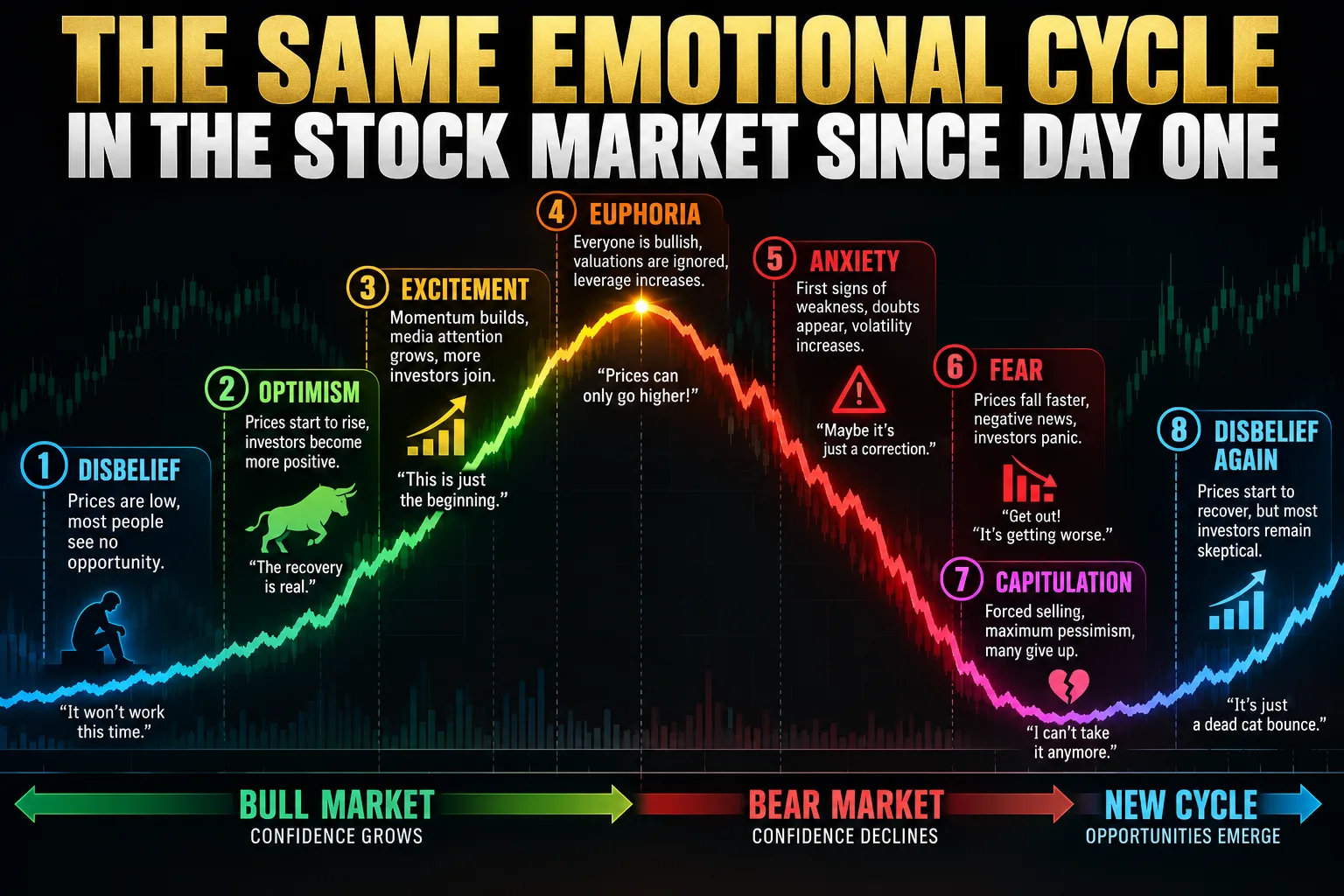
Each episode had different causes and consequences. Not every bull market ended in a crash, and historical comparisons cannot tell us precisely when the next downturn will begin. Nevertheless, a common emotional sequence appears repeatedly.
It often begins with disbelief.
Following a major downturn, investors remain cautious. Valuations may be more attractive, but memories of losses discourage people from buying. As prices recover, the first investors begin to recognize opportunities.
Gradually, optimism spreads. Rising prices attract attention, financial media become more positive, and investors who initially stayed on the sidelines begin participating.
Eventually, excitement can become euphoria. Investors stop asking whether assets are reasonably valued and start asking how much higher prices can go. Risk appears less threatening because recent experience has rewarded risk-taking.
Then something changes.
It might be rising interest rates, weaker corporate earnings, disappointing economic data, a credit event, or simply valuations that leave little room for disappointment. The original catalyst matters, but the damage often depends on how much confidence and leverage have accumulated beforehand.
Investors begin questioning the prevailing narrative. Volatility increases, prices weaken, and yesterday's confident buyers become today's sellers.
Anxiety turns into fear. Fear can become capitulation, particularly when leveraged investors are forced to liquidate positions.
Eventually, prices stabilize. The news may still be negative, but expectations have already deteriorated. A new recovery can begin while the majority remains skeptical.
That is the cycle: disbelief, optimism, excitement, euphoria, anxiety, fear, capitulation, and disbelief again.
The precise sequence varies, but the underlying psychology is familiar.
Determining the current stage of the market cycle requires more than looking at a single index or a few days of price movements.
Investors need to consider valuations, earnings expectations, market breadth, credit conditions, positioning, and the behavior of capital across asset classes.
One of the most important questions is whether enthusiasm for artificial intelligence has pushed parts of the stock market beyond what future earnings can reasonably justify.
AI has the potential to transform industries, increase productivity, and create entirely new business opportunities. That does not automatically mean every company associated with AI is attractively valued.
The same distinction was evident during the dot-com era. The internet genuinely transformed the global economy, but many internet-related investments became severely overvalued. Some companies failed, while others eventually became enormously successful. Investors who bought at excessive prices could still suffer devastating losses despite being correct about the technology's long-term importance.
The lesson is straightforward: a revolutionary technology can be real while the associated investment bubble is also real.
Today, the key questions include whether projected AI revenues justify the enormous capital expenditure involved, whether expected productivity gains will translate into sustainable profits, and whether investors have become too optimistic about the speed at which those benefits will materialize.
If expectations are already exceptionally high, even strong earnings growth may disappoint the market.
This is how a bull market can become vulnerable without the underlying economy immediately entering a recession.
Artificial intelligence has become one of the defining investment narratives of the current market cycle.
Major technology companies are investing heavily in computing infrastructure, data centers, semiconductors, energy supply, and AI-related services. Investors are attempting to identify the companies that will capture the greatest share of the resulting economic value.
The difficulty is that markets tend to discount the future well in advance.
When investors expect extraordinary growth, they may be willing to pay very high multiples for future earnings. That can support prices for a considerable period, especially when corporate results continue to exceed expectations.
But elevated expectations create a problem.
Suppose a company is valued on the assumption that its earnings will grow rapidly for many years. If earnings merely grow at a respectable rather than exceptional rate, the market may reduce the valuation multiple. The share price can decline even while the business remains profitable and continues to grow.
This distinction is crucial.
A stock does not need to be a bad company to become a bad investment. It only needs to be purchased at a price that assumes too much future success.
The warning signs to monitor include:
None of these indicators independently proves that an AI bubble is about to burst. Their importance lies in whether several begin deteriorating simultaneously.
One of the most revealing aspects of any market cycle is how investors respond when uncertainty increases.
During periods of strong confidence, cash can appear unattractive. It earns relatively little compared with rising equities, and holding it creates the fear of missing out on further gains.
As markets become more uncertain, however, the calculation changes.
Cash offers liquidity, flexibility, and the ability to take advantage of opportunities when valuations become more attractive. For investors who are concerned about a potential correction, it can also reduce exposure to short-term market volatility.
The attraction of cash should not automatically be interpreted as a prediction of an imminent crash. Investors hold cash for many reasons, including upcoming spending requirements, portfolio rebalancing, attractive short-term interest rates, and uncertainty about future returns.
Nevertheless, a broad shift toward liquidity can be an important part of a defensive investment strategy.
It also raises an important question: where is capital moving when investors reduce exposure to risk?
Some money may move into money-market funds, Treasury bills, or other short-duration instruments. Some may move into high-quality bonds. Other investors may simply reduce leverage or keep proceeds from asset sales in cash.
Importantly, selling pressure in one market does not guarantee that an equivalent amount of money flows directly into another. Cash balances, fund flows, market capitalization, and changes in asset prices are different measurements.
The objective is to understand whether investors are becoming more defensive, rather than assuming that every decline in one asset class represents an equal and identifiable inflow into another.
Interest rates and financial conditions have an important influence on the stock market.
When borrowing costs decline and liquidity becomes more abundant, investors may become more willing to accept lower prospective returns in exchange for growth. Companies can also finance investment more cheaply, while lower discount rates can increase the present value of future earnings.
The opposite can happen when monetary policy tightens or credit becomes less available.
Higher interest rates can make safe, short-duration investments more competitive with equities. They can also raise financing costs, put pressure on corporate margins, and reduce the present value of profits expected far into the future.
This is particularly relevant for growth stocks whose valuations depend heavily on earnings expected many years from now.
However, the relationship between interest rates and equities is not mechanical. Falling rates can support valuations, but they can also signal weakening economic conditions. Rising rates can pressure valuations, but they may also reflect strong economic growth.
Investors therefore need to distinguish between a benign adjustment in monetary conditions and a deterioration in the economy or financial system.
The combination of slowing earnings, tightening credit, declining market breadth, and deteriorating liquidity would be more concerning than any one indicator in isolation.
Headline stock-market indices can conceal significant differences between the performance of individual companies.
A market-capitalization-weighted index may continue rising even when a large proportion of its constituents are declining, provided that a relatively small group of heavily weighted companies performs strongly.
This makes market breadth an important indicator to monitor.
If a handful of large technology stocks are responsible for most of an index's gains, the headline performance may overstate the strength of the broader market.
Conversely, if more companies begin participating in a rally, it can suggest that investor confidence is spreading beyond a narrow group of market leaders.
A deterioration in breadth does not guarantee a crash. Leadership can remain concentrated for extended periods, and strong companies can legitimately outperform the rest of the market.
But when narrowing leadership coincides with stretched valuations, rising volatility, and weakening earnings expectations, investors have more reasons to examine their exposure carefully.
The question is not simply whether the S&P 500 or Nasdaq is rising. It is how many companies are participating in the advance, whether their earnings support their valuations, and whether market leadership is becoming increasingly fragile.
The most dangerous assumption investors can make is that a correction must follow a predictable schedule.
Markets do not operate according to a fixed timetable. Bull markets can continue far longer than skeptics expect, and apparently expensive assets can become even more expensive.
At the same time, corrections can begin before economic data clearly signal trouble.
The dot-com bubble is a powerful example of the difference between a real technological revolution and the prices investors paid for it. The 2008 financial crisis demonstrated how leverage, deteriorating credit quality, and interconnected financial institutions can amplify losses across the economy.
Other episodes have shown that markets can recover relatively quickly when a shock does not develop into a broader financial crisis.
These distinctions matter because not all declines create the same opportunities.
A 10% correction in an otherwise healthy market is different from a prolonged bear market accompanied by recession, falling earnings, forced deleveraging, and a banking crisis.
Investors who treat every decline as the beginning of a depression risk remaining on the sidelines for years. Those who assume every decline is a buying opportunity risk underestimating a deteriorating financial environment.
The challenge is to identify which conditions are changing.
Rather than attempting to predict the exact top, investors can monitor a combination of indicators that reveal whether market conditions are becoming more fragile.
1. Earnings revisions
Are analysts increasing or reducing their expectations for corporate profits? Sustained downward revisions can undermine valuations, especially when prices already assume strong growth.
2. Market breadth
Is the rally broadening to more companies, or is performance increasingly concentrated in a few large stocks?
3. Credit spreads
Are investors demanding greater compensation for holding corporate debt rather than safer government securities? A sustained widening in credit spreads can indicate rising concerns about default risk and economic conditions.
4. Volatility and positioning
Are volatility measures rising while investors remain heavily positioned for further gains? Sudden changes in positioning can accelerate market moves.
5. Liquidity and interest rates
Are financing conditions becoming more restrictive? Is the cost of capital changing in ways that challenge elevated valuations?
6. Investor behavior
Are investors becoming more defensive, increasing cash holdings, reducing leverage, or shifting toward higher-quality assets?
The greatest concern would be a convergence of negative signals rather than a single dramatic headline.
A substantial stock-market correction can have different consequences depending on its cause.
If valuations simply decline while earnings remain resilient, the result may be a healthier market with more attractive entry points.
If the decline is driven by recession fears, corporate earnings may fall at the same time as valuation multiples contract. That combination can produce much larger losses than either development alone.
A more severe financial shock can also trigger forced selling, margin calls, reduced lending, and a deterioration in consumer and business confidence.
These feedback loops help explain why some corrections remain contained while others develop into prolonged bear markets.
For long-term investors, the practical issue is whether their portfolios can withstand a substantial decline without forcing them to sell assets at depressed prices.
Liquidity needs, investment horizons, debt exposure, and portfolio concentration all influence that decision.
There is no universal cash allocation that suits every investor. Cash can provide valuable flexibility, but excessive cash holdings also carry opportunity costs and inflation risk over time.
The objective is not to eliminate every possible loss. It is to maintain enough flexibility to respond rationally when markets become unstable.
Not necessarily.
Gold is often viewed as a defensive asset, but its short-term behavior during market stress can be counterintuitive.
During a sudden liquidity crisis, investors may sell gold alongside equities to raise cash, meet margin calls, or reduce overall risk. This can produce an initial decline even when longer-term factors remain supportive.
Later, gold may benefit from declining real interest rates, a weaker currency, increased demand for diversification, or concerns about monetary and fiscal stability.
The sequence matters.
A stock-market correction driven by higher real yields and a stronger US dollar may produce a different outcome for gold than a downturn driven by financial instability and expectations of monetary easing.
Investors should therefore avoid assuming that gold must immediately rise whenever stocks decline.
The same caution applies to other assets. Government bonds, cash, gold, silver, and commodities respond to different economic forces and can behave differently across the stages of a crisis.
One of the most difficult aspects of investing is distinguishing between a genuine deterioration in fundamentals and an emotional overreaction.
At market peaks, investors often extrapolate recent gains far into the future. At market lows, they can extrapolate recent losses just as aggressively.
Both behaviors can create mispricing.
When investors become excessively optimistic, they may overlook risk. When fear dominates, they may sell assets without adequately considering their long-term earning power or underlying value.
The best opportunities often emerge when prices have fallen substantially, expectations have deteriorated, and the difference between market sentiment and underlying fundamentals has become unusually wide.
But identifying those moments requires patience and analysis.
A falling share price does not automatically make a company cheap. Earnings may continue to decline, debt may become unsustainable, or the original investment thesis may no longer be valid.
Likewise, a rising share price does not automatically make a market a bubble.
The objective is to evaluate price, fundamentals, expectations, and risk together.
The stock market has experienced technological revolutions, speculative booms, financial crises, recessions, and extraordinary recoveries for centuries.
The names and circumstances change, but the recurring forces of liquidity, leverage, greed, fear, and crowd psychology remain important.
Today, investors face a familiar challenge: determining whether enthusiasm has become excessive, whether valuations leave enough room for disappointment, and whether capital is beginning to move toward greater safety.
Artificial intelligence may deliver enormous economic benefits. Corporate earnings may continue to grow. The bull market may extend further than skeptics expect.
Equally, if expectations become too optimistic and financial conditions deteriorate, the market could become vulnerable to a significant repricing.
The available evidence must determine which interpretation is most credible. The emotional-cycle framework alone cannot establish the market's current stage or predict the timing of a correction.
The most important question is not whether a crash is coming tomorrow. It is whether investors are being adequately compensated for the risks they are taking today.
When confidence is high, risk can appear almost invisible. When fear takes over, opportunities can become difficult to recognize.
History suggests that both extremes deserve caution.
The investors who navigate these cycles most effectively are rarely those who predict every market top and bottom. They are those who understand the risks, avoid excessive leverage, preserve flexibility, and remain prepared to act when prices and fundamentals finally align.
Disclaimer: This article is for informational and educational purposes only and does not constitute investment advice.