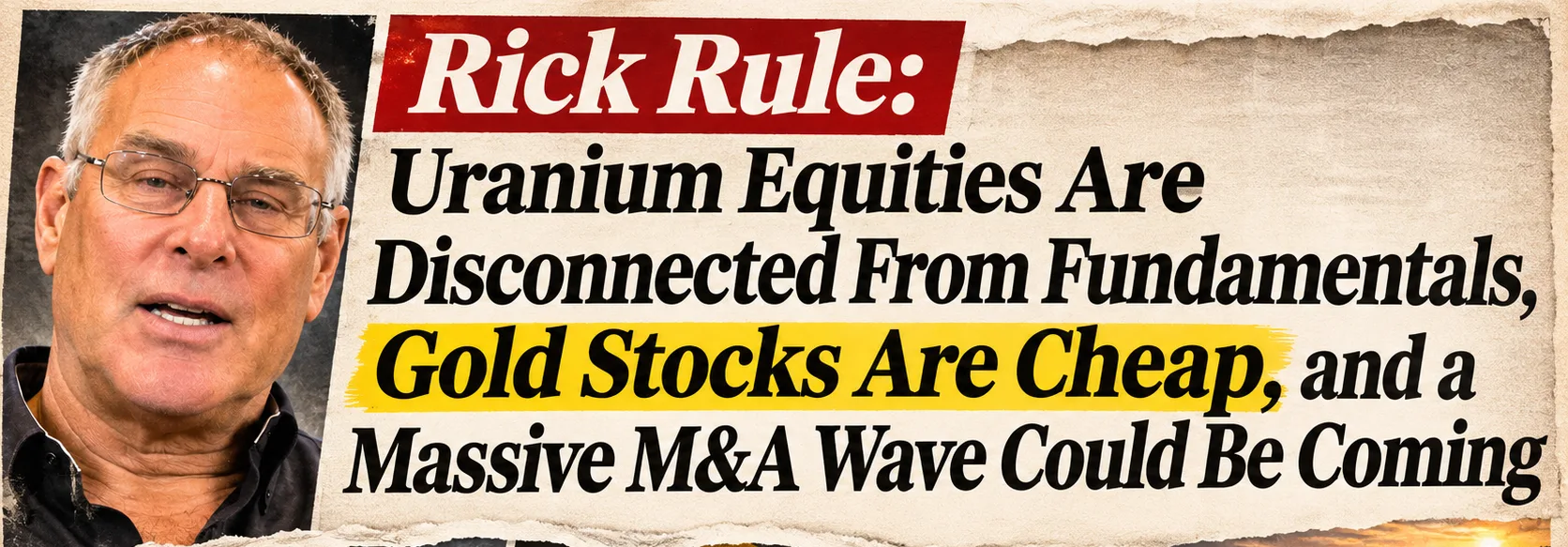
Legendary natural resource investor Rick Rule sees growing opportunities across uranium, gold, silver and copper equities despite a challenging capital markets environment. While warning that resource stocks could move lower before recovering, Rule believes some companies are already trading at valuations that offer compelling long-term opportunities. He also discusses his favourite mining investments, the future of copper M&A, overlooked jurisdictions and why investors should be looking beyond the most popular resource markets.
The natural resources sector is entering an interesting phase. After years of strong performance across several commodity markets, investor sentiment is becoming more cautious, financing conditions are tightening, and valuations across parts of the mining sector are coming under pressure.
Yet for investors with available capital and a longer investment horizon, this environment could create some exceptional opportunities.
In our latest talk, legendary natural resource investor Rick Rule shared his latest views on the global financial markets, uranium, gold, silver, copper, oil, lithium and emerging mining jurisdictions.
His central message was clear: although the market could still move lower in the near term, some resource equities are becoming difficult to ignore.
Rule is not attempting to predict short-term market movements. Instead, he is positioning himself for opportunities that could deliver meaningful returns over the next five years.
Rule sees two contrasting developments in the current market environment.
On one hand, investor sentiment has deteriorated, with investors becoming increasingly cautious about deploying capital into resource equities. On the other, significant amounts of liquidity remain available and could eventually return to the sector.
However, the junior resource financing market is showing signs of deterioration.
According to Rule, only a few weeks ago, even relatively small exploration companies could successfully raise $5 million to $10 million. Many financings were oversubscribed, demonstrating that institutional and sophisticated investors were still willing to provide capital despite declining share prices.
That environment appears to have changed.
Rule described how investment bankers, who previously had no difficulty filling financing books, have suddenly started approaching him with investment opportunities.
He believes two factors are contributing to this change: institutional investors have already deployed substantial amounts of capital into the resource sector over the past 18 months, while persistently elevated interest rates continue to weigh on commodity prices, particularly precious metals.
The consequence could be another difficult period for junior mining equities.
Rule believes 2026 could remain a relatively soft year for the sector and does not rule out further declines in share prices.
However, he is beginning to see opportunities worth pursuing.
"Sometimes stuff is cheap enough. And this is one of those times."
For investors, the distinction between market direction and individual company valuation is particularly important. Even if the broader market continues to weaken, certain companies may already offer attractive entry points.
One of the most interesting developments in the interview was Rule's renewed interest in gold investments.
After aggressively selling investments in October 2025 and selling physical silver in January 2026, he is now preparing to allocate capital back into the gold sector.
His preferred starting point is not the speculative end of the market. Instead, he is focusing on established companies with proven management teams, strong capital allocation records and attractive business models.
Three companies stand out:
Rule considers these among the highest-quality businesses in the global gold mining industry.
Franco-Nevada and Wheaton Precious Metals operate streaming and royalty business models, giving them exposure to precious metals production without assuming the same operating responsibilities as traditional mining companies.
Although both companies trade at premium valuations, Rule believes the market may be underestimating their future growth opportunities.
His argument is that the mining industry will require enormous amounts of capital to develop new copper and other metal projects. Streaming companies are uniquely positioned to provide that financing.
He specifically highlighted the approximately $4 billion transaction involving Wheaton Precious Metals and BHP as evidence of the financial strength of streaming companies.
In his view, the industry's major streaming transactions could become significantly larger over the next decade.
Agnico Eagle is attractive for different reasons. Rule particularly appreciates its capital allocation discipline, relatively low production costs and internally funded production pipeline.
Unlike companies that must constantly acquire new projects to sustain growth, Agnico Eagle has substantial opportunities to expand production through its existing operations.
Rule also sees potential in Barrick and Newmont, particularly through their respective asset portfolios and possible turnaround opportunities. However, he believes Franco-Nevada, Wheaton Precious Metals and Agnico Eagle offer more compelling investment propositions.
Importantly, he is also preparing to purchase physical gold.
His approach reflects a longer-term investment philosophy: he is willing to buy before the market reaches its bottom if the underlying valuation becomes attractive enough.
Beyond the major gold producers, Rule believes one of the most interesting opportunities could emerge in the mergers and acquisitions market.
The mining industry has underinvested in new production for an extended period. Meanwhile, gold prices have significantly improved the economics of existing assets.
Rule argues that many mining equities are still being valued using considerably lower gold price assumptions than the current market price.
He pointed to an example of gold trading around $3,800 per ounce while certain mining equities appeared to be valued using an assumed gold price closer to $3,000.
That difference creates a substantial valuation gap.
If gold prices remain elevated while smaller companies continue trading at discounted valuations, major producers with lower costs of capital could increasingly look to acquire smaller companies and their development projects.
Rule believes this could create a particularly attractive environment for investors positioned in smaller companies before acquisition activity accelerates.
"I think the M&A market has been very hot for the last two years, and I think it turns white hot if the equity prices stay low in 2027."
The implication is important: investors do not necessarily need to own the largest gold producers to benefit from the next phase of the gold cycle. Smaller developers with attractive deposits could become acquisition targets as major mining companies seek to replenish their production pipelines.
Uranium was another major topic of discussion, and Rule strongly agreed that uranium equities are becoming increasingly disconnected from the underlying fundamentals of the uranium market.
Several developments caught his attention.
First, the announcement of a new institutional uranium investment vehicle suggests that the market is attracting additional financial interest.
Rule was careful to emphasize that he had not yet reviewed the issuer's financial statements and was not recommending the investment vehicle. Nevertheless, he believes the growing financial interest in uranium is significant.
Second, he highlighted new long-term uranium contracts announced by Uranium Energy Corp. with US utilities.
The contracts were particularly interesting because they were reportedly priced at spot, suggesting that utilities are increasingly focused on securing supply rather than waiting for more favourable prices.
For Rule, the growing importance of the uranium term market is one of the most bullish developments for the industry.
Long-term contracting does not simply influence the uranium price. It also improves the financing environment for companies capable of delivering future production.
This is particularly important for developers that require substantial capital to advance their projects.
Rule believes that if uranium long-term contract pricing continues to strengthen, the market could begin assigning significantly higher valuations to established producers and high-quality developers.
He specifically mentioned Cameco, NexGen Energy, Mega Uranium and Paladin Energy as companies worth considering.
Regarding Cameco, Rule believes the company may not be as expensive as its headline valuation suggests.
He pointed to the potential value of its Westinghouse subsidiary and argued that a valuation based on a $120-per-pound uranium price could make Cameco look considerably more attractive.
For investors willing to accept greater development risk, he also sees opportunities among high-quality uranium developers.
One of the most interesting company-specific discussions concerned Denison Mines.
Rule openly admitted that he would like to own more Denison, highlighting several aspects of the company that he particularly appreciates:
However, there is one major obstacle preventing him from becoming a significant investor.
Denison is making a substantial technological bet on in-situ recovery (ISR) at depth.
While ISR is an established extraction method for certain uranium deposits, Rule wants to see convincing evidence that the technology can operate successfully at commercial scale in Denison's geological setting.
The company has demonstrated positive results at bench scale, but Rule emphasized that laboratory or bench-scale success does not automatically translate into commercial production.
He wants to see tangible evidence in the company's financial statements and cash flow before committing substantial capital.
"There's a huge difference between a bench scale and a commercial scale."
This is a particularly important distinction for resource investors.
A technically attractive project and a commercially successful mining operation are two very different things. Rule has spent decades investing in technology and processing companies, and he openly acknowledges that anticipating technological success has not been his strongest investment skill.
He would rather wait for proof, even if that means paying a higher share price later.
Rule also expressed caution regarding Energy Fuels.
He views the company as increasingly becoming a technology and processing business rather than simply a uranium producer.
Energy Fuels is pursuing an integrated strategy involving uranium, rare earths and battery-related materials.
While the strategy could create substantial opportunities, Rule is uncomfortable investing in a company simultaneously attempting to build several businesses.
His concern is execution.
He believes companies must demonstrate that their investments are generating tangible financial results before investors should assign substantial value to those ambitions.
For Rule, positive announcements and attractive corporate presentations are not sufficient.
He wants to see the results reflected in income statements and cash flow.
This is consistent with his broader investment philosophy: distinguish between what management hopes to accomplish and what the business has actually achieved.
Global Atomic was another uranium company discussed during the interview.
The company has experienced significant challenges associated with the political situation in Niger, despite owning a highly attractive uranium deposit.
Rule acknowledged the company's perseverance and suggested that Global Atomic was caught in the middle of a broader geopolitical conflict between Niger and France.
He believes the original agreement with the Nigerien government became more valuable as uranium prices increased, potentially changing the government's perception of the economics of the project.
Although Rule considers the deposit exceptional, he does not currently own Global Atomic.
His main concern is the need to carefully examine the revised agreement with the Nigerien government.
He wants to understand the contractual provisions, identify any potential risks and calculate a new net present value before comparing it with the company's enterprise value.
His comments underline an important lesson for uranium investors: a world-class deposit does not automatically translate into a successful investment.
Jurisdictional stability, contractual certainty and the government's willingness to honour agreements can be just as important as geology.
While Rule is not currently buying physical silver, he sees considerable opportunities in silver equities.
His reasoning is straightforward.
He purchased physical silver when sentiment was extremely negative and prices were considerably lower. Having bought around $20 per ounce, he does not consider the current price particularly attractive from a speculative perspective.
However, he believes several silver companies are trading at valuations that do not adequately reflect their underlying assets.
One of his preferred investments is Pan American Silver.
Rule particularly likes the company's exposure to approximately one billion ounces of high-grade silver resources in Argentina and Guatemala that are not currently producing.
He believes the market assigns very little value to these assets, effectively giving investors an attractive option on potential future development.
He also mentioned AbraSilver and Vizsla Silver as companies worth considering for investors willing to accept additional development and political risk.
Vizsla was particularly interesting.
Rule considers its Panuco project in Mexico one of the five best undeveloped silver deposits globally.
However, the project faces significant security and political challenges associated with the situation in Sinaloa and the presence of organized criminal groups.
He acknowledged that the risks remain substantial and that investors should not assume the situation has been resolved.
Nevertheless, he is buying Vizsla.
His investment thesis is that if the company can successfully navigate the existing challenges, the market could substantially revalue the project.
He believes the potential upside justifies taking that risk.
Rule's outlook for oil and natural gas was considerably more cautious.
He expects lower prices, partly because elevated energy costs have already reduced consumption in certain parts of the global economy.
He made an important distinction between developed and emerging markets.
In North America and Western Europe, consumers may complain about higher fuel prices but generally continue driving.
In frontier and emerging economies, however, higher prices can force consumers to reduce consumption or stop using vehicles altogether.
This demand destruction could become increasingly important if geopolitical hostilities in the Persian Gulf or between Russia and Ukraine begin to ease.
A reduction in geopolitical supply disruptions could bring additional barrels into a market where demand has already weakened.
Despite his negative outlook on prices, Rule does not believe oil equities are necessarily overvalued.
In fact, he suggested that a further decline in oil prices could create a significant buying opportunity.
"If that occurs, I will be a very large buyer."
Once again, his approach is to distinguish between the commodity outlook and the valuation of the companies producing it.
Lithium remains one of the sectors Rule is unwilling to re-enter aggressively.
His concern is not simply the current lithium price. It is the enormous number of deposits that have been discovered over the past decade.
When the industry began searching for lithium on a much larger scale, exploration companies identified approximately 120 to 150 deposits.
However, Rule believes the global market may ultimately have room for only five to ten of those projects.
That leaves more than 100 potential projects competing for limited capital and market share.
For junior lithium companies, this represents a substantial structural challenge.
Even if lithium prices recover, not every deposit will become an economically viable operation.
He also highlighted the potential impact of direct lithium extraction (DLE).
Major companies, including ExxonMobil and Chevron, are investing in lithium extraction technologies that could potentially recover lithium from brines and other sources.
Rule specifically mentioned Exxon's belief that its technology could already be commercially viable.
He was careful to acknowledge that he does not know whether these technologies will ultimately succeed at scale.
However, if they do, they could create additional competitive pressure for conventional lithium projects.
For Rule, the combination of excess deposits and technological uncertainty makes the lithium sector unattractive at the moment.
Copper remains one of the most interesting long-term commodity markets, but Rule's preferred investment strategy may surprise some investors.
Rather than concentrating exclusively on copper producers, he prefers companies that provide capital to the copper industry.
This is one reason he remains interested in Franco-Nevada and Wheaton Precious Metals.
The development of new copper mines requires enormous amounts of capital, and streaming companies could become increasingly important financing partners.
He also owns substantial positions in several large mining companies, including Southern Copper, BHP, Glencore and Rio Tinto.
These companies offer exposure to copper while benefiting from established operations, strong balance sheets and, in several cases, attractive dividend yields.
However, Rule is also interested in moving further down the quality spectrum.
He specifically mentioned NGEx Minerals as one of his larger copper positions based on current market value.
His reasoning is connected to his expectations for copper prices over the next five years.
If copper prices rise substantially, the industry will need to accelerate investment in new production.
Major producers may increasingly look to acquire advanced-stage development projects rather than relying exclusively on building new mines themselves.
This could create substantial M&A opportunities for investors holding quality copper developers.
However, Rule also highlighted an important risk associated with the large diversified miners.
While copper could benefit from stronger demand and constrained supply, other commodities within their portfolios may face weaker conditions.
He specifically mentioned iron ore, where additional supply from the Simandou project could create an oversupplied market over the coming years.
Investors buying diversified mining companies therefore need to consider both the positive and negative contributions of their different commodity exposures.
One of the most fascinating parts of the conversation concerned mining jurisdictions.
Rule explained that his risk tolerance has increased because he currently has substantial personal liquidity.
For years, he has followed a simple investment principle: look for commodities and assets that investors hate.
Historically, he could find opportunities in unpopular commodities such as uranium, potash and silver.
Today, he believes the situation is different.
There are fewer hated commodities, but several countries remain deeply unpopular among international investors.
He specifically highlighted the Democratic Republic of Congo and Bolivia as jurisdictions that increasingly interest him.
He also mentioned Iran and Russia as countries with potentially extraordinary natural resource opportunities, although he emphasized the considerable political, regulatory and practical complications associated with investing there.
For Western investors, sanctions, banking restrictions and geopolitical developments can make access to these markets extremely difficult.
However, Rule's broader point is that investors should not automatically dismiss a country simply because its reputation is poor.
He sees significant opportunities in Kazakhstan, Uzbekistan and Kyrgyzstan as well.
Kazakhstan is particularly attractive to him because he believes the country has made meaningful progress in developing its financial institutions, regulatory framework and mining industry.
He already has substantial investments in three exploration companies operating in Kazakhstan.
His explanation for the market's continued discount is particularly interesting:
"It is unrealistically negatively priced as a consequence of the fact that its name ends in stand."
For investors willing to undertake additional research, these jurisdictions could offer opportunities that are largely overlooked by mainstream capital.
Throughout the interview, one theme repeatedly emerged: successful resource investing requires patience, discipline and the ability to distinguish between attractive stories and attractive investments.
Rule openly admitted that he is often early when returning to the market.
When he starts seeing numerous opportunities and begins deploying capital, it frequently means that prices could still decline further.
However, he does not consider this a problem if the investment thesis is based on a five-year horizon rather than the next five weeks.
He has been an aggressive seller when valuations became excessive and is now gradually preparing to redeploy capital into selected opportunities.
He also emphasizes the importance of understanding the risks associated with individual companies.
His positions on Denison Mines and Energy Fuels demonstrate that he is unwilling to invest heavily in technological and processing businesses without tangible evidence of commercial success.
Similarly, his approach to Global Atomic highlights the importance of contractual and jurisdictional due diligence.
And his interest in Kazakhstan demonstrates his willingness to look beyond conventional mining jurisdictions when valuations become attractive.
These are important lessons for investors navigating a volatile resource market.
Towards the end of the interview, Rule also discussed the upcoming Boca Raton Natural Resources Investment Symposium.
Following the success of the 2026 event, he expects the next conference to be even stronger.
The conference will feature three major components:
Rule also highlighted the conference's unconditional money-back guarantee, which applies to in-person attendees, livestream participants and exhibitors.
He reported that the previous conference attracted more than 1,000 in-person attendees and approximately 2,300 livestream participants, with only three refund requests.
He considers customer satisfaction more important than simply maximizing attendance revenue.
Additionally, Rule continues to offer his free natural resource portfolio ranking service through Rule Investment Media.
Investors can submit their existing natural resource portfolios and receive a ranking from one to ten, together with comments on individual holdings.
Rick Rule's latest comments offer an interesting perspective on the current state of the natural resource investment sector.
He is not particularly optimistic about the immediate direction of commodity equities. Financing conditions are tightening, institutional investors have already deployed significant capital, and further share price weakness remains possible.
However, that does not mean he believes investors should remain on the sidelines.
Quite the opposite.
He is preparing to buy physical gold, increase exposure to selected gold equities and take advantage of opportunities across the resource sector.
Uranium equities appear increasingly disconnected from the underlying fundamentals, silver stocks offer attractive valuations, and copper developers could benefit from an acceleration in M&A activity.
At the same time, he remains selective, avoiding sectors where excessive project supply or technological uncertainty could undermine long-term returns.
Perhaps the most important takeaway is his investment horizon.
Rather than attempting to identify the exact market bottom, Rule is focused on acquiring high-quality assets at prices that could look exceptionally attractive several years from now.
As he put it:
"Short term stupid, long term smart is what has given me the financial position that I enjoy today."
For resource investors, that may be the most important lesson from this conversation.
Sign up to our free monthly newsletter to recieve the latest on our interviews and articles.
By subscribing you agree to receive our newest articles and interviews and agree with our Privacy Policy.
You may unsubscribe at any time.

We use cookies to improve your experience on our site. By using our site, you consent to cookies.
Websites store cookies to enhance functionality and personalise your experience. You can manage your preferences, but blocking some cookies may impact site performance and services.
Essential cookies enable basic functions and are necessary for the proper function of the website.
These cookies are needed for adding comments on this website.
Statistics cookies collect information anonymously. This information helps us understand how visitors use our website.
Google Analytics is a powerful tool that tracks and analyzes website traffic for informed marketing decisions.
Service URL: policies.google.com (opens in a new window)
You can find more information in our Privacy Policy.