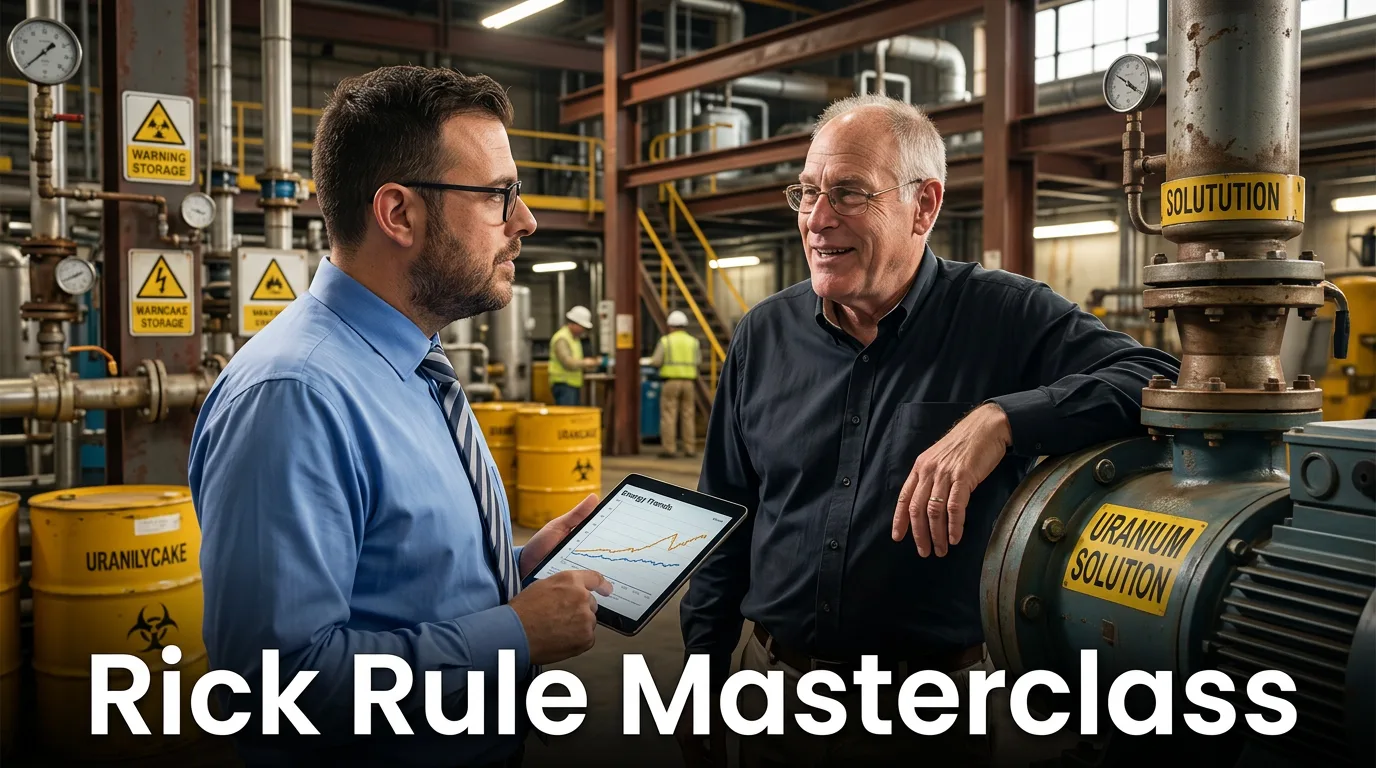
Few investors in the natural resource world command the kind of respect that Rick Rule does.
That respect was not built in a bull market. It was forged across multiple commodity cycles, sovereign crises, inflationary regimes, and decades of capital allocation in sectors where mistakes are punished brutally. Whether one agrees with all of his views or not, Rule remains one of the sharpest macro-resource minds in the market.
In our latest interview, Rule covered an extraordinary range of topics—from uranium and precious metals to sovereign debt, oil, copper, lithium, and even the character traits that define great capital allocators.
The result was less an interview and more a practical field manual for serious investors.
Here are the major takeaways—and, more importantly, what they mean for your portfolio.
One of the most revealing parts of the conversation came right at the beginning.
Rule explained that he had recently completed a liquidity-building phase. The geopolitical backdrop—particularly escalating Gulf tensions—introduced uncertainty that justified caution. But now that the liquidity cushion is in place, he is moving back into deployment mode.
That matters.
Because Rule's approach is not to chase momentum. He buys temporary dislocation.
His framework remains elegantly simple:
Buy what is hated. Buy what is misunderstood. Buy what is temporarily impaired—but fundamentally intact.
Right now, his attention appears focused on precious metals equities, particularly segments where recent weakness has created valuation disconnects.
But importantly, this is not the same bullish gold thesis many investors have been parroting for the past several years.
He is not simply saying “buy gold.”
He is positioning for corporate action.
That distinction matters enormously.
The first phase of a precious metals bull market usually rewards quality and scale.
The biggest names move first:
These companies represent safety, liquidity, and institutional confidence.
Rule's suggestion is that we may now be entering a different phase.
The second phase.
The phase where larger companies begin acquiring developers, single-asset producers, and strategically attractive deposits.
That is where outsized returns can emerge.
This is classic cycle behavior.
When majors generate excess cash flow from elevated metal prices, they face a strategic problem:
Replace reserves—or shrink.
Mining is a depleting business.
If you do not replace ounces, you slowly liquidate yourself.
That creates acquisition pressure.
Rule specifically pointed to recent market weakness in certain royalty and development names as examples of how temporary panic can create takeover opportunities.
This is important because retail investors often misunderstand mining acquisitions.
A company doesn't need to be perfect to become attractive.
It needs:
If Rule is correct, investors may want to think less about bullion proxies and more about companies that larger players cannot easily replicate internally.
That does not mean blindly buying speculative juniors.
It means understanding where acquisition economics make sense.
When asked about overlooked commodities, Rule's answer was immediate:
Uranium.
And his reasoning was compelling.
The geopolitical lesson of the 1970s oil embargo was energy security.
That lesson appears to be returning.
Energy markets today are once again forcing nations to confront uncomfortable dependencies.
And when governments think seriously about reliable, scalable, non-carbon baseload power, nuclear becomes difficult to ignore.
This is not a fashionable ESG slogan.
It is a practical engineering reality.
Wind and solar can contribute meaningfully.
But intermittent generation cannot fully replace dependable baseload capacity.
Meanwhile, AI infrastructure, electrification, and industrial reshoring are increasing power demand.
The arithmetic is becoming difficult to dismiss.
Rule's framing is particularly useful because he avoids the "immediate moonshot" narrative.
He explicitly noted:
This is not necessarily a one-year trade.
This is a decade-long investment thesis.
That distinction separates serious investors from speculators.
One of the most overlooked uranium catalysts remains Japan.
After Fukushima, many investors effectively wrote off Japanese nuclear demand.
That may prove to be a profound mistake.
Rule's thesis is straightforward:
As reactors restart, inventory previously treated as excess supply becomes strategic fuel inventory.
That is a major psychological shift.
Even more important is his point about leased fuel.
Some uranium that entered the market in recent years was not truly “sold.”
It was leased.
Meaning future replacement demand already exists.
That matters because supply-demand analysis often misreads inventory flows.
A pound appearing available today may represent a future liability tomorrow.
Commodity investors who ignore these nuances often misunderstand tightening cycles until prices have already moved.
The bigger lesson:
Headline inventory numbers can be deceptive.
Rule made an important distinction.
When uranium was universally despised, it was an obvious contrarian opportunity.
That phase has passed.
Uranium is no longer hated.
Institutional capital understands the thesis.
Governments increasingly support nuclear.
Retail investors discuss SMRs casually.
The easy re-rating has happened.
But that does not invalidate the structural opportunity.
Instead, it changes the game.
The next phase may reward:
This is where many investors make mistakes.
They assume “not hated” means “fully priced.”
Those are not the same thing.
A secular bull market can remain investable long after the contrarian phase ends.
Perhaps the most intellectually provocative section of the conversation centered on sovereign debt.
Rule's short-term view was surprisingly calm.
His long-term view was deeply concerning.
In the immediate future, he sees bond market instability as background noise.
But structurally?
A serious problem.
His central point is brutally simple:
If bonds grow faster than productive capacity, arithmetic eventually wins.
Investors frequently underestimate this because the past 40 years conditioned them differently.
From roughly 1982 to 2022, markets experienced one of the most forgiving financial eras in modern history:
That environment shaped expectations.
Many investors literally cannot imagine failed sovereign auctions, forced monetization, or structural confidence erosion.
Yet history contains many such examples.
Rule's warning is not that collapse is imminent.
His warning is more subtle:
The assumptions underpinning traditional portfolio construction may not hold forever.
That deserves serious reflection.
Rule's answer was revealing.
Not the currency first.
Almost everything else.
Higher rates pressure:
This is not theoretical.
Duration math is brutal.
If long-duration yields rise materially, capital losses become severe.
And if rates remain structurally elevated, economic activity slows through financing friction.
Investors often obsess over equity drawdowns while ignoring the fact that bond repricing can destabilize entire institutional ecosystems.
This is exactly what happened in various forms during previous tightening shocks.
The key takeaway for investors:
Interest rates are not just a macro statistic. They are the price of economic oxygen.
Rule was unsurprised by strong precious metals earnings.
Why?
Because analyst expectations were too low.
If forecasts were based on lower gold assumptions while realized prices remained materially higher, upside surprises were inevitable.
That part was predictable.
What comes next is more complicated.
Rule expects cost inflation.
Potentially severe cost inflation.
This includes:
Mining investors often focus obsessively on revenue sensitivity while underestimating cost creep.
That can be dangerous.
A rising gold price does not automatically translate into proportionally rising profitability.
Margins can compress if inflation accelerates.
Yet Rule still sees value.
Why?
Balance sheets improved.
Debt burdens fell.
Valuations remain historically attractive relative to asset value and cash flow.
That combination matters.
This suggests selectivity—not blind enthusiasm.
Copper remains one of the most compelling long-term commodity stories.
The structural thesis is well known:
Rule's interpretation is refreshingly pragmatic.
Yes, early-stage developers can generate spectacular returns.
But most investors should not pretend they are specialized mine financiers.
That is a hard truth.
There is a difference between:
The latter requires expertise.
For most investors, Rule's advice is straightforward:
Own the best producers.
If supply deficits are inevitable, quality operators benefit.
Simple.
This is an important Triangle Investor principle too.
Complexity does not equal sophistication.
Sometimes the obvious trade is the right trade.
Rule's oil view is nuanced.
Before geopolitical escalation, oil was broadly unloved.
That created an opportunity.
Now?
The setup is different.
War premiums distort price discovery.
Short-term oil can move violently based on headlines rather than fundamentals.
That makes tactical forecasting hazardous.
Yet structurally, Rule remains constructive.
His thesis:
Years of underinvestment in sustaining production capacity create future supply constraints.
This is a classic resource cycle dynamic.
Commodity shortages rarely emerge because demand surprises alone.
They emerge because capital discipline starves future supply.
Oil appears to fit that framework.
But investors must separate:
Those are different activities requiring different psychology.
Lithium is perhaps the most fascinating "maybe" in the interview.
Rule remains cautious.
Not because lithium lacks demand.
But because technology could reshape supply economics.
Specifically:
Direct lithium extraction.
If DLE scales economically, legacy assumptions about scarcity may collapse.
That matters enormously.
Many investors treat commodities as static.
They are not.
Technology changes cost curves.
Hydraulic fracturing transformed oil.
Heap leaching transformed gold.
DLE could transform lithium.
Rule's concern is especially notable because he explicitly acknowledges uncertainty.
He is not claiming DLE will dominate.
He is saying:
He does not want to bet against well-capitalized industrial giants pursuing it.
That is rational risk management.
One of the richest parts of the discussion had little to do with commodity prices.
It focused on people.
Rule's reflections on the investors who shaped him offer profound lessons.
From Lundin, Rule learned:
This matters because many investors confuse uncertainty with uninvestability.
Great investors ask:
Am I being compensated?
Note:
Is this perfectly safe?
This may be the most transferable lesson.
Beaty reinforced:
The combination is powerful.
Buying mediocre assets because they are cheap is not contrarian brilliance.
Buying exceptional assets when sentiment is broken—that is different.
Perhaps the most overlooked investment edge is reputation.
Rule's praise for Quartermain emphasized:
These are soft variables with hard consequences.
Deals happen because of trust.
Talent stays because of culture.
Permitting improves because of reputation.
This is not abstract idealism.
It is economic reality.
Rule's admission here was striking.
His instinct focused heavily on downside protection.
Sprott forced a broader lens:
Avoiding losses matters.
But wealth creation requires upside exposure.
This is crucial.
Many investors become so defensive that they mathematically eliminate meaningful returns.
The solution is not recklessness.
It is asymmetric opportunity selection.
Rule's enthusiasm for the next Lundin generation was unmistakable.
That should catch investor attention.
Resource investing often appears asset-driven.
In reality, repeat builders matter enormously.
Capital allocation skill compounds.
Network compound.
Execution experience compounds.
When proven families or operators repeatedly create value, investors should pay attention.
That does not mean blind hero worship.
It means acknowledging pattern recognition.
The most useful question is not whether Rick Rule is right about every detail.
No investor is.
The useful question is:
What actionable principles emerge?
Here are some.
Oil and uranium may both be bullish.
But for different reasons.
Time horizon matters.
Especially in copper and mining broadly.
Promotional narratives are plentiful.
Cash-generating quality is scarce.
Commodity price upside can be neutralized by operational inflation.
Margin matters.
Not just emerging market sovereign risk.
Developed market fiscal deterioration matters too.
Back repeat winners.
Character matters.
Execution matters.
Reputation matters.
This remains perhaps Rule's most enduring lesson.
Comfort is expensive.
Fear creates opportunity.
Rick Rule remains one of the rare investors who combines macro awareness, commodity expertise, historical memory, and practical capital allocation.
That combination is increasingly uncommon.
The most valuable insight from this conversation may not be uranium, gold, or sovereign debt.
It may be philosophical.
Markets reward discipline, patience, asymmetry, and the willingness to think independently.
That sounds obvious.
It rarely is.
And in a world increasingly driven by narrative momentum, those old principles may become more valuable than ever.
Sign up to our free monthly newsletter to recieve the latest on our interviews and articles.
By subscribing you agree to receive our newest articles and interviews and agree with our Privacy Policy.
You may unsubscribe at any time.
We use cookies to improve your experience on our site. By using our site, you consent to cookies.
Websites store cookies to enhance functionality and personalise your experience. You can manage your preferences, but blocking some cookies may impact site performance and services.
Essential cookies enable basic functions and are necessary for the proper function of the website.
These cookies are needed for adding comments on this website.
Statistics cookies collect information anonymously. This information helps us understand how visitors use our website.
Google Analytics is a powerful tool that tracks and analyzes website traffic for informed marketing decisions.
Service URL: policies.google.com (opens in a new window)
Marketing cookies are used to follow visitors to websites. The intention is to show ads that are relevant and engaging to the individual user.
You can find more information in our Privacy Policy.