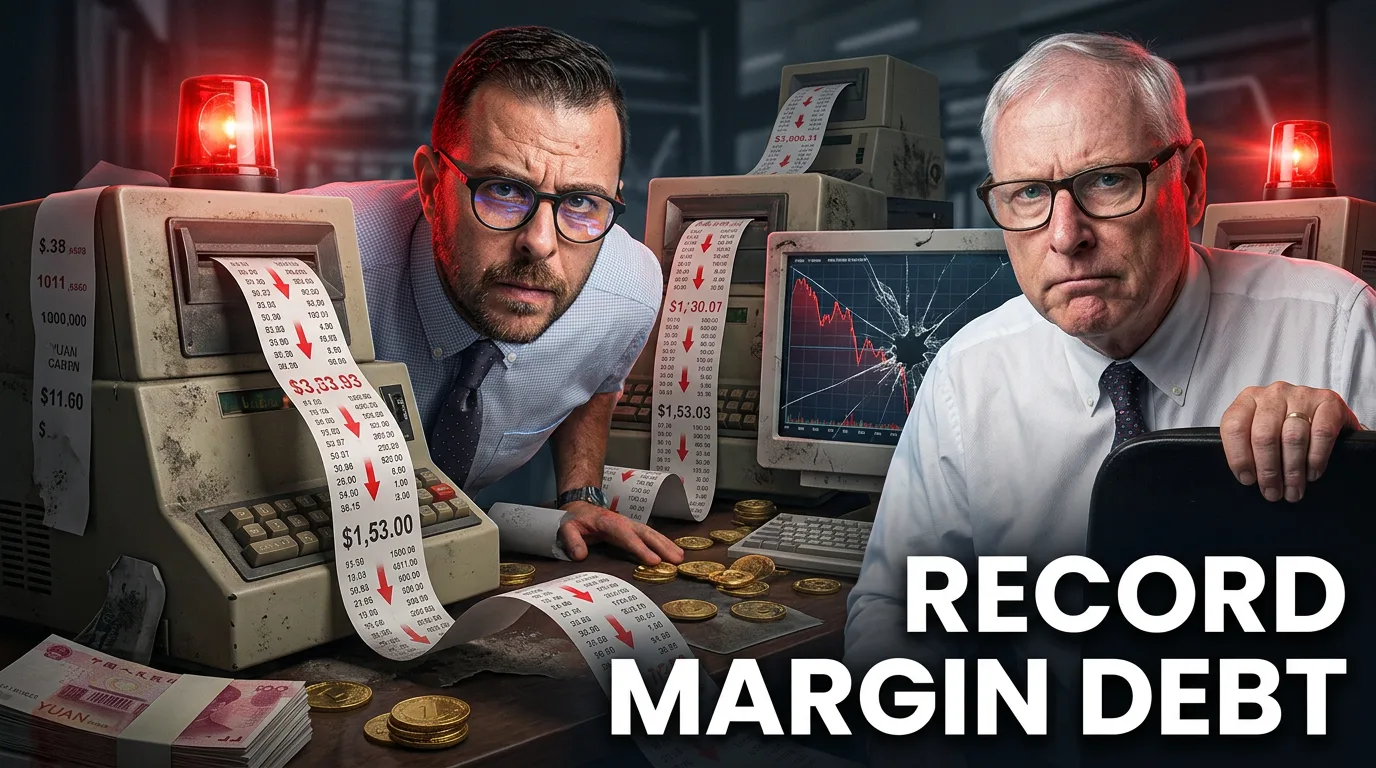
Financial markets have rarely looked stronger on the surface. U.S. equity indices continue trading near record highs, artificial intelligence remains the dominant investment theme, and investors appear increasingly confident that technology will continue driving global growth.
Yet beneath this optimism lies a growing concern.
U.S. margin debt has climbed to record levels, government debt continues expanding at an unprecedented pace, equity valuations remain elevated, and central banks are quietly accumulating gold at historic rates.
During a recent talk, veteran Swiss wealth manager Clive Thompson shared his perspective on today's investment landscape, explaining why investors should not panic—but should become significantly more selective about where they allocate capital.
His outlook combines caution with pragmatism. Rather than predicting an imminent financial collapse, Thompson argues that investors should prepare portfolios capable of surviving whatever economic environment emerges over the coming years.
One of the biggest concerns discussed during the interview was the unprecedented level of leverage throughout financial markets.
Margin debt allows investors to borrow money against their investment portfolios to purchase additional securities. While leverage magnifies gains during bull markets, it can quickly accelerate losses when prices decline.
According to Thompson, the existence of high margin debt alone does not automatically create a market crash.
Instead, the danger begins after prices start falling.
Once portfolios lose value, investors suddenly become less comfortable with the amount of debt they're carrying. Even before banks issue formal margin calls, psychological pressure encourages investors to reduce exposure by selling assets.
Those sales create additional downward pressure.
As prices continue declining, more investors begin receiving margin calls, forcing additional liquidation. The cycle feeds itself.
In Thompson's words, leverage becomes "self-fulfilling" because each wave of selling creates conditions that force even more selling.
This dynamic has been present during many of history's major market corrections.
While artificial intelligence remains one of the strongest investment themes of the decade, Thompson believes many investors have overlooked one important reality:
The semiconductor industry has always been cyclical.
Current AI demand has created significant shortages of advanced chips, allowing manufacturers to generate exceptional profits.
Investors have rewarded these companies with increasingly higher valuations based on expectations of continued earnings growth.
However, Thompson believes markets may be underestimating what naturally happens in every cyclical industry.
Higher prices encourage increased production.
Eventually supply catches up.
Then supply exceeds demand.
When that occurs, semiconductor prices fall, future profit expectations decline, and stock valuations often contract sharply.
Importantly, Thompson is not bearish on technology itself.
Instead, he explained that he has gradually reduced his exposure over recent months because the risk-reward balance has become less attractive than it previously was.
This measured approach reflects a broader philosophy:
Successful investing is rarely about predicting exact turning points.
It is about managing risk before markets force investors to react.
Given today's elevated leverage and expensive equity valuations, comparisons with the 1929 stock market bubble naturally arise.
Thompson acknowledges that nearly every major market crash shares common characteristics.
Excessive leverage.
Investor optimism.
High valuations.
Speculation.
However, he cautions against assuming that similar conditions automatically produce identical outcomes.
He compared the current environment with both 1929 and 1987.
Although the 1987 crash was actually larger in percentage terms than the 1929 collapse, it was not followed by a prolonged depression.
The Great Depression resulted from a much broader combination of financial and economic factors.
This illustrates an important lesson:
Markets may experience sharp corrections without triggering deep recessions.
Likewise, expensive valuations alone do not determine market timing.
One of Thompson's strongest historical examples involved the late 1990s technology bubble.
By 1996 and 1997, many investors already believed equities had become dangerously expensive.
Even Federal Reserve Chairman Alan Greenspan warned about "irrational exuberance."
Yet the market continued climbing dramatically for several more years before finally peaking in 2000.
Investors who exited immediately after Greenspan's warning missed enormous gains.
Eventually valuations corrected.
But timing remained impossible.
This is why Thompson avoids making absolute market calls.
Rather than abandoning equities entirely, he prefers adjusting portfolio exposure according to changing risks.
That distinction may be one of the most valuable lessons long-term investors can learn.
When discussing recession risks, Thompson presented a nuanced perspective.
Traditional economic indicators send conflicting signals.
Corporate profits remain surprisingly strong.
Meanwhile, employment data suggests underlying weakness.
He pointed out that although monthly payroll reports often receive positive headlines, comparing longer-term employment trends reveals that fewer people are working relative to population growth.
At the same time, companies continue improving profitability by increasing efficiency and reducing labor costs.
This creates an unusual environment where businesses can generate higher earnings despite softer employment conditions.
Government borrowing further complicates the picture.
The United States continues running enormous fiscal deficits while interest payments consume an increasing share of federal spending.
In Thompson's view, governments are effectively borrowing new money simply to service existing debt.
That process injects liquidity into the economy, supporting consumption and corporate earnings—for now.
Whether this ultimately delays recession or merely postpones necessary adjustments remains one of the biggest questions facing investors.
Sign up to our free monthly newsletter to recieve the latest on our interviews and articles.
By subscribing you agree to receive our newest articles and interviews and agree with our Privacy Policy.
You may unsubscribe at any time.

We use cookies to improve your experience on our site. By using our site, you consent to cookies.
Websites store cookies to enhance functionality and personalise your experience. You can manage your preferences, but blocking some cookies may impact site performance and services.
Essential cookies enable basic functions and are necessary for the proper function of the website.
These cookies are needed for adding comments on this website.
Statistics cookies collect information anonymously. This information helps us understand how visitors use our website.
Google Analytics is a powerful tool that tracks and analyzes website traffic for informed marketing decisions.
Service URL: policies.google.com (opens in a new window)
Marketing cookies are used to follow visitors to websites. The intention is to show ads that are relevant and engaging to the individual user.
You can find more information in our Privacy Policy.