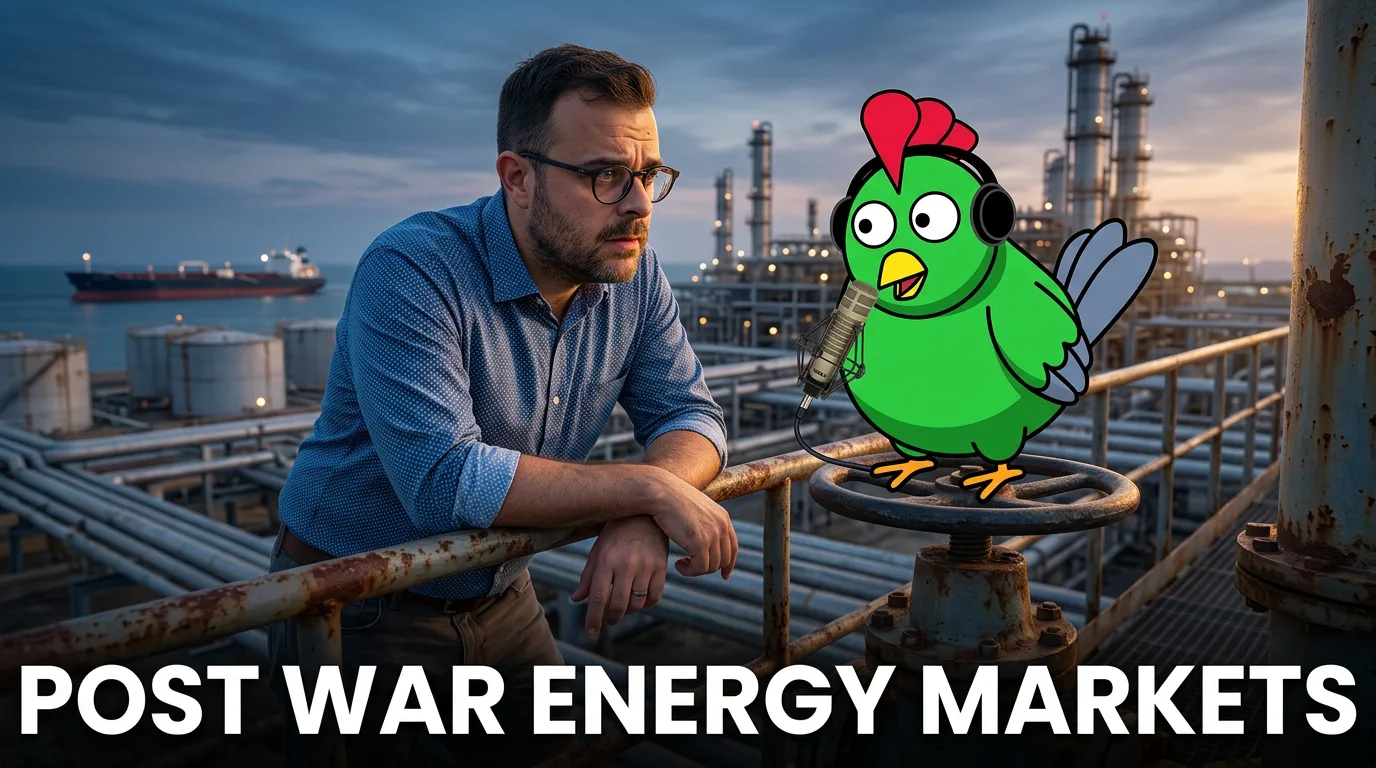
Macro and energy analyst Doomberg presented a provocative thesis: despite one of the most significant geopolitical conflicts in recent years, the global energy system emerged stronger, more flexible, and more resilient than most analysts anticipated.
At the center of his argument is a challenge to one of the market's most widely held assumptions—that geopolitical crises inevitably lead to sustained commodity price spikes. According to Doomberg, the recent conflict involving Iran demonstrated precisely the opposite. Instead of exposing fragility in global energy markets, the crisis revealed just how adaptable modern energy systems have become.
His broader conclusion extends beyond oil and gas. From copper and uranium to gold and agriculture, Doomberg argues that investors must rethink many conventional commodity narratives and pay closer attention to technological innovation, market adaptability, and long-term deflationary forces.
The first major topic discussed was the apparent agreement ending hostilities between the United States and Iran.
Doomberg characterized the conflict as strategically misguided and economically unnecessary. More importantly for investors, he believes the market response throughout the conflict revealed a critical truth: global energy systems are far more resilient than previously assumed.
Many analysts predicted catastrophic outcomes if the Strait of Hormuz were disrupted. Forecasts of $150 to $200 oil became commonplace. Yet despite elevated tensions and significant military activity, oil prices never approached those levels.
According to Doomberg, this failure of prices to respond dramatically should not be dismissed as market manipulation or irrationality. Instead, it should be interpreted as evidence that market participants correctly understood something many commentators missed:
The world has become much more capable of adapting to supply disruptions than traditional models suggest.
One of Doomberg's most intriguing observations concerns China.
He argues that China quietly demonstrated an ability to adjust its hydrocarbon consumption patterns in ways that surprised nearly every energy analyst.
Traditionally, oil markets have been viewed as highly vulnerable because of the world's dependence on crude oil. However, China appears capable of substituting between different hydrocarbon energy sources more effectively than expected.
In practical terms, this means:
According to Doomberg, China may have effectively "harmonized global hydrocarbon fungibility."
If true, this has enormous implications.
The ability to substitute among energy sources weakens the traditional scarcity premium embedded in crude oil prices. It reduces the probability of extreme spikes and challenges long-standing assumptions about supply vulnerability.
One of the strongest claims made during the interview was Doomberg's expectation that oil prices could trend materially lower over the coming year.
His argument is straightforward:
If the market could not generate sustained triple-digit oil prices during one of the most significant geopolitical crises imaginable, what future event realistically could?
This observation leads him to conclude that:
Consequently, geopolitical spikes should increasingly be viewed as temporary events rather than structural shifts.
Investors expecting every crisis to trigger a new commodity supercycle may therefore be disappointed.
A recurring theme throughout the discussion was Doomberg's skepticism toward commodity scarcity narratives.
His central principle is simple:
The long-term real price of most commodities trends downward.
This statement appears counterintuitive. After all, commodities are finite physical resources.
However, Doomberg argues that investors consistently underestimate the power of human innovation.
Every year industries become better at:
These improvements effectively increase available supply even when geological resources remain unchanged.
In his view, commodities should not be analyzed as fixed inventories but as products of continuously improving technological systems.
Copper has become one of the market's favorite bullish stories.
Supporters point to:
At first glance, the case appears compelling.
Yet Doomberg offers a powerful counterargument.
Most copper bulls argue that declining ore grades signal scarcity.
Doomberg disagrees.
When mining companies learn to profitably process lower-grade deposits, they unlock vast new reserves that were previously uneconomic.
In other words:
The result is not necessarily scarcity but abundance.
This perspective highlights a broader principle often overlooked in commodity investing: technological progress frequently overwhelms geological constraints.
Copper bulls frequently cite explosive future demand from artificial intelligence and renewable energy projects.
While Doomberg acknowledges these trends, he questions whether investor expectations have become excessive.
For example:
The market, he argues, often extrapolates optimistic scenarios too aggressively.
As a result, projected demand growth may not justify current bullish expectations.
Among all commodities discussed, uranium received perhaps the most favorable assessment.
Doomberg generally believes commodity prices trend lower over time, but uranium possesses unique characteristics.
The key factor is the role of the Sprott Physical Uranium Trust, which actively accumulates physical uranium.
This creates an unusual market structure where a major participant is intentionally removing supply from circulation.
Furthermore, uranium enjoys another advantage:
Its cost represents only a tiny fraction of nuclear power generation expenses.
Unlike oil or natural gas, a doubling or tripling of uranium prices would have minimal impact on electricity costs.
This means higher uranium prices are easier for the market to absorb.
While Doomberg stops short of making a direct investment recommendation, he clearly views uranium as one of the more interesting commodity markets today.
Silver occupies an unusual position.
Part industrial metal, part monetary asset, it exhibits characteristics of both categories.
The bullish case includes:
However, silver's supply dynamics are complicated because most silver is produced as a byproduct of other mining operations.
This means:
As a result, silver remains difficult to model compared with more straightforward commodities.
Gold stands apart from every other resource discussed.
Doomberg explicitly rejects the notion that gold should be analyzed as a commodity.
Instead, he views gold primarily as:
His long-term bullishness stems from a larger geopolitical trend: the transition from a unipolar world dominated by the United States toward a more multipolar international system.
In such an environment:
Gold's historical role makes it uniquely positioned to benefit.
For this reason, Doomberg remains significantly invested in physical gold despite his skepticism toward most commodity narratives.
Interestingly, Doomberg also discussed his personal investment philosophy.
Rather than concentrating heavily in publicly traded equities, he prefers a three-part framework:
Generate income through the conventional financial system.
Preserve purchasing power through:
Deploy capital where active involvement can influence outcomes.
This approach reflects a preference for ownership and control rather than passive exposure to financial markets.
The interview concluded with a discussion of agricultural commodities.
Rather than focusing on crops themselves, Doomberg highlighted a potentially disruptive technological trend: AI-powered weed control.
Emerging systems combine:
These technologies could eventually eliminate weeds without chemical herbicides.
If successful, such innovations would transform agricultural economics by:
Although still early-stage, Doomberg believes this area deserves close attention.
Perhaps the most important takeaway from the conversation is not about oil, copper, uranium, or gold individually.
It is about humility.
The Iran conflict exposed how easily investors can become attached to narratives that markets refuse to validate.
Many participants remained convinced that catastrophic energy shortages were imminent even as prices consistently signaled otherwise.
For Doomberg, the lesson is clear:
Markets often contain information that analysts do not.
When reality contradicts a thesis, investors must adapt rather than defend outdated assumptions.
In a world increasingly shaped by technological innovation, supply flexibility, and global interconnectedness, simplistic scarcity narratives may become less reliable than ever before.
The future of commodity investing may therefore belong not to those who predict shortages, but to those who best understand humanity's remarkable ability to overcome them.
Sign up to our free monthly newsletter to recieve the latest on our interviews and articles.
By subscribing you agree to receive our newest articles and interviews and agree with our Privacy Policy.
You may unsubscribe at any time.
We use cookies to improve your experience on our site. By using our site, you consent to cookies.
Websites store cookies to enhance functionality and personalise your experience. You can manage your preferences, but blocking some cookies may impact site performance and services.
Essential cookies enable basic functions and are necessary for the proper function of the website.
These cookies are needed for adding comments on this website.
Statistics cookies collect information anonymously. This information helps us understand how visitors use our website.
Google Analytics is a powerful tool that tracks and analyzes website traffic for informed marketing decisions.
Service URL: policies.google.com (opens in a new window)
Marketing cookies are used to follow visitors to websites. The intention is to show ads that are relevant and engaging to the individual user.
You can find more information in our Privacy Policy.