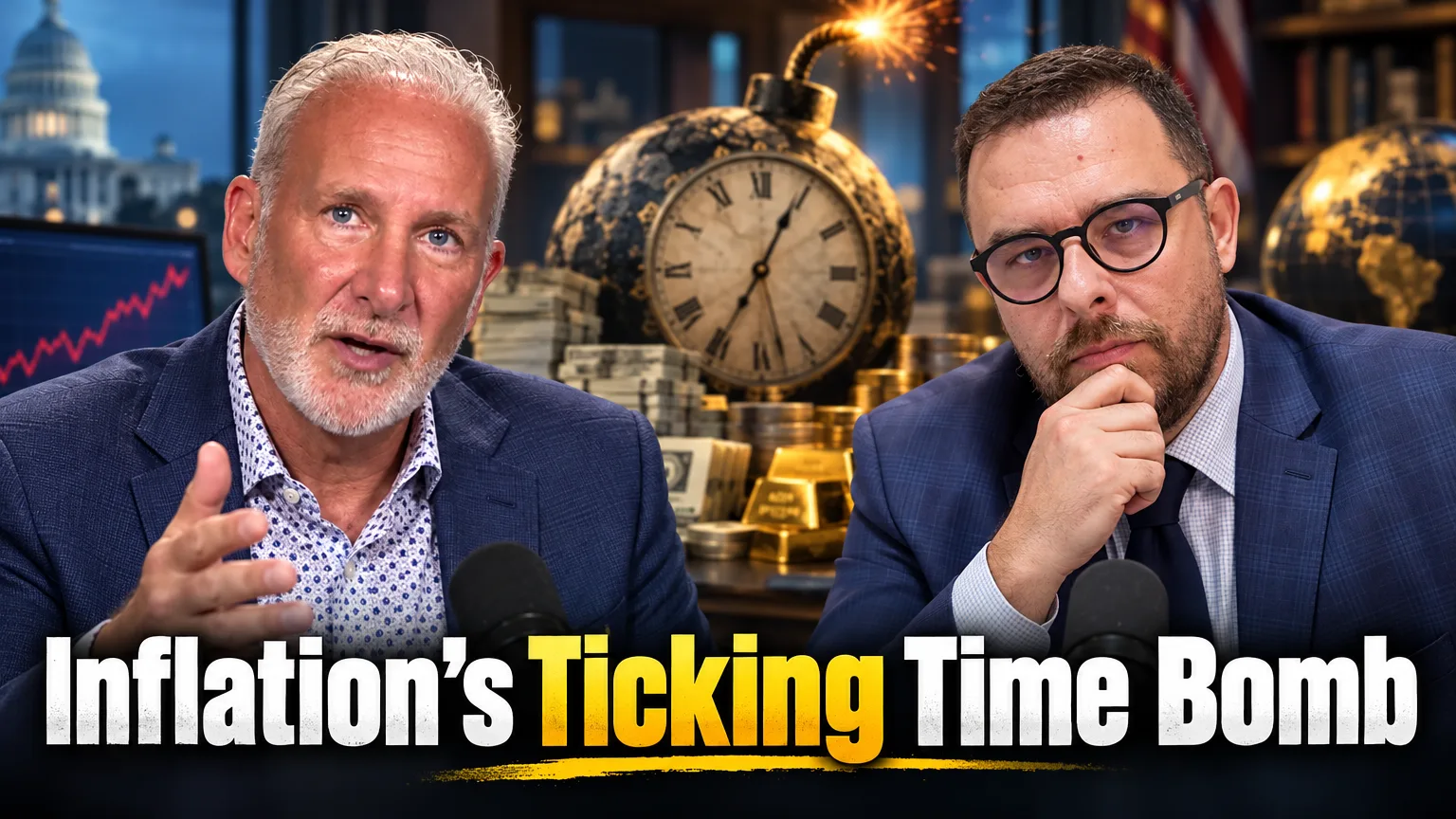
Against this macroeconomic backdrop, Schiff believes investors should prioritize assets that are not simply promises to pay money in the future.
Gold and silver remain central to his investment philosophy, but his recommended approach extends beyond precious metals.
He highlighted several categories of assets that could benefit from persistent inflation or offer diversification away from traditional financial assets:
Schiff's underlying principle is that investors should own productive assets rather than depend exclusively on fixed financial claims.
As he explained, “You need to own things, not a paper promise.”
This distinction is particularly important in an inflationary environment. Cash and fixed-income investments can lose real value when inflation exceeds the return they generate. Real assets, by contrast, may retain or increase their value in nominal terms, although their prices can also decline substantially.
For investors considering mining companies, the distinction between owning physical gold and owning shares in a gold producer is equally important. Mining equities can offer operational leverage to rising metal prices, but they also introduce company-specific risks, including cost inflation, permitting delays, political uncertainty and capital dilution.
Schiff's broader point is that portfolio diversification should extend beyond the conventional mix of domestic equities, bonds and cash.
At the end of the interview, Schiff returned to precious metals and argued that investors still had an opportunity to protect their portfolios.
He cited gold trading around $4,100 per ounce and silver around $56 per ounce at the time of the discussion, describing those levels as attractive entry points in the context of his longer-term outlook.
These prices reflect the interview's stated market levels and should not be treated as current live quotations.
Schiff believes both metals have further upside potential as investors confront persistent inflation, rising sovereign debt and concerns about the long-term purchasing power of fiat currencies.
For gold, the investment case rests partly on its role as a monetary asset outside the direct control of governments and central banks. Silver shares some of those characteristics but also has substantial industrial demand, making its price sensitive to both investment flows and economic activity.
The two metals can therefore behave differently across market cycles. Gold may attract demand during periods of monetary uncertainty, while silver can experience additional volatility because of its industrial applications.
For resource investors, Schiff's outlook also raises a broader question: if inflation remains persistent and investors increasingly seek tangible assets, could the benefits extend to the wider commodity complex?
That possibility would depend on individual supply-and-demand balances. Energy, copper, agricultural commodities and precious metals have different market drivers, and inflation alone does not guarantee rising prices across every commodity.
Nevertheless, Schiff's emphasis on real assets aligns with the view that portfolios should be prepared for an environment in which monetary stability cannot be taken for granted.
Energy was another important topic in the interview, particularly in the context of rising global demand and geopolitical uncertainty.
Schiff believes the energy market is already facing structural challenges because supply may not be sufficient to meet future demand without substantial additional investment.
He argued that the world needs to invest more in energy production and capacity. At the same time, geopolitical conflicts involving Russia and Ukraine, as well as instability in the Middle East, complicate the outlook.
These disruptions can affect production, transportation, trade flows and investment decisions, increasing uncertainty for both energy producers and consumers.
The implications extend well beyond the oil and gas industry.
Energy is a fundamental input across the economy. Higher prices can increase transportation costs, raise manufacturing expenses, affect food production and reduce the amount of disposable income available to households.
For businesses, energy inflation can squeeze margins unless higher costs can be passed on to customers. For governments, higher energy costs can create political pressure to provide subsidies or other forms of financial assistance.
Schiff's argument is that energy should not be viewed solely through the lens of short-term geopolitical events. If demand continues to grow while supply investment remains inadequate, the resulting price pressure could persist even when individual disruptions ease.
For investors, this creates a potential distinction between temporary price spikes and a longer-term structural tightening of energy markets.
The latter would require sustained demand, insufficient supply growth and investment conditions that do not quickly eliminate the imbalance.
It could also create opportunities for companies involved in energy production, infrastructure and other essential resources, although outcomes will vary considerably between businesses.
The rapid expansion of artificial intelligence has created enormous expectations for future productivity growth, but Schiff believes the economic payoff remains uncertain.
He acknowledged that AI could transform the economy, potentially delivering substantial improvements in efficiency and reducing the cost of producing goods and services.
However, he questioned whether companies investing heavily in data centers, computing infrastructure and AI development will ultimately generate enough income to justify their spending.
The distinction is important because technological progress and investment returns are not the same thing.
A technology can transform society while many of the companies investing in it fail to earn adequate returns. Investors may overestimate future demand, underestimate competition or pay valuations that assume profits far beyond what businesses can realistically deliver.
Schiff drew parallels with earlier investment cycles, including the expansion of the railroads and the development of the internet.
Both technologies transformed economic activity. Yet the economic importance of a technology did not guarantee that every company associated with its development would become profitable.
The AI boom could follow a similar pattern if companies commit enormous amounts of capital based on expectations that ultimately prove too optimistic.
One risk he highlighted is that the current investment race may encourage businesses to spend defensively. Companies may feel compelled to build computing capacity simply because they fear competitors will gain an advantage if they do not.
This can create an environment in which capital spending accelerates before the ultimate commercial returns are established.
Another uncertainty is the potential for future competitors to deliver AI services at much lower costs. Companies that invest heavily today could find themselves competing with businesses that use more efficient technologies or require substantially less capital.
In that scenario, the benefits of AI could spread across the economy even as some early investors struggle to recover their investment.
Schiff summarized the problem through a fundamental economic question: what must society sacrifice to finance the expansion?
Schiff argued that the capital committed to AI infrastructure cannot be considered in isolation from the broader economy.
Building data centers, purchasing computing equipment and expanding electricity capacity require labor, materials, financing and energy. Those resources must come from somewhere.
If businesses and governments allocate trillions of dollars to AI-related infrastructure, that capital cannot simultaneously be used for every other potential investment.
The issue becomes especially significant in a high-interest-rate environment. Businesses that borrow heavily to finance infrastructure must generate sufficient future cash flow to cover financing costs and deliver acceptable returns to shareholders.
Meanwhile, higher interest rates affect the valuations of growth companies because a greater share of their expected profits lies in the future.
Schiff used the example of building a bridge to illustrate the timing problem. The construction process requires substantial resources before the infrastructure begins delivering its intended economic benefits.
AI infrastructure presents a similar challenge. The investment costs are incurred today, while the productivity gains may take years to materialize and may not be distributed evenly across the economy.
If the returns are substantial, the investment could prove justified. If the returns disappoint, however, businesses may be left with expensive infrastructure, excess capacity and debt that must still be serviced.
This concern connects directly to Schiff's broader argument about government borrowing. He believes an economy already carrying enormous debt may be particularly vulnerable if it attempts to finance another major investment cycle at elevated interest rates.
The AI boom, in his view, should therefore be assessed not only by its technological potential but also by the cost of capital, the expected returns and the opportunity cost of the resources being committed.
Schiff also pointed to what he described as significant weakness beneath the surface of the US stock market.
He referenced a social media post in which he noted that 479 US stocks had reached 52-week lows. He argued that many companies were already experiencing bear-market conditions, even as technology and AI-related stocks continued to attract investor attention.
According to Schiff, the sectors facing particular pressure included homebuilders, real estate, banks, financial companies and various consumer-oriented businesses.
By contrast, he identified technology, AI-related companies and energy as areas where share prices were performing comparatively well.
This divergence matters because headline stock indexes can obscure substantial differences between individual sectors and companies.
When a relatively small group of large companies drives index performance, investors may interpret the broader market as healthier than it actually is. Meanwhile, smaller businesses and economically sensitive industries may struggle with higher financing costs and weaker consumer demand.
Schiff argued that the majority of S&P 500 constituents were trading more than 20% below their respective highs at the time of the interview, a threshold commonly associated with bear-market conditions.
That claim was his characterization of market breadth during the discussion and would need to be checked against contemporaneous market data to establish the exact proportion of companies affected.
Nevertheless, the distinction between index performance and the performance of its constituents is an important consideration for investors.
A narrow rally can leave portfolios vulnerable if leadership changes or the strongest-performing companies experience a significant correction.
Schiff also highlighted weak consumer confidence, arguing that households were under pressure from rising living costs and expensive borrowing.
He described consumer confidence as being at its lowest level in approximately 75 years of recorded data. That historical comparison was cited by Schiff during the interview and should be verified against the relevant confidence index and survey period before being used as a standalone statistical conclusion.
His broader argument was that households are struggling with the cumulative effects of inflation, interest rates and the cost of maintaining their standard of living.
Higher mortgage rates can make housing less affordable, while expensive consumer credit can discourage spending on discretionary purchases. At the same time, households facing higher prices for essential goods may have less money available for other expenses.
If consumer confidence weakens and spending slows, businesses can experience declining sales, while companies with substantial debt may face additional pressure.
Schiff contrasted these concerns with political claims that the United States was experiencing an exceptionally strong economic boom. In his view, the behavior of consumers and the weakness of numerous individual stocks suggest a more complicated picture.
For investors, this reinforces the importance of looking beyond headline economic growth and index performance to examine market breadth, household finances, credit conditions and corporate earnings.
Schiff maintained his longstanding skepticism toward Bitcoin during the interview.
When asked what was supporting the cryptocurrency's price, he acknowledged that he was surprised it had not already fallen further. He suggested that investor optimism and expectations of another rally could be helping sustain demand.
He did not indicate that he had changed his position.
Schiff believes Bitcoin remains vulnerable to a significant decline and suggested that the US midterm elections could become a catalyst for renewed weakness.
His political scenario was that a shift in congressional control could reduce the political support for the cryptocurrency industry, particularly given its growing association with Republican political interests and the Trump family.
He argued that a less supportive political environment could undermine investor expectations regarding future regulation and government policy.
This remains Schiff's political and market forecast, not an established prediction of election outcomes or their effect on cryptocurrency prices.
Bitcoin's performance is influenced by multiple factors, including liquidity, investor risk appetite, institutional demand, regulation and broader financial conditions. Political developments can matter, but their impact depends on the policies actually pursued and how markets interpret them.
For investors, the broader lesson is that expectations can support asset prices for extended periods, but a change in those expectations can also produce substantial volatility.
Schiff's comments also fit his wider macroeconomic framework. If higher interest rates and financial stress cause investors to reassess speculative investments, assets whose valuations depend heavily on continued demand could face pressure.
However, the interview did not establish a specific Bitcoin price target or a precise timetable for a potential decline.
Schiff emphasized that the problems he sees in the US economy are not confined to one country.
He pointed to France, Japan and other heavily indebted economies as examples of governments that benefited from years of low interest rates but could face greater difficulty as borrowing costs rise.
The underlying issue is common across countries: governments can accumulate substantial debt when financing is inexpensive, but the long-term cost of that debt becomes more difficult to manage when interest rates increase.
France faces its own fiscal and political challenges, while Japan has a distinct economic history characterized by prolonged low interest rates and exceptionally high public debt relative to the size of its economy.
Although these countries have different financial structures and policy options, Schiff believes the broader pattern is similar.
Governments have borrowed heavily while the cost of financing remained low, often postponing difficult fiscal decisions. If borrowing costs remain elevated, interest expenses can consume a larger share of government revenue and reduce room for other spending.
Schiff argued that the consequences of excessive borrowing are becoming increasingly difficult to avoid.
He also rejected the idea that a future financial crisis would necessarily demonstrate an inherent failure of capitalism. Instead, he attributed the conditions for such a crisis to government intervention, monetary distortions and policies that encourage excessive borrowing and inflate asset bubbles.
That interpretation is Schiff's economic viewpoint. The causes of financial crises are debated, and actual outcomes can reflect a combination of fiscal policy, monetary policy, financial regulation, private-sector decisions and external shocks.
Still, his warning highlights the risk that financial systems can become fragile when debt expands faster than the capacity to service it under less favorable economic conditions.
For investors, international diversification may help reduce dependence on a single country's economic trajectory, although it does not eliminate exposure to global financial stress.
In the final part of the discussion, we asked Schiff about the possibility of a prolonged inflation cycle lasting another decade or longer.
Schiff considered such a scenario realistic.
His argument is that persistent inflation could remain a defining feature of the economic environment if governments continue accumulating debt and monetary policy remains constrained by the need to support financial markets.
He did identify one potential counterforce: a dramatic increase in productivity driven by AI.
If AI substantially reduces the cost of producing goods and services, it could exert downward pressure on prices. In theory, sufficiently strong productivity improvements could offset some of the inflationary pressure created by monetary expansion.
Schiff illustrated the point by considering a hypothetical situation in which AI reduces prices by 20% annually while inflationary forces push prices upward by 22%. Under those simplified assumptions, the combined effect would still leave prices rising by approximately 2%.
This is a conceptual illustration rather than an economic forecast. Actual price changes would depend on how productivity gains affect individual sectors, wages, profit margins, demand and the broader price level.
Schiff's argument is that monetary inflation can prevent consumers from fully benefiting from technological progress.
If technological advances make goods and services cheaper to produce, consumers could benefit through lower prices, while businesses could benefit from lower costs and potentially higher sales volumes.
However, if monetary and fiscal policies continue generating substantial inflationary pressure, some of those gains may instead appear as slower price increases rather than outright declines in prices.
This is an important distinction between nominal and real economic growth. An economy can experience technological progress while households continue struggling with affordability if the prices of essential goods and services remain elevated.
Schiff also challenged the idea that falling prices are necessarily harmful to businesses. In his view, companies can remain profitable in a deflationary environment if their production costs decline alongside selling prices and their margins remain sustainable.
Whether that happens depends on the source of deflation. Productivity-driven price declines can benefit consumers and businesses, while deflation caused by collapsing demand and financial distress can create serious economic problems.
The broader question is whether technological progress will be sufficient to counteract the inflationary effects of debt accumulation, government spending and monetary policy.
Schiff believes investors should not assume that it will.
The interview presents a consistent investment framework built around three concerns: the purchasing power of money, the sustainability of debt and the vulnerability of financial assets to higher interest rates.
Schiff's conclusions are decidedly bearish toward the current economic and monetary system, but several of the risks he identifies are relevant to portfolio analysis even for investors who disagree with his more extreme forecasts.
The following considerations emerge from the discussion.
1. Examine real returns, not just nominal returns.
An investment generating a positive nominal return may still lose purchasing power if inflation is higher. Investors should consider how their portfolios may perform under different inflation scenarios.
2. Understand interest-rate exposure.
Bonds, banks, real estate companies and highly leveraged businesses can be sensitive to changes in interest rates. The impact depends on asset duration, financing structures, debt maturities and cash flow.
3. Assess government debt and fiscal sustainability.
Rising interest expenses can affect future budgets, taxation and government borrowing requirements. The consequences may differ across countries, creating potential opportunities as well as risks for international investors.
4. Diversify across assets and regions.
Schiff favors precious metals, resource companies, energy, industrial metals, agriculture and selected international equities. Such diversification can reduce dependence on individual markets, although each category carries its own risks and correlations can rise during market crises.
5. Distinguish technological progress from investment returns.
AI may transform the economy without guaranteeing that every company investing in it will earn attractive returns. Capital expenditure, competition, financing costs and future cash flow matter alongside technological potential.
6. Look beyond headline stock indexes.
Market breadth, smaller-company performance, sector weakness and consumer conditions can reveal vulnerabilities that are less obvious when a handful of large companies dominate index returns.
7. Avoid treating forecasts as certainties.
Schiff expects severe financial and monetary consequences from current policies. Investors should evaluate his thesis against alternative scenarios, independently verified data and their own investment objectives rather than assuming that a crisis must occur on a particular timetable.
Peter Schiff's message in his latest Triangle Investor interview is that the global economy faces a difficult combination of persistent inflation, excessive borrowing and financial assets vulnerable to higher interest rates.
He believes the Federal Reserve has limited room to maneuver because aggressive tightening could expose weaknesses in banks, mortgages and other debt-dependent sectors, while monetary easing could prolong inflationary pressures.
He also questions the long-term sustainability of US fiscal policy and argues that the dollar's reserve-currency position should not be taken for granted.
For investors, his preferred response is to diversify beyond conventional paper assets, with particular emphasis on gold, silver, natural resources and selected international investments.
At the same time, Schiff's warnings about AI spending, stock market weakness and Bitcoin reflect his broader concern that investor expectations may be running ahead of economic fundamentals.
His forecasts of an inevitable sovereign debt crisis and a potentially severe housing collapse are not certainties. The timing and severity of any financial adjustment will depend on policy decisions, economic growth, interest rates, bank resilience and the behavior of investors.
Nevertheless, the central question raised by the interview is difficult to ignore: how long can governments, businesses and households continue relying on expanding debt when the cost of financing that debt is rising?
For resource investors in particular, Schiff's perspective provides a framework for examining the potential role of precious metals, energy, mining and other tangible assets in an uncertain monetary environment.
Whether his most bearish predictions prove correct or not, the relationship between debt, interest rates, inflation and purchasing power remains central to understanding the risks facing the global economy.
This article is based on the Triangle Investor interview with Peter Schiff. The market figures and economic estimates attributed to Schiff reflect statements made during the discussion and have not all been independently verified. This article is for informational and educational purposes only and does not constitute investment advice or a recommendation to buy or sell any security or asset.
Sign up to our free monthly newsletter to recieve the latest on our interviews and articles.
By subscribing you agree to receive our newest articles and interviews and agree with our Privacy Policy.
You may unsubscribe at any time.

We use cookies to improve your experience on our site. By using our site, you consent to cookies.
Websites store cookies to enhance functionality and personalise your experience. You can manage your preferences, but blocking some cookies may impact site performance and services.
Essential cookies enable basic functions and are necessary for the proper function of the website.
These cookies are needed for adding comments on this website.
Statistics cookies collect information anonymously. This information helps us understand how visitors use our website.
Google Analytics is a powerful tool that tracks and analyzes website traffic for informed marketing decisions.
Service URL: policies.google.com (opens in a new window)
You can find more information in our Privacy Policy.