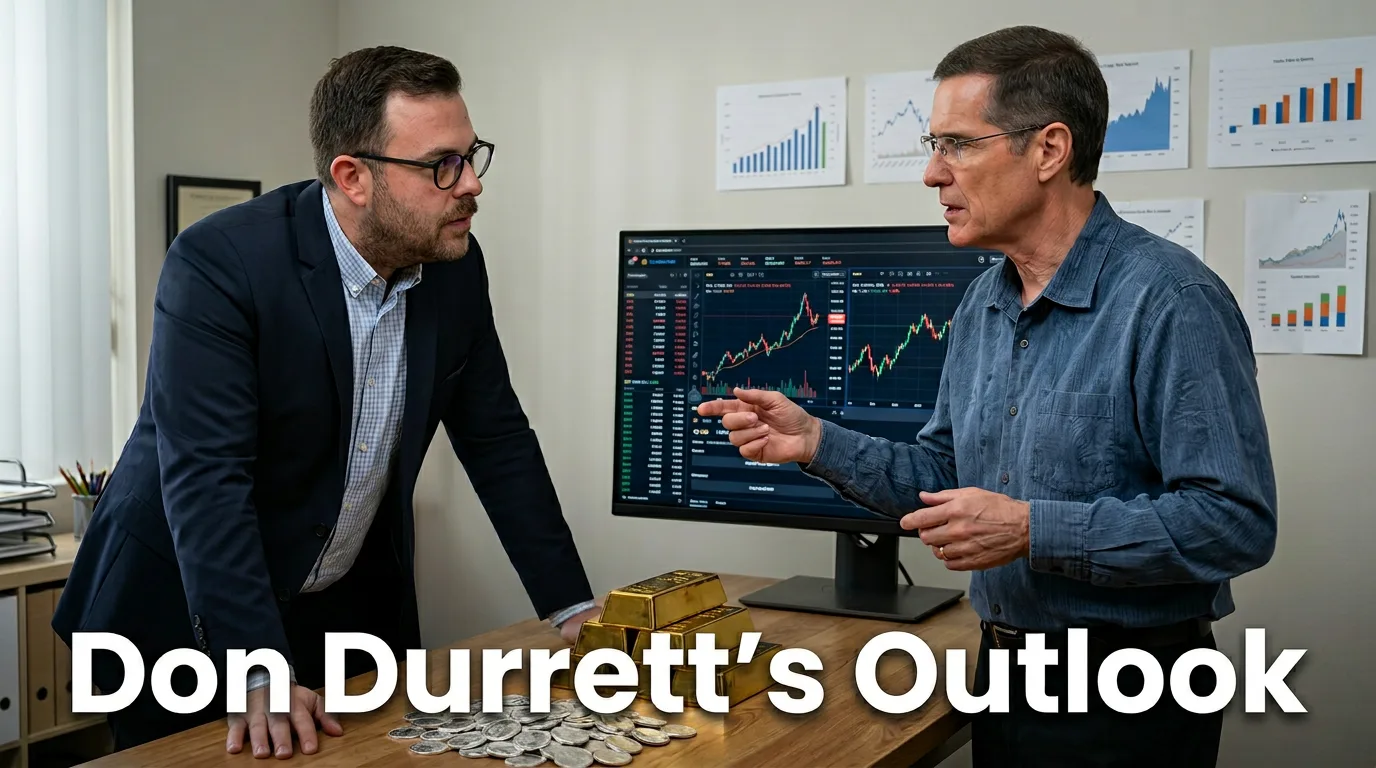
In a deeply insightful chat, veteran precious metals analyst Don Durrett delivers a sobering assessment of today’s global financial system. His message is clear: the world is approaching a tipping point driven by excessive debt, distorted economic data, and dangerously inflated asset prices.
This isn’t just another market cycle—Durrett argues it may mark the end of a decades-long economic paradigm.
Below is a comprehensive,deep dive into his macro thesis, market predictions, and investment strategy for navigating what could be one of the most volatile financial periods in modern history.
At the core of Durrett’s outlook lies a fundamental critique of modern economics:
He frames this as a structural flaw:
👉 Economic growth today is increasingly synthetic, not organic.
Historically, economies thrived on productivity and innovation. Today, they are propped up by borrowing and spending—creating what Durrett calls a “debt bubble” decades in the making.
Despite positive headlines, Durrett argues the real economy is far weaker than advertised.
This leads to a misleading narrative:
👉 “Strong consumer spending” is often just recycled government debt
With GDP growth hovering near 1–2%, Durrett believes the U.S. is already in a stealth recession—one masked by accounting tricks and media optimism.
Durrett identifies three systemic bubbles that could trigger a major financial reset:
The U.S. equity market—tracked by indices like the S&P 500—is, in his view, dangerously overvalued.
👉 This suggests a market fueled more by liquidity than fundamentals.
The federal government is running:
Durrett highlights a critical flaw:
👉 The system depends on constant refinancing, not repayment.
This creates a fragile structure where even small disruptions in borrowing conditions could trigger cascading failures.
Perhaps the most underappreciated risk:
If major holders begin selling:
👉 The result could be a global bond market panic
Durrett describes this as a potential “game over” scenario for the current financial system.
A key anomaly in recent markets:
Historically, these assets move in opposite directions.
Gold typically rises during:
Stocks rise during:
👉 When both rise simultaneously, it signals deep systemic contradictions
Durrett interprets this as evidence that global investors—especially outside the U.S.—are quietly preparing for instability.
Despite his bullish long-term outlook on metals, Durrett expects volatility ahead.
He warns of sudden drops—what he calls a “whoosh” moment:
👉 Rapid, unexpected declines driven by leverage and panic selling
Durrett believes markets have not yet entered true panic mode—but may soon.
👉 “The people who get out early will be the happiest.”
While many see artificial intelligence as a growth driver, Durrett takes a contrarian stance:
👉 AI may accelerate productivity—but also destabilize demand
Durrett’s approach focuses on capital preservation, not speculation.
However, he notes:
👉 Gold becomes more attractive once silver reaches higher valuations due to lower volatility.
Durrett also highlights other defensive assets:
👉 Diversification outside the U.S. system is key.
One of the most fascinating parts of Durrett’s thesis involves a future scenario:
A global stablecoin backed by real assets
Inspired by Mark Zuckerberg’s Libra concept, such a currency could:
If implemented:
👉 It could significantly reduce demand for gold as a store of value
However, political and economic barriers make this unlikely in the near term.
Durrett outlines three key risks to his outlook:
All are possible—but he views them as low probability in the near future.
Durrett ultimately frames this moment as historic:
His bold conclusion:
👉 We are witnessing the end of one era—and the beginning of another
Whether you agree with Durrett or not, his framework forces investors to confront uncomfortable questions:
In his view, the answer lies in preparation—not prediction.
👉 Because when the system finally adjusts, it won’t happen gradually—it will happen fast.