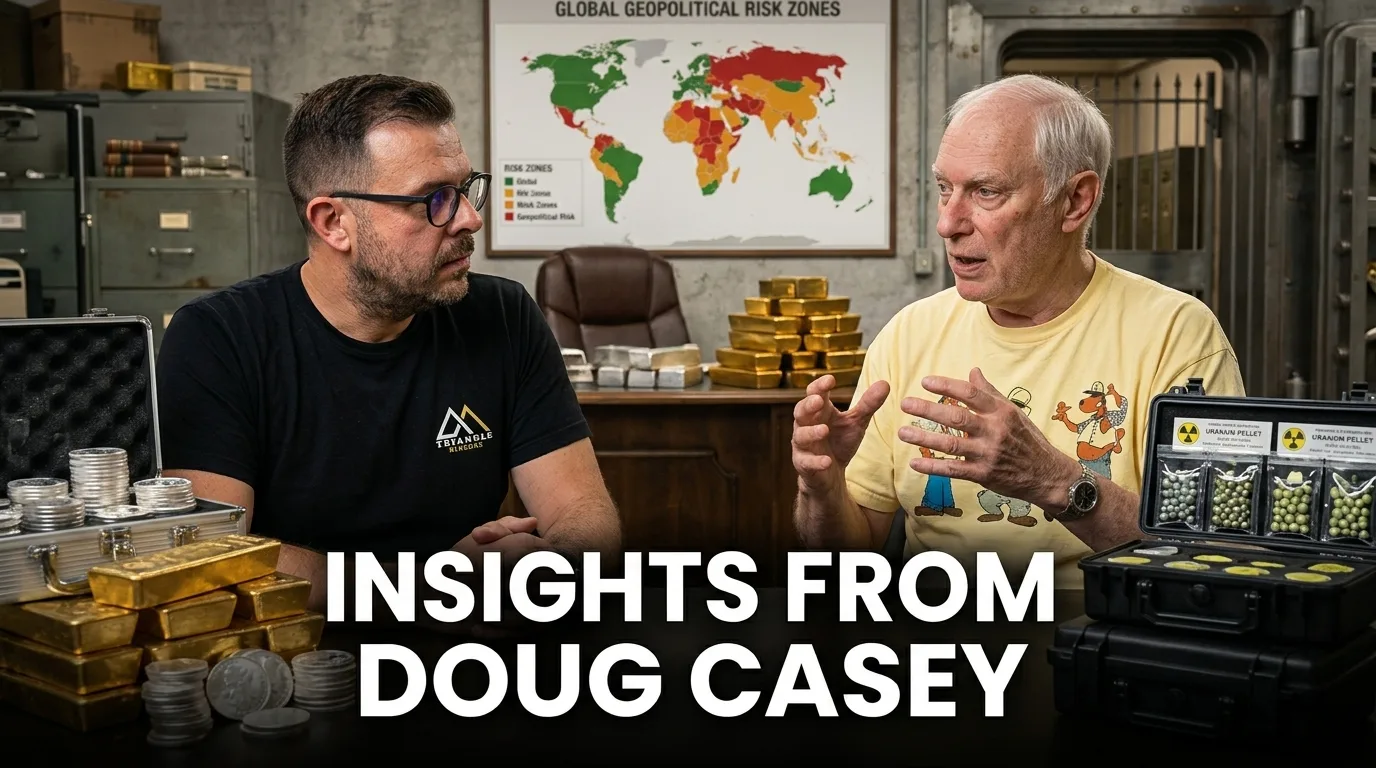
In an era defined by rising geopolitical tensions, record government debt, persistent inflation concerns, and rapidly changing energy markets, investors are searching for clarity. Few voices in the resource-investing world have remained as consistently outspoken as Doug Casey, the veteran speculator and founder of Casey Research. Casey laid out his perspective on commodity cycles, precious metals, uranium, energy security, financial markets, and what he believes could become a much larger economic crisis than most investors currently anticipate.
His views are often controversial, but they are rooted in decades of observing market cycles and geopolitical developments. The interview paints a picture of a world entering a new phase where commodities may outperform traditional financial assets, government debt becomes increasingly problematic, and resource scarcity regains strategic importance.
One of Casey’s central arguments is that the current commodity cycle remains in its relatively early stages. Despite strong performances in certain sectors, he believes there is little evidence of the speculative excesses typically associated with major commodity tops.
According to Casey, many agricultural commodities remain historically inexpensive. Grains such as wheat, corn, soybeans, and rice continue to trade at levels that do not reflect their long-term importance to the global economy. While some soft commodities like cocoa and coffee have experienced substantial price increases, he sees these moves more as a return to fair value than the emergence of a speculative bubble.
More importantly, Casey argues that commodities remain undervalued when compared with financial assets. Relative to stocks and bonds, commodity prices are still near historical lows. This valuation gap suggests significant room for appreciation should capital begin rotating away from financial assets and into tangible resources.
For investors, his conclusion is straightforward: commodities remain one of the most attractive sectors available today.
Gold occupies a unique position in Casey’s investment philosophy. Unlike most investors who view gold primarily as a speculative vehicle, Casey has long regarded it as a form of savings.
He argues that gold's rise is being driven by two powerful forces:
What makes the current gold market particularly interesting, according to Casey, is that the rally has not been driven by retail investors. Historically, major gold manias have involved widespread public participation, often reflected through high premiums on gold coins and retail products. Today, those premiums remain relatively subdued.
Instead, Casey believes central banks are the dominant buyers.
As governments around the world reassess their foreign reserve holdings, many are reducing their dependence on U.S. dollars. Yet alternatives remain limited. The euro faces structural challenges, the Chinese yuan lacks full international convertibility, and other currencies carry their own risks. Gold, by contrast, remains unique because it is not simultaneously someone else's liability.
This distinction is critical. Unlike government bonds, bank deposits, or fiat currencies, gold carries no counterparty risk. In an increasingly uncertain financial system, that characteristic becomes particularly valuable.
Although gold attracts most headlines, Casey expressed significant optimism about silver.
Silver has experienced persistent supply deficits for several consecutive years, with global consumption exceeding mine production. Unlike gold, silver possesses substantial industrial utility, making it both a monetary and technological metal.
Casey highlights several unique properties of silver:
As the global economy becomes increasingly electrified, silver's industrial demand continues expanding. Solar panels, electronics, advanced manufacturing systems, and emerging technologies all require substantial quantities of silver.
Another factor supporting silver prices is the structure of its production. Most silver is produced as a by-product of mining operations focused on other metals such as gold, lead, and zinc. As a result, higher silver prices do not automatically generate significant increases in supply.
This combination of growing demand and constrained production creates a favorable long-term outlook.
Few sectors generated as much enthusiasm from Casey as uranium.
He argues that the world is entering a nuclear renaissance driven by practical energy realities. While renewable energy sources such as wind and solar may have important roles in specific applications, Casey believes they cannot reliably power large industrial economies on their own.
Nuclear energy offers several advantages:
Japan's gradual restart of nuclear reactors following the Fukushima disaster represents an important development in this trend. Casey views the original shutdowns as largely driven by political and emotional reactions rather than technological shortcomings.
He is particularly optimistic about Small Modular Reactors (SMRs), which many analysts consider the next generation of nuclear technology. These smaller reactors offer improved safety, lower construction costs, and greater deployment flexibility.
The implications for uranium demand could be profound.
Current uranium production remains concentrated in Kazakhstan and a handful of other countries. Meanwhile, the United States, despite its ambitions for expanded nuclear capacity, produces relatively little uranium domestically.
If global nuclear expansion accelerates, Casey believes uranium prices could rise substantially, benefiting both producers and developers.
The discussion then shifted toward geopolitical risk, particularly tensions involving Iran and the Strait of Hormuz.
This narrow waterway serves as one of the world's most strategically important energy chokepoints. Approximately one-fifth of global oil and gas shipments pass through it, making any disruption potentially significant for global markets.
Casey notes that oil prices have risen but not nearly as dramatically as some observers expected. One possible explanation is that governments have been drawing down strategic petroleum reserves, temporarily cushioning supply shocks.
However, he believes such measures can only provide short-term relief.
Beyond oil itself, disruptions in the region also affect other critical commodities, including sulfur and industrial materials used in fertilizer production and manufacturing processes.
Should tensions remain elevated, Casey expects energy prices to remain structurally higher than many market participants currently anticipate.
One of the more provocative themes explored during the interview was whether the world could experience inflationary conditions similar to those seen during the 1970s energy crisis.
Casey believes today's environment may actually be more vulnerable.
Several factors support his argument:
In his view, the combination of debt monetization and energy constraints creates fertile conditions for sustained inflation.
Unlike temporary inflation spikes, structural inflation tends to persist because it is rooted in systemic imbalances rather than short-term supply disruptions.
Perhaps the most alarming part of Casey's outlook concerns government finances.
The United States continues to run massive fiscal deficits, requiring enormous amounts of debt issuance. Historically, foreign governments and institutions helped absorb this debt. Today, many of those buyers are reducing exposure.
This leaves central banks playing an increasingly important role.
When central banks purchase government debt, they effectively create new money. While this process can support government spending in the short term, Casey argues it ultimately weakens purchasing power and contributes to inflation.
The consequence is a feedback loop:
Casey believes this dynamic has been building for decades and may now be approaching a critical stage.
He refers to the coming period not simply as a recession or depression but as a "Greater Depression," reflecting what he sees as deeper structural problems than those experienced during previous downturns.
According to Casey, the answer is yes.
He argues that stocks, bonds, and real estate have all benefited from decades of monetary expansion. Much of the wealth created during this period stems not from productive growth but from rising asset valuations fueled by abundant liquidity.
Several factors concern him:
In his view, markets increasingly resemble an "everything bubble."
While timing any correction remains impossible, Casey believes risk-reward dynamics currently favor commodities and resource investments over broad equity indices.
For resource investors, mining equities remain one of Casey's preferred sectors.
Current gold prices have dramatically increased profit margins for many producers. With production costs substantially below prevailing gold prices, mining companies are generating significant cash flows.
Development-stage projects may also benefit, as higher metal prices improve project economics and increase investment attractiveness.
However, Casey cautions that mining stocks are still equities. During broad market sell-offs, investors often liquidate profitable positions to meet margin calls or raise cash. As a result, even fundamentally attractive mining companies can experience severe short-term declines.
This reality explains why Casey is simultaneously bullish on mining stocks while also seeking to maintain higher cash balances.
Another area Casey strongly favors is energy.
One statistic particularly stands out: energy companies once represented roughly 30% of the S&P 500's market value during the early 1980s. Today, despite energy's continued importance to modern civilization, that figure is only a fraction of its former level.
This disconnect suggests significant undervaluation.
Many energy companies also offer attractive dividend yields, providing investors with cash flow while waiting for market recognition.
For Casey, the combination of low valuations, rising geopolitical risk, and persistent global energy demand creates a compelling long-term investment case.
Doug Casey's worldview is fundamentally rooted in tangible assets, skepticism toward government finance, and confidence in long-term commodity cycles.
His key conclusions can be summarized as follows:
Whether investors agree with Casey's conclusions or not, his arguments highlight important themes shaping today's global economy: energy security, monetary credibility, resource scarcity, and the sustainability of debt-driven growth.
As uncertainty continues to define financial markets, these themes are likely to remain central to investment discussions for years to come.
Sign up to our free monthly newsletter to recieve the latest on our interviews and articles.
By subscribing you agree to receive our newest articles and interviews and agree with our Privacy Policy.
You may unsubscribe at any time.

We use cookies to improve your experience on our site. By using our site, you consent to cookies.
Websites store cookies to enhance functionality and personalise your experience. You can manage your preferences, but blocking some cookies may impact site performance and services.
Essential cookies enable basic functions and are necessary for the proper function of the website.
These cookies are needed for adding comments on this website.
Statistics cookies collect information anonymously. This information helps us understand how visitors use our website.
Google Analytics is a powerful tool that tracks and analyzes website traffic for informed marketing decisions.
Service URL: policies.google.com (opens in a new window)
Marketing cookies are used to follow visitors to websites. The intention is to show ads that are relevant and engaging to the individual user.
You can find more information in our Privacy Policy.