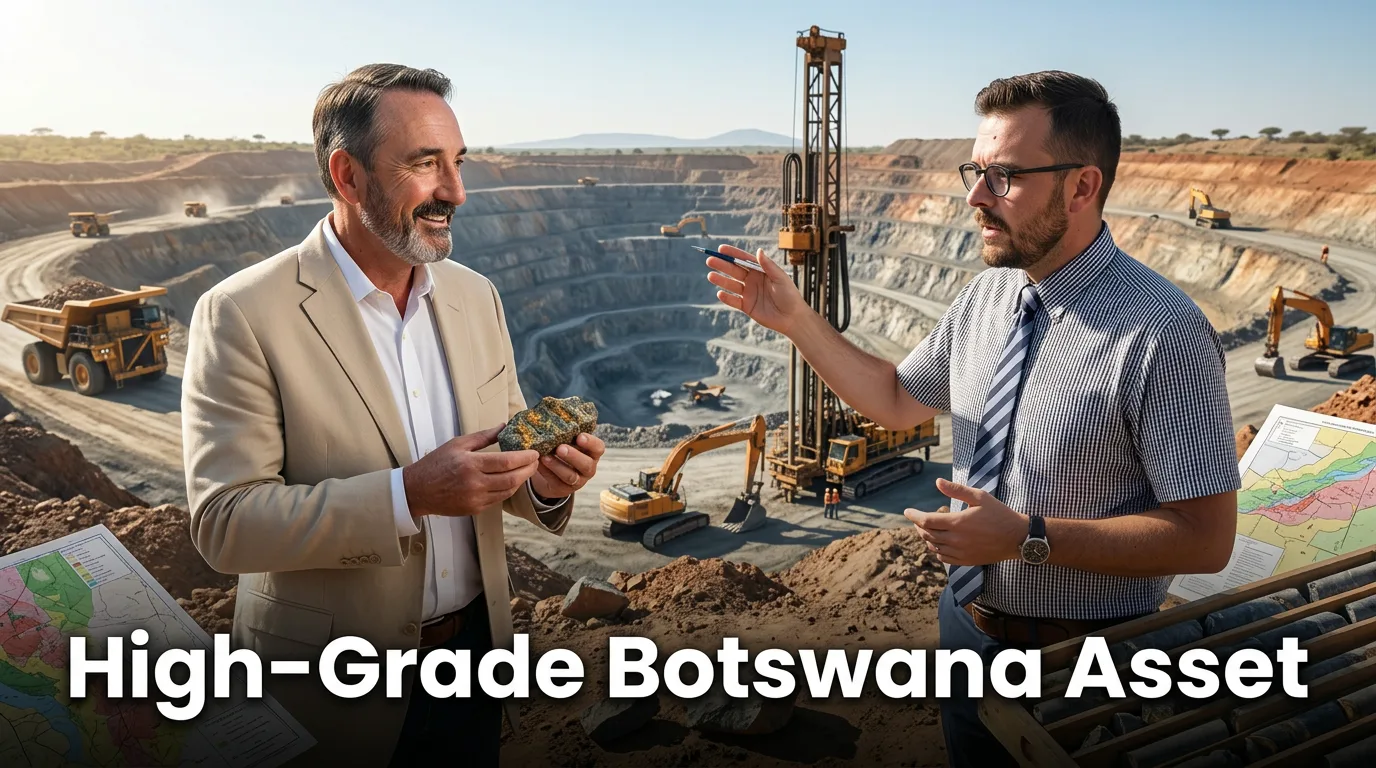
The global mining industry is entering what many analysts believe will be one of the most important commodity cycles in decades. As electrification accelerates, artificial intelligence expands, and power infrastructure is modernized worldwide, copper has become one of the most strategically important metals for the global economy.
At the same time, the industry faces a fundamental challenge: new copper mines are becoming increasingly difficult, expensive, and time-consuming to develop. Against this backdrop, companies that already control permitted, past-producing mining assets with existing infrastructure may hold a significant competitive advantage.
One company pursuing this strategy is NexMetals , a Canadian exploration and development company focused on redeveloping historic copper-nickel mines in Botswana. During a recent interview, CEO Sean Whiteford discussed the company's projects, the outlook for copper markets, and the milestones investors can expect over the coming months.
Although Whiteford is quick to point out that he is not a commodity economist, he shares the increasingly common industry view that copper demand is likely to outpace supply over the coming decades.
Several structural trends are contributing to this outlook:
While demand projections receive considerable attention, Whiteford believes investors often underestimate the supply-side challenge.
Developing a new copper mine is an exceptionally long process. Discovering a deposit, completing exploration, obtaining permits, financing construction, and ultimately bringing a mine into production can take well over a decade. Unlike many industries, mining cannot simply increase output in response to higher prices.
According to Whiteford, this long development timeline creates the potential for a significant supply gap as global copper consumption continues to rise. Years of underinvestment in exploration have only compounded the issue, limiting the pipeline of future projects.
Whiteford also highlighted several structural factors that continue to increase the cost of producing copper:
Many of the world's newest copper discoveries are located at high altitudes in the Andes or in technically challenging jurisdictions, making development more expensive than in previous decades.
As a result, Whiteford believes higher copper prices will ultimately be required to incentivize new mine construction. Without sustained pricing that justifies investment, the industry risks widening the imbalance between supply and demand.
Rather than pursuing grassroots exploration, NexMetals has built its strategy around acquiring and redeveloping historic producing mines.
The company currently controls two principal assets in Botswana:
Both projects possess characteristics that differentiate them from many early-stage exploration companies.
Unlike greenfield projects that require entirely new infrastructure, both properties already benefit from:
This significantly reduces development risk while potentially shortening the timeline to production.
The flagship Selebi project contains copper and nickel mineralization with copper-equivalent grades exceeding 3% according to management, placing it among the higher-grade undeveloped projects in the sector.
Jurisdiction plays a critical role in mining investment, and Whiteford emphasized Botswana's strong reputation.
The country consistently ranks among the world's leading mining jurisdictions according to international investment surveys. It combines:
Botswana has historically relied heavily on diamond revenues through its partnership with De Beers. However, declining diamond prices have created a strong incentive for the government to diversify its mining sector.
As a result, copper, nickel, gold, and other base metals have become increasingly important priorities.
Because NexMetals' assets are former producing mines with existing permits, management believes they could be brought back into production considerably faster than entirely new projects—a prospect welcomed by Botswana's government due to its potential to create jobs and generate new revenue.
One of the interview's major topics was the company's updated Mineral Resource Estimate (MRE) for the Selkirk project.
The update increased the resource by approximately 70%, bringing the indicated resource to roughly 1.1 billion pounds of copper equivalent according to company disclosures discussed during the interview.
Whiteford explained that Selkirk has evolved considerably over the past year.
Unlike Selebi, Selkirk is:
Beyond copper, the project also contains:
This polymetallic nature provides an important advantage because revenue is diversified across several commodities rather than relying solely on copper prices.
One of the most significant developments at Selkirk has been advances in metallurgy.
According to Whiteford, recent test work demonstrated the ability to produce separate salable copper and nickel concentrates while improving recoveries for additional payable metals.
These improvements produced several important benefits:
Collectively, these improvements strengthen the project's economics and increase its attractiveness as a future mining operation.
An interesting point raised during the discussion was Selkirk's stage of development.
Because most of the resource now falls into the indicated category, Whiteford noted that the company could proceed directly towards a Pre-Feasibility Study (PFS) following additional metallurgical work.
Although Selebi remains the flagship asset, Selkirk's growing scale and advanced resource classification may allow it to progress more rapidly through the engineering process.
Management is evaluating whether accelerating Selkirk could unlock value while allowing exploration at Selebi to continue simultaneously.
Despite Selkirk's progress, Selebi remains NexMetals' primary focus.
The project consists of two historic mining areas:
When management first evaluated the property several years ago, they noticed that the two former mining operations appeared to be advancing towards one another underground.
This raised an intriguing geological question:
Had previous operators failed to fully define the mineralized system between the two mines?
Subsequent drilling has continued to validate that thesis.
According to Whiteford, the company has already extended Selebi North approximately 315 meters down plunge, with mineralization remaining open.
Meanwhile, exploration continues to expand Selebi Main.
A key competitive advantage at Selebi is the company's use of borehole electromagnetic (EM) geophysics.
Because the surrounding rocks are largely non-conductive, massive sulphide bodies containing copper and nickel stand out clearly in EM surveys.
This allows geophysicists to identify highly prospective drill targets before drilling begins.
While drilling is still required to determine thickness and grade, the geophysical system greatly improves targeting efficiency.
Whiteford credits this approach as one of the reasons the company has consistently expanded the known resource.
Management outlined several major milestones expected over the coming months.
Current activities include:
The company expects:
Each of these milestones has the potential to materially advance the project towards development.
Despite industry consolidation, Whiteford indicated that mergers and acquisitions are not currently a priority.
Management believes that developing two sizeable projects already requires significant capital and operational attention.
Instead, the company's immediate focus remains on maximizing the value of its existing Botswana portfolio before considering additional acquisitions.
The company's shareholder base has evolved since listing.
While early investors have experienced frustration with the share price despite positive operational progress, management has been actively working to increase institutional ownership.
According to Whiteford, recent financings were approximately 75% institutional.
Major institutional shareholders now include several established investment firms, reflecting growing professional interest in the company's assets.
Management believes broader institutional participation will become increasingly important as development milestones continue to be achieved.
Whiteford stated that the company finished the first quarter with approximately C$26 million in cash.
According to management, this treasury is sufficient to fund:
This reduces near-term financing risk while allowing the company to execute its planned work program.
Whiteford also discussed the depth of the technical team supporting NexMetals .
Key expertise includes:
The company has strengthened its leadership with experienced professionals from major mining companies, including Rio Tinto and De Beers, while continuing to rely on specialized external consultants for metallurgy and engineering until project development reaches a more advanced stage.
One issue Whiteford addressed candidly was management turnover.
The company has had multiple CEOs since going public, something he acknowledged may have affected investor confidence.
Since taking over, Whiteford has focused heavily on meeting investors, rebuilding credibility, and communicating the company's progress more effectively.
He noted that operational results have continued to improve, and management hopes that consistent execution will eventually be reflected in the company's market valuation.
The coming months could represent a pivotal period for NexMetals .
Investors can expect a steady stream of news driven by ongoing drilling, updated resource estimates, and economic studies.
If exploration continues to expand the Selebi resource while Selkirk advances towards feasibility, the company may emerge as one of the more advanced copper-nickel redevelopment stories in Botswana.
At a time when the global mining industry is searching for new copper supply, projects with existing infrastructure, established permits, and supportive jurisdictions may become increasingly valuable.
For NexMetals , the next phase will be less about proving geological potential and more about demonstrating economic viability. With drilling continuing, resources expanding, and key technical studies approaching, the company is entering what could be its most important stage since going public
Sign up to our free monthly newsletter to recieve the latest on our interviews and articles.
By subscribing you agree to receive our newest articles and interviews and agree with our Privacy Policy.
You may unsubscribe at any time.
We use cookies to improve your experience on our site. By using our site, you consent to cookies.
Websites store cookies to enhance functionality and personalise your experience. You can manage your preferences, but blocking some cookies may impact site performance and services.
Essential cookies enable basic functions and are necessary for the proper function of the website.
These cookies are needed for adding comments on this website.
Statistics cookies collect information anonymously. This information helps us understand how visitors use our website.
Google Analytics is a powerful tool that tracks and analyzes website traffic for informed marketing decisions.
Service URL: policies.google.com (opens in a new window)
Marketing cookies are used to follow visitors to websites. The intention is to show ads that are relevant and engaging to the individual user.
You can find more information in our Privacy Policy.