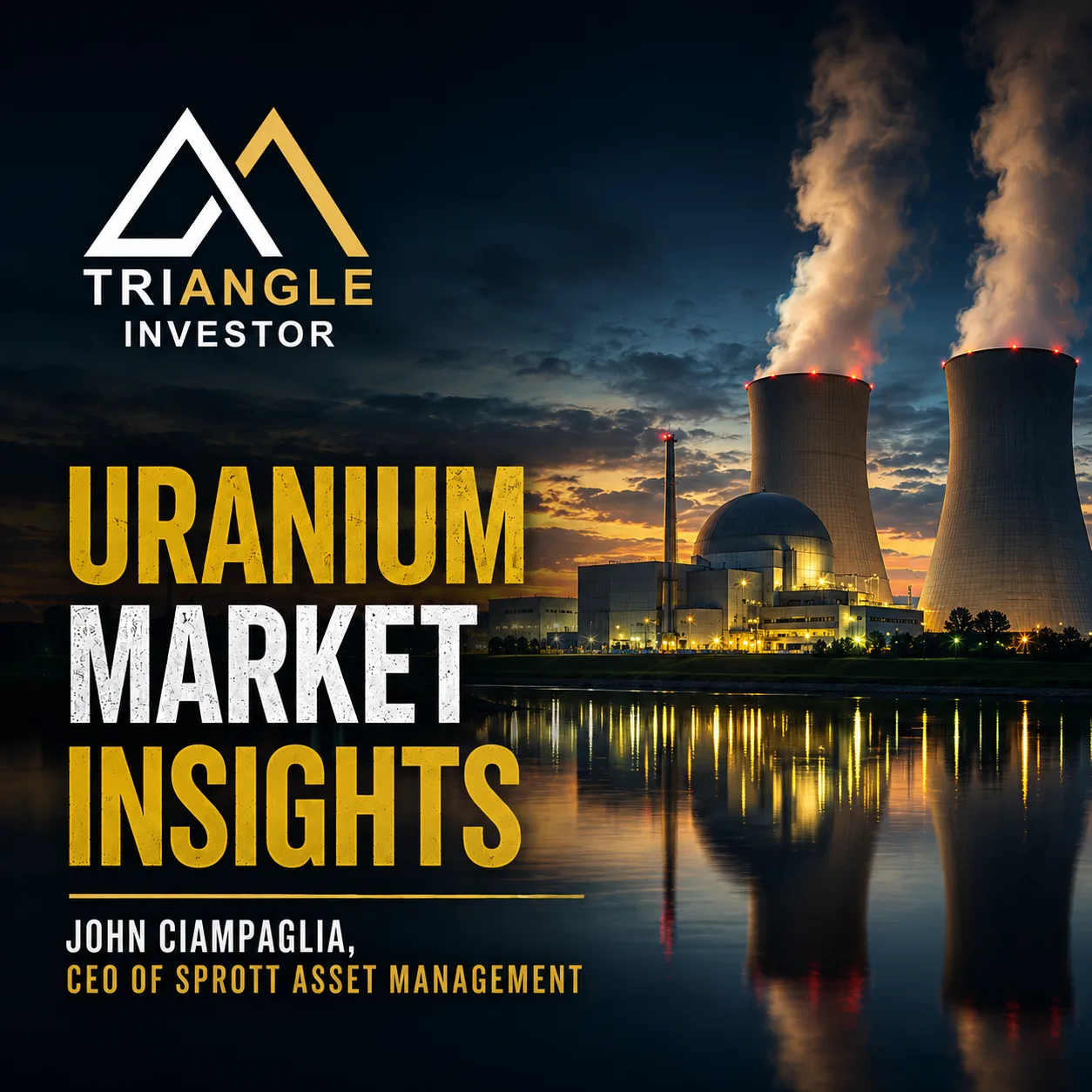
The uranium market is entering a period in which the distinction between short-term sentiment and long-term fundamentals is becoming increasingly important.
After consolidating through the summer, the uranium spot price has begun moving higher again, approaching the $90-per-pound level. Yet beneath the surface, the longer-term uranium market has continued to send a much more constructive signal.
According to John Ciampaglia, CEO of Sprott Asset Management and Senior Managing Partner at Sprott Inc., the most important message is coming not from the spot market, but from the term market—the market in which utilities and other end users secure uranium for future reactor fuel requirements.
And that market remains tight.
Ciampaglia argues that the current uranium price, despite reaching levels that appear impressive in nominal terms, is still well below the highs of the previous cycle when adjusted for inflation. At the same time, mining costs have increased substantially over the past 18 years, meaning that today’s price environment may not provide the same economic incentive that the headline number suggests.
The result is a market where the price may have considerably further to go before it provides enough incentive for the next wave of uranium supply.
Uranium has two important pricing markets: the spot market and the long-term, or term, market.
While the spot market tends to receive most of the attention from investors because it is more visible and accessible, the term market is arguably much more important for understanding the underlying fundamentals of nuclear fuel.
More than 100 million pounds of uranium transact annually through the term market, according to Ciampaglia. Unlike the spot market, it is driven primarily by utilities and other end users seeking material that will eventually be converted into fuel and loaded into nuclear reactors.
That distinction matters.
The spot market can be heavily influenced by investor sentiment, financial flows and short-term positioning. The term market, by contrast, reflects the physical requirements of the nuclear industry.
And that market is increasingly indicating that uranium supply is tight.
The term uranium price has moved into the mid-$90s per pound, representing an important recovery from the lows of the previous uranium bear market. But Ciampaglia cautions against looking at the nominal price alone.
While today’s price may be described as an 18-year high, it is not an 18-year high in real, inflation-adjusted terms. Uranium prices were substantially higher during the previous cycle once inflation is taken into account.
More importantly, the cost of developing and operating uranium mines has increased dramatically over the same period.
That means the uranium industry needs a significantly higher price environment to justify the capital required to bring new supply online.
The headline price, therefore, may underestimate the economic incentive required to stimulate the next generation of production.
One of the clearest structural changes in the uranium market is the growing importance of state-owned entities in China and India.
Both countries are pursuing significant nuclear expansion programs, creating future uranium requirements that must eventually be secured.
Ciampaglia highlights China and India as two of the most important sources of incremental uranium demand. India, in particular, has recently announced two very large uranium purchases, reflecting its position as the world’s second-largest nuclear build-up program after China.
The significance of this demand goes beyond the immediate pounds purchased.
Nuclear reactors require a long and complicated fuel cycle. Uranium must be mined, converted, enriched and fabricated into fuel before it can ultimately reach a reactor core.
That means utilities cannot simply wait until the moment they need fuel before beginning to procure uranium.
Future requirements need to be covered years in advance.
This creates an important dynamic: when utilities eventually realize they have uncovered requirements, the demand cannot necessarily be postponed indefinitely.
Ciampaglia describes this future demand as a form of pent-up, relatively inelastic demand.
In other words, the uranium ultimately has to be purchased.
The major question is therefore not necessarily whether the uranium will be bought, but at what price it will be bought.
While China and India are actively securing future supply, Western utilities have taken a considerably more cautious approach.
Ciampaglia characterizes Western utilities as being in a “maintenance mode.”
Rather than aggressively rebuilding inventories or dramatically increasing uranium purchases, many utilities are primarily replacing the material they consume.
This does not mean the Western nuclear sector is standing still.
The industry is seeing reactor restarts, lifetime extensions and power uprates, all of which are positive developments for uranium demand.
The issue is timing.
Utilities have not yet demonstrated the same urgency in contracting that might be expected given the industry’s long-term growth prospects.
One reason is an enduring assumption that uranium will always be available when needed.
But that assumption becomes increasingly difficult to reconcile with the data on future uncovered requirements.
Recent U.S. Energy Information Administration data is particularly important in this context.
The data indicates that, as the industry approaches 2030, the proportion of future U.S. reactor fuel requirements that are already covered becomes increasingly modest.
That creates a potentially significant future procurement requirement.
The problem is that the nuclear fuel cycle is exceptionally long.
A utility cannot simply identify an uncovered requirement in 2029 and expect the uranium to be mined, processed, enriched and fabricated into fuel immediately.
The purchasing process has to begin well in advance.
This creates what Ciampaglia describes as a substantial amount of pent-up buying that could eventually enter the market.
European utilities appear to be in a somewhat better position.
According to Ciampaglia, European utilities have generally responded more proactively over recent years and have maintained a higher level of coverage.
That may partly reflect the experience of two major energy shocks, including the 2022 energy crisis and another period of energy insecurity in 2026.
Europe’s greater dependence on foreign energy supplies has encouraged a more conservative approach to nuclear fuel procurement.
In uranium, that effectively means: buy more, and buy earlier.
The uranium industry faces an unusual paradox.
On one hand, the price environment has improved substantially and new projects are being developed.
On the other hand, some of the world’s largest uranium producers are deliberately holding back on expanding production.
Why?
Not because uranium prices are necessarily too low.
The issue is the lack of sufficiently attractive long-term contracts.
Ciampaglia points to two of the largest uranium producers as examples of companies that have entered a period of supply discipline.
These producers have additional capacity available, but they are reluctant to expand existing operations, restart higher-cost production or develop new mines without contracts that provide sufficient confidence in future economics.
This creates an important feedback loop.
Utilities are waiting for greater clarity on future supply.
Producers are waiting for utilities to commit to long-term contracts.
Both sides are therefore waiting for the other to move.
But that equilibrium may not last.
Eventually, utilities will have to cover their future requirements.
And when they do, producers may require substantially higher prices to commit to new production.
Another major question is where the uranium will come from when utilities eventually return to the market in force.
A number of new uranium projects are being developed with production timelines that appear to coincide with the period in which uncovered utility requirements begin to increase.
On paper, that may look reassuring.
A utility can look at the projected supply pipeline and conclude that new mines will simply fill the gap.
The problem is that mining projects rarely proceed exactly according to their original schedules.
Construction delays, permitting issues, financing challenges, cost inflation, technical problems and other complications can all push production timelines further into the future.
As Ciampaglia puts it, mining projects have a long history of not being built exactly on schedule or exactly on budget.
This creates a potential timing mismatch.
If utilities wait too long to secure supply and one or more major projects are delayed, the market could suddenly discover that expected future production is not actually available when required.
That is the type of development that can cause uranium prices to move sharply.
The current price environment is already providing an incentive to develop new projects.
The challenge is turning that incentive into actual mines—and securing contracts that give producers confidence to invest the necessary capital.
For much of the recent uranium cycle, the conversation has not been limited to mining.
Conversion and enrichment capacity have also emerged as major bottlenecks in the nuclear fuel cycle.
Uranium itself is not sufficient.
It must be processed before it can ultimately become reactor fuel.
The disruption of Russian participation in the nuclear fuel supply chain highlighted the vulnerability of the Western nuclear industry to dependence on foreign processing capacity.
But according to Ciampaglia, the situation is gradually improving.
New capacity is being developed and existing facilities are being expanded.
He specifically points to planned expansion at the Urenco facility in New Mexico and a new facility planned by Orano in the United States.
Other potential conversion capacity may also emerge.
These developments suggest that some of the pressure on enrichment and conversion is beginning to ease.
That could actually shift attention back toward uranium itself.
For several years, utilities have had to worry about whether sufficient enrichment and conversion capacity would be available.
As those constraints gradually become less severe, the next question becomes much more straightforward:
Where is the uranium?
Ciampaglia expects increasing attention to move back toward U3O8 procurement, with signs already emerging that utilities are beginning to investigate future purchases more actively.
Despite the constructive long-term outlook, one number stands out.
Only approximately 37 million pounds had been booked into long-term contracts during the year at the time of the interview.
Ciampaglia describes that number as extremely weak.
The figure is also somewhat misleading because two large Indian long-term purchase agreements were not included since the volumes were not disclosed.
Nevertheless, even after accounting for those transactions, contracting remains well below the level required to comfortably replace uranium being consumed.
This is not necessarily evidence of a deteriorating market.
Instead, it could be evidence of how much potential contracting remains ahead.
Last year demonstrated how quickly the market can change.
Uranium contracting was relatively soft during the first two-thirds of the year before activity accelerated toward year-end.
Ciampaglia therefore believes the same pattern could occur again.
If so, the second half of the year could become increasingly important for uranium prices and producers.
While the term market provides the clearest fundamental signal, the spot market remains important to investors.
The spot price experienced a strong start to the year before pulling back.
However, Ciampaglia points out that the market demonstrated considerable resilience during the summer.
Spot uranium spent much of the summer in the mid-$80s, despite the fact that summer is typically a weak seasonal period for uranium trading.
July has historically been one of the weakest months for uranium spot performance.
September, by contrast, has historically been one of the strongest.
As market participants return from the summer break and the World Nuclear Association symposium takes place, uranium trading activity typically begins to increase.
There are already indications that buyers with requests for proposals are returning to the market to begin covering uncovered requirements.
That creates an interesting setup.
The uranium spot price did not collapse during a seasonally weak period.
Instead, it held relatively firm.
At the same time, the term price continued to rise.
That combination suggests that there may have been an underlying floor beneath the spot market.
The uranium fundamentals may be improving, but investors are not operating in a vacuum.
Geopolitical uncertainty, particularly surrounding the Middle East, has caused many investors to step back from risk assets.
Ciampaglia argues that the decline in trading activity is not necessarily evidence of bearish sentiment toward uranium.
Instead, investors are simply reluctant to make large decisions while geopolitical uncertainty remains elevated.
Trading volumes across many uranium equities and ETFs have reportedly fallen by 40% to 50% from the first quarter.
The distinction is important.
There is a major difference between investors selling because they believe the fundamentals have deteriorated and investors simply waiting because they lack conviction amid uncertainty.
The latter can change very quickly.
If geopolitical concerns ease, capital that has been sitting on the sidelines could return to the sector.
That could coincide with the historically stronger September period and renewed utility procurement activity.
One of the most important developments in the uranium investment landscape over the past several years has been the emergence of physical uranium investment vehicles.
Sprott Physical Uranium Trust, commonly referred to as SPUT, has now accumulated more than 80 million pounds of physical uranium.
The trust has purchased approximately seven million pounds during the year discussed in the interview, compared with approximately 8.6 million pounds in the previous year.
Perhaps even more significant is the amount of capital flowing into the vehicle.
Ciampaglia says SPUT has raised more money during the previous 14 months than during any comparable period in its first five years.
That is an important signal.
Investors are not simply expressing interest in uranium miners.
They are also seeking direct exposure to the physical commodity.
SPUT’s mandate is straightforward: raise capital, use that capital to acquire physical uranium and place the material into long-term storage.
The trust has not sold or lent a single pound of uranium since inception.
From an initial holding of approximately 18 million pounds, the trust has grown toward 82 million pounds.
Its objective remains to become larger and more liquid, allowing an increasingly broad range of investors to participate in the uranium market.
As SPUT’s physical uranium holdings grow, an obvious question emerges.
Could the trust eventually become a major source of secondary uranium supply?
Ciampaglia’s answer is nuanced.
The trust’s mandate has remained consistent since inception: accumulate physical uranium and hold it.
However, because the vehicle is ultimately owned by its shareholders, a theoretical takeover or acquisition of the trust is possible.
Any such transaction would require shareholder approval, with a two-thirds threshold applying to all outstanding shares.
The more interesting question is what a large bid for SPUT’s uranium would signal to the broader market.
If someone were willing to purchase tens of millions of pounds of uranium from a vehicle holding more than 80 million pounds, that could itself be interpreted as evidence of substantial demand for physical material.
Ciampaglia uses a hypothetical example to illustrate the point.
With uranium around $88 per pound, he asks institutional investors at what price they would be willing to sell their SPUT holdings.
At $100, the answer is generally no.
At $120, still no.
At $150, some investors begin to consider the possibility.
It is purely hypothetical—SPUT has not been approached with such a proposal—but the exercise demonstrates how investors may value scarce physical uranium well above the prevailing spot price.
The uranium market is also becoming part of a much broader geopolitical trend: the reshoring of critical-material supply chains.
Governments increasingly recognize the strategic risk of depending on foreign suppliers for materials essential to national security, energy infrastructure and advanced industries.
In other critical materials, governments have already begun providing loans, loan guarantees, capital and offtake agreements to support domestic production.
Price floors and other mechanisms are also being considered or implemented in certain markets.
The objective is straightforward:
Create enough economic security for strategic projects to actually get built.
Uranium has not yet received the same degree of government intervention as some other critical materials, but Ciampaglia believes that could change.
The United States could potentially introduce mechanisms such as differentiated pricing for domestically produced uranium.
Government agencies could also potentially provide equity or debt financing to new uranium projects in exchange for securing future supply.
None of these developments should be considered guaranteed.
But they illustrate the increasingly strategic role that uranium plays in national and energy security.
The broader shift is perhaps best illustrated by the changing definition of what constitutes a “critical” material.
Ciampaglia notes that the U.S. Geological Survey now considers approximately three-quarters of the elements on the periodic table to be critical.
The reason is increasingly clear: supply chains have become concentrated in a relatively small number of countries and companies.
That creates vulnerabilities.
In the case of rare earths, for example, a sudden restriction of supply could have immediate consequences across enormous sections of the global economy.
Uranium presents a somewhat different situation.
There is currently enough fuel within the system to continue operating existing reactors.
The urgency is therefore not the same as it is for some other critical minerals.
But the strategic importance of nuclear energy is increasing.
As governments seek reliable, low-carbon baseload electricity and greater energy independence, nuclear power is becoming more important.
That inevitably makes uranium more strategically significant.
Against this backdrop, the upcoming World Nuclear Association symposium in London takes on additional importance.
The event is much more than a traditional industry conference.
It brings together utilities, uranium producers, traders, financial institutions, investors and participants from across the nuclear fuel cycle.
It is also a major venue for contract discussions and negotiations.
Ciampaglia describes it as the event that effectively restarts the uranium industry’s business calendar after the summer slowdown.
The timing is particularly interesting because September has historically been a strong month for uranium spot prices.
The symposium can therefore provide both a fundamental and psychological catalyst.
Utilities can signal their purchasing intentions.
Producers can communicate their development plans.
Traders can assess supply and demand.
Investors can receive new information about the pace of contracting.
And new transactions can emerge.
In a market where so much attention is focused on future supply and future uncovered requirements, these signals can be particularly valuable.
Another important change is occurring in the structure of the uranium market itself.
The sector is attracting more participants.
What was once a relatively small community of specialist uranium traders and investors is becoming increasingly institutionalized.
More banks are participating.
More investment events are being organized.
More generalist investors are paying attention.
Trading houses that previously abandoned uranium during the bear market are returning.
This matters because greater participation improves liquidity.
Large trading houses bring larger balance sheets, more counterparties and greater capacity to finance physical uranium transactions.
For physical buyers such as SPUT, having more counterparties capable of handling significant transactions is a major advantage.
The evolution is a natural consequence of a maturing market.
As prices rise and economic opportunities increase, more financial institutions have an incentive to participate.
And as participation increases, liquidity improves.
The uranium story ultimately comes back to a simple question.
How much does uranium need to cost to incentivize enough new production?
The answer is not simply the cost of extracting uranium from the ground.
Developers need sufficient margins to justify exploration, permitting, construction, financing, infrastructure and operating risks.
Existing producers need confidence that higher production levels will be supported by long-term contracts.
Utilities need confidence that sufficient fuel will be available years into the future.
Governments increasingly want secure domestic and allied supply chains.
And investors are increasingly seeking exposure to the physical commodity itself.
All of these forces are converging.
The current uranium price may therefore not be the end point of the cycle, but rather part of the price discovery process required to bring the next wave of supply online.
Perhaps the most important conclusion from Ciampaglia’s analysis is that the uranium market does not necessarily need a dramatic deterioration in supply to become significantly tighter.
The ingredients are already visible.
Future uncovered utility requirements are increasing.
Major producers are exercising supply discipline.
New projects face construction and financing risks.
Enrichment and conversion bottlenecks are gradually easing.
China and India are securing future supply.
Western utilities remain relatively under-contracted.
Physical uranium investment continues to grow.
And government interest in strategic supply chains is increasing.
The missing ingredient is a sufficiently large wave of utility contracting.
Once utilities begin moving more aggressively to cover future requirements, the market could discover that available supply is much less abundant than the prevailing assumptions suggest.
And because the nuclear fuel cycle operates on such long timelines, waiting until the shortage becomes obvious could be too late.
The uranium market is therefore increasingly defined by a race between future demand certainty and future supply availability.
If utilities move early, prices may rise gradually as producers receive the contracts needed to expand.
If utilities continue delaying and supply projects encounter delays, the adjustment could be considerably more abrupt.
The uranium market today presents a fascinating contradiction.
Prices have already risen substantially from the lows of the previous cycle, yet the market remains below its historical highs in inflation-adjusted terms.
New projects are being developed, yet major producers remain reluctant to expand without stronger contracting.
Utilities know they will need uranium, yet many are still waiting to secure future requirements.
Physical uranium investment is growing rapidly, yet geopolitical uncertainty has temporarily pushed many investors to the sidelines.
And the nuclear industry itself is expanding, even as the fuel supply chain works to rebuild capacity that was allowed to shrink during years of weak uranium prices.
For Ciampaglia, the overall outlook remains constructive.
The summer period has been resilient rather than weak, spot uranium is beginning to show renewed momentum, utilities are beginning to investigate uncovered requirements, and the industry is heading into a seasonally stronger period.
The key question now is not whether uranium demand will exist.
The reactors already operating—and the reactors being built, restarted, extended and uprated—make that increasingly clear.
The key question is when utilities decide they need to secure that demand, and how much uranium will be available when they do.
If contracting accelerates while new production remains constrained by development timelines, the uranium market could enter a substantially tighter phase.
And if that happens, the price required to balance the market may be considerably higher than today’s level.
Watch the interview here: https://youtu.be/FB_ijBkptxU?si=50T1tKBBTTWjYCBD
This article is based on an interview with John Ciampaglia, CEO of Sprott Asset Management and Senior Managing Partner at Sprott Inc., conducted by Lucijan Valkovic for Triangle Investor Interviews. The discussion reflects the views expressed by the interviewee and is not investment advice or a recommendation to buy or sell any security, commodity or financial product. Investors should conduct their own due diligence and consult a qualified financial adviser.
Sign up to our free monthly newsletter to recieve the latest on our interviews and articles.
By subscribing you agree to receive our newest articles and interviews and agree with our Privacy Policy.
You may unsubscribe at any time.
We use cookies to improve your experience on our site. By using our site, you consent to cookies.
Websites store cookies to enhance functionality and personalise your experience. You can manage your preferences, but blocking some cookies may impact site performance and services.
Essential cookies enable basic functions and are necessary for the proper function of the website.
These cookies are needed for adding comments on this website.
Statistics cookies collect information anonymously. This information helps us understand how visitors use our website.
Google Analytics is a powerful tool that tracks and analyzes website traffic for informed marketing decisions.
Service URL: policies.google.com (opens in a new window)
You can find more information in our Privacy Policy.