The modern gold market is no longer driven solely by inflation fears, jewelry demand, or speculative cycles. Increasingly, it is being shaped by something larger: geopolitical fragmentation, sovereign insecurity, resource nationalism, and the restructuring of global supply chains.
Against that backdrop, a new class of junior mining companies is emerging—companies attempting to align themselves not merely with rising commodity prices, but with a broader structural transformation in how countries think about strategic resources.
One of those companies is SEVA Mining, a Canadian gold exploration and development company focused on the Cameron Gold Project in Northwestern Ontario. The company’s newly appointed CEO, Ranj Pillai, brings an unusual background to the junior mining sector: before entering mining, Pillai spent years in Canadian politics, including serving as Premier of Yukon and holding senior economic development and mining portfolios.
In a lengthy interview with Triangle Investor, Pillai outlined not only SEVA’s operational plans, but also a broader thesis about gold, geopolitics, Indigenous partnerships, and the future of Canadian resource development.
What emerges from that discussion is a picture of a company attempting to position itself at the intersection of several powerful trends:
Whether SEVA ultimately succeeds remains uncertain. Like every junior mining company, it faces substantial execution risks, financing challenges, permitting complexities, and geological uncertainty. But its strategy provides a revealing lens through which to examine where the mining industry may be heading over the next decade.
Pillai’s central macro argument is straightforward: gold is increasingly functioning as a geopolitical hedge in an unstable world.
During the interview, he referenced several themes now dominating global commodity discussions—BRICS reserve accumulation, deteriorating geopolitical relationships, supply-chain realignment, and strategic concerns around sovereign resilience.
His view reflects a broader shift occurring across institutional markets.
For much of the 2010s, gold frequently struggled to maintain investor enthusiasm despite periodic economic shocks. Real interest rates, equity market performance, and the dominance of growth-oriented technology investing often suppressed sustained enthusiasm for precious metals.
The post-2020 environment, however, altered the equation.
The pandemic exposed the fragility of global supply chains. Inflation returned aggressively after years of dormancy. Major economies weaponized trade relationships. Central banks began reassessing reserve strategies. And geopolitical competition intensified simultaneously across energy, defense, semiconductors, and critical minerals.
In that context, gold regained relevance—not merely as an inflation hedge, but as a neutral reserve asset outside sovereign liabilities.
Pillai emphasized that during his years in government, gold repeatedly surfaced in diplomatic and economic discussions related to security and strategic alignment. While that observation is anecdotal, it aligns with broader market data showing sustained central bank purchasing over recent years.
The significance of that trend cannot be overstated.
Historically, retail investors and ETFs have often dominated gold narratives. But central bank demand changes the psychology of the market because sovereign accumulation tends to be slower-moving, strategic, and less price-sensitive than speculative investment flows.
Countries accumulating gold reserves are not usually trading quarterly momentum. They are positioning for long-term monetary and geopolitical resilience.
That distinction matters.
If sovereign reserve diversification continues accelerating, the gold market may increasingly resemble a structural demand story rather than a cyclical speculative trade.
One of the most important observations in the interview concerns exploration underinvestment.
Pillai argued that the industry has spent years underfunding discovery and reserve expansion, even as demand expectations improve.
This is not a new concern within mining circles, but it has become more acute recently.
Large gold producers face a persistent reserve replacement problem. Existing mines deplete over time, grades decline, and new world-class discoveries have become increasingly rare. Meanwhile, environmental permitting timelines continue lengthening in many jurisdictions.
The result is a growing strategic importance for advanced-stage juniors holding meaningful resources in politically stable regions.
Northwestern Ontario has become one of the key beneficiaries of this dynamic.
According to Pillai, nearly CAD $10 billion in M&A activity has occurred in the region since 2020. That activity reflects a broader trend: major and mid-tier producers increasingly prefer acquiring de-risked ounces rather than spending years pursuing greenfield discoveries themselves.
This creates an important asymmetry in the junior mining sector.
Small exploration companies are inherently risky. Most never become mines. Many dilute shareholders repeatedly while failing to establish economic viability.
But when gold prices rise and reserve replacement pressure intensifies, successful junior developers can become strategically valuable acquisition targets.
That possibility appears central to SEVA’s positioning.
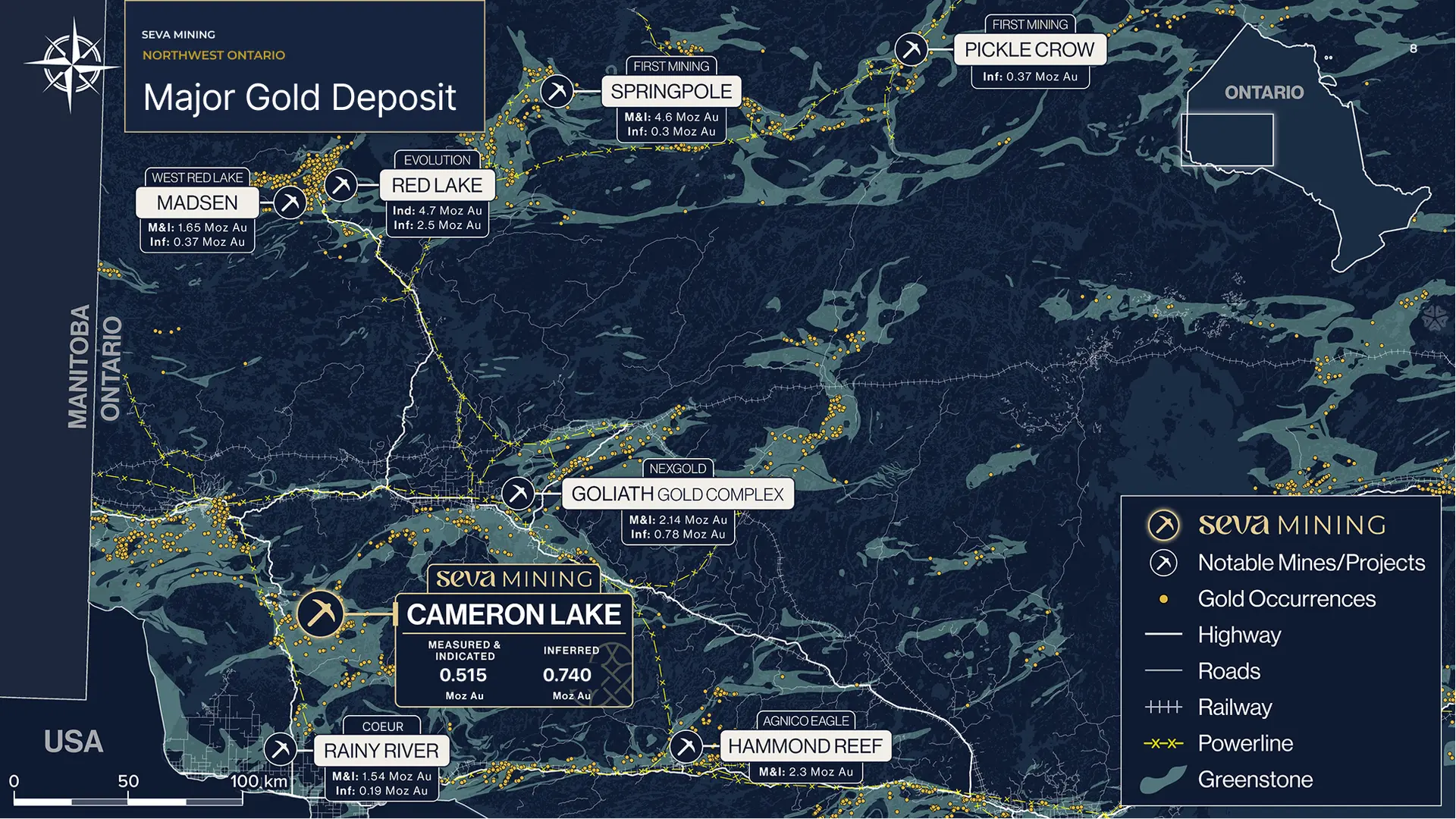
At the core of SEVA’s story is the Cameron Gold Project in Northwestern Ontario.
The project currently hosts approximately 1.25 million ounces in total resources and sits on a land package of roughly 55,000 hectares.
Importantly, SEVA’s thesis is not based solely on proving an initial deposit.
Management believes the broader district remains materially underexplored due to decades of interrupted exploration cycles. Commodity downturns repeatedly halted activity across the property over the last forty years.
This pattern is common across the mining industry.
Exploration rarely proceeds linearly. Junior companies often lose funding access during commodity downturns, forcing projects into dormancy long before their geological potential is fully evaluated.
As a result, some districts receive fragmented exploration campaigns spanning decades without systematic development.
SEVA believes Cameron may represent one of those opportunities.
Pillai repeatedly emphasized geological comparisons to the Red Lake district and the broader Abitibi greenstone belt—two of Canada’s most historically productive gold regions.
Those comparisons should not be interpreted as guarantees of equivalent outcomes. Geological similarity does not automatically translate into economic deposits. Nonetheless, regional analogues matter because they help establish the plausibility of broader mineral systems.
The company’s strategy appears built around three parallel objectives:
This multi-track approach is important because junior mining valuations are rarely determined solely by existing ounces in the ground. Markets typically reward perceived scalability.
A company with 1.25 million ounces and district expansion potential often commands greater strategic interest than a fully constrained standalone deposit with limited exploration upside.
Perhaps the most distinctive element of SEVA’s strategy is its proposed Direct Shipping Ore (DSO) development model.
Instead of building a fully integrated processing operation from scratch, the company hopes to leverage existing regional infrastructure and nearby milling capacity.
This matters because capital intensity is one of the greatest obstacles facing junior developers.
Building a conventional mine can require hundreds of millions—or even billions—of dollars in upfront capital. For small companies, raising that level of financing is enormously dilutive and operationally risky.
SEVA’s proposed approach attempts to avoid that trap.
Pillai suggested the company believes production could potentially be achieved with sub-CAD $200 million capital expenditures by trucking ore to existing mills in the region.
Nearby infrastructure includes processing facilities associated with regional operators, including operations connected to Rainy River and other Northwestern Ontario mining hubs.
Conceptually, the strategy resembles a hub-and-spoke model increasingly explored within mining jurisdictions that already possess established infrastructure.
If successful, the advantages could be substantial:
However, this model also introduces dependencies.
SEVA would require stable third-party processing relationships, transportation economics that remain viable across commodity cycles, and sufficient operational reliability from partner infrastructure.
In mining, lower CapEx often means greater operational interdependence.
Still, in a capital-constrained environment, flexible development models may become increasingly attractive—particularly for junior companies attempting to bridge the gap between exploration and production.
One of the more intriguing aspects of SEVA’s plan involves an existing surface stockpile.
According to Pillai, approximately three years of historical mining activity in the 1980s left behind material currently estimated to contain roughly CAD $15 million worth of gold at prevailing prices.
The company hopes to monetize that stockpile through toll processing arrangements.
Financially, the stockpile itself is not transformative relative to the scale of a future mining operation. But strategically, management views it as highly significant.
Why?
Because monetizing the stockpile could accomplish several objectives simultaneously:
In effect, management appears to see the stockpile as a live operational test case.
For investors, this may become one of the most important near-term catalysts because it moves the company beyond conceptual development discussions into real-world execution.
Junior mining markets often reward tangible operational progress disproportionately compared to early-stage theoretical studies.
A successful stockpile monetization effort could therefore carry signaling value beyond its immediate economics.
Junior mining companies are typically led by geologists, engineers, financiers, or serial promoters.
Pillai’s background is fundamentally different.
Before joining SEVA, he spent years in politics, including serving as Yukon Premier and holding economic development and mining responsibilities.
At first glance, that might seem unconventional for a resource company CEO.
But the mining industry itself is changing in ways that may increasingly reward political and relationship-oriented expertise.
Modern mining projects do not succeed solely because of geology. They require:
In many jurisdictions, social license has become as important as technical competence.
Pillai repeatedly returned to that theme throughout the interview.
Rather than portraying community engagement as a secondary obligation, he framed Indigenous partnership-building as central to project development itself.
That orientation may reflect broader structural realities.
Across Canada, resource projects increasingly depend on negotiated partnerships with Indigenous governments and communities. Companies unable to establish durable trust often encounter substantial delays, legal disputes, or outright project opposition.
SEVA appears to be attempting a different model—one based on collaborative development from the outset.
Whether this succeeds remains uncertain. Building trust is inherently difficult, especially in regions where communities may have experienced historical disappointment or conflict with prior operators.
But strategically, the company’s emphasis on early engagement appears deliberate rather than cosmetic.
One of the strongest themes throughout the interview was reconciliation and Indigenous participation.
Pillai discussed previous Yukon initiatives involving collaborative mining reform, government-to-government negotiations, and Indigenous equity structures.
This matters because the Canadian mining industry is increasingly moving toward participation models that extend beyond traditional impact-benefit agreements.
New frameworks now often include:
SEVA appears interested in pursuing some version of that model.
Importantly, management repeatedly emphasized consultation before operational advancement. The company delayed aggressive drilling timelines partly to prioritize relationship-building with local First Nations.
From a short-term market perspective, this may frustrate some investors seeking rapid catalysts.
But from a long-term development perspective, early engagement may reduce future permitting friction.
Mining history is full of technically promising projects that failed because companies underestimated social and political complexity.
The industry increasingly recognizes that development speed without durable stakeholder alignment often creates larger delays later.
Another important aspect of SEVA’s positioning is its association with the broader Fiore/Fury ecosystem.
Pillai highlighted backing from figures including Frank Giustra and Sean Khunkhun, alongside relationships with multiple resource companies operating within Northwestern Ontario.
Within junior mining, strategic ecosystems matter enormously.
Most juniors fail not simply because projects are poor, but because they lack:
SEVA’s connection to experienced mining financiers and operators potentially mitigates some of those vulnerabilities.
Pillai described the broader organization almost like an internal accelerator platform, with access to engineers, geologists, capital markets specialists, and development expertise across affiliated companies.
This creates several potential advantages:
Still, ecosystem affiliation alone does not guarantee success.
Mining history also contains many well-connected projects that ultimately failed due to geology, economics, or execution challenges.
But in a sector where credibility often determines survival, strong sponsorship matters.
Pillai repeatedly emphasized disciplined treasury management and dilution awareness.
That focus is critical because dilution remains one of the greatest risks in junior mining investing.
Exploration and development require constant capital. Companies frequently issue shares repeatedly long before reaching production. As a result, investors can experience significant ownership erosion even when projects advance technically.
SEVA’s management appears acutely aware of that concern.
The company describes itself as tightly held, with major strategic shareholders maintaining meaningful positions and financing participation.
The emphasis on lower-capital-intensity development also connects directly to dilution control.
A project requiring several hundred million dollars less upfront financing can materially alter long-term shareholder economics.
Nonetheless, investors should remain cautious.
Even disciplined junior miners often require additional financing rounds as exploration and development evolve. Commodity cycles can shift rapidly, and permitting or operational delays frequently increase funding requirements beyond initial expectations.
SEVA’s immediate roadmap appears relatively clear.
Key expected developments include:
The company continues discussions with local First Nations regarding drilling plans, stockpile movement, and broader development cooperation.
Potential movement and processing of the historical stockpile could become the first real-world validation of the DSO thesis.
Management discussed a proposed 25,000-meter drilling campaign over roughly 18 months, with drilling potentially beginning near late summer.
New drilling may attempt both infill optimization and district-scale discovery targeting.
Potential processing relationships and regional cooperation agreements remain ongoing possibilities.
Each of these catalysts carries both opportunity and risk.
Junior mining valuations can re-rate dramatically on exploration success or strategic validation. But setbacks in any one of these areas could materially impact investor sentiment.
Despite management optimism, SEVA is a junior exploration and development company.
Several major risks deserve attention.
Additional exploration may fail to expand resources meaningfully or improve economics.
The DSO model depends heavily on processing compatibility, transportation economics, and partner availability.
Even lower-CapEx development strategies require substantial capital.
Community support remains essential and can evolve over time.
Gold prices strongly influence project economics and investor appetite.
Transitioning from explorer to producer is notoriously difficult.
Most junior miners never successfully complete that transition.
Investors must therefore distinguish between narrative potential and operational proof.
At present, SEVA remains largely a thesis-driven story rather than a de-risked production company.
Whether or not SEVA ultimately succeeds, the company reflects several broader transformations underway in mining.
The sector increasingly rewards:
This represents a meaningful departure from older resource development models that often prioritized aggressive expansion over stakeholder alignment.
At the same time, gold itself appears to be re-entering strategic conversations at sovereign and institutional levels.
If the global economy continues fragmenting into competing geopolitical blocs, reserve diversification and strategic commodity security may become defining themes of the next decade.
In that environment, advanced-stage gold assets located in stable jurisdictions could become increasingly valuable.
That does not mean every junior miner will succeed.
Far from it.
But it does mean the backdrop supporting companies like SEVA may be structurally stronger than many investors realize.
SEVA Mining is attempting something ambitious but increasingly relevant:
to develop a gold project in a stable jurisdiction using a lower-capital-intensity model while embedding Indigenous partnership structures into the project foundation from the outset.
The company’s strengths include:
Its challenges are equally substantial:
For now, SEVA remains an emerging story rather than a proven one.
But in an industry searching for new discoveries, politically secure ounces, and socially sustainable development pathways, the company represents a compelling case study in how the next generation of mining companies may attempt to evolve.
And perhaps most importantly, it illustrates a larger truth now reshaping global resource markets:
Gold is no longer merely a commodity trade.
It is increasingly becoming a strategic asset again.
Sign up to our free monthly newsletter to recieve the latest on our interviews and articles.
By subscribing you agree to receive our newest articles and interviews and agree with our Privacy Policy.
You may unsubscribe at any time.
We use cookies to improve your experience on our site. By using our site, you consent to cookies.
Websites store cookies to enhance functionality and personalise your experience. You can manage your preferences, but blocking some cookies may impact site performance and services.
Essential cookies enable basic functions and are necessary for the proper function of the website.
These cookies are needed for adding comments on this website.
Statistics cookies collect information anonymously. This information helps us understand how visitors use our website.
Google Analytics is a powerful tool that tracks and analyzes website traffic for informed marketing decisions.
Service URL: policies.google.com (opens in a new window)
Marketing cookies are used to follow visitors to websites. The intention is to show ads that are relevant and engaging to the individual user.
You can find more information in our Privacy Policy.