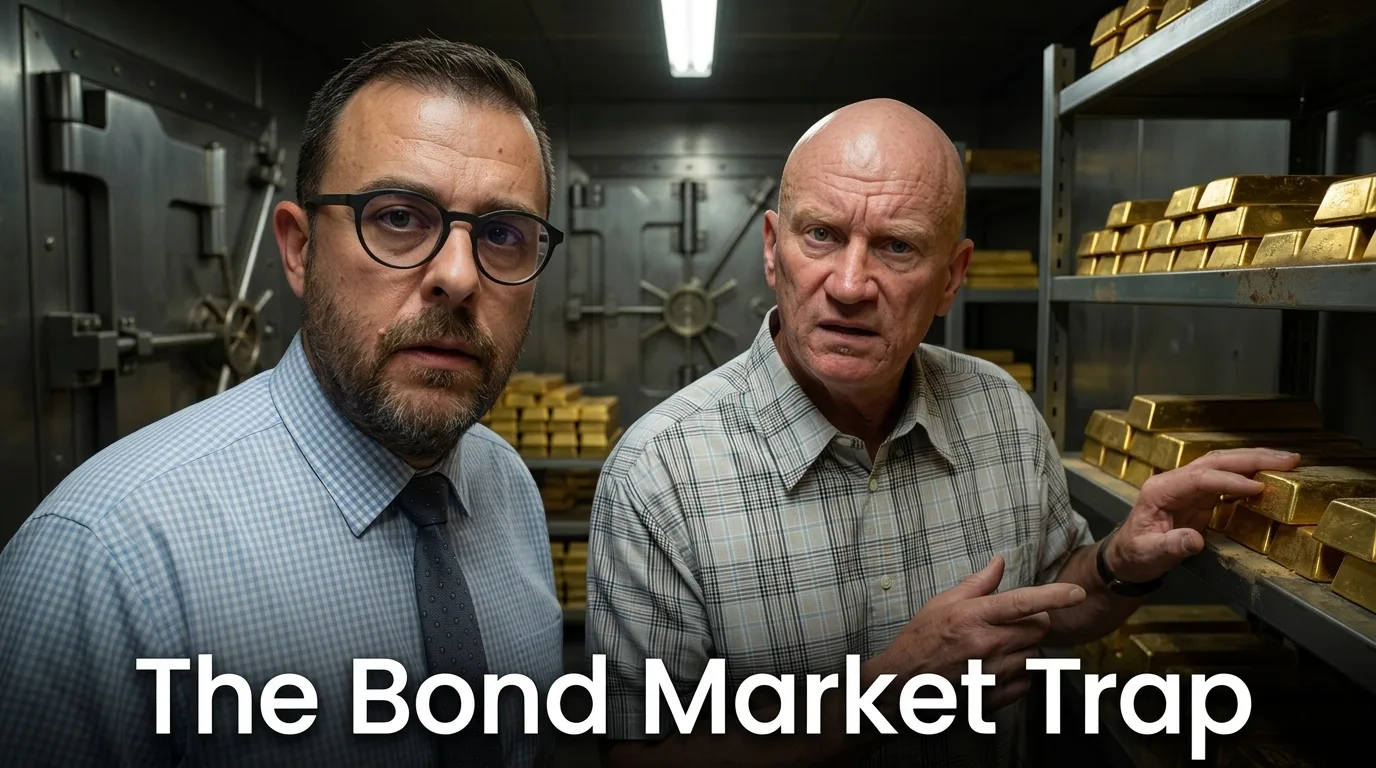
Francis Hunt, also known as “The Market Sniper,” believes the global financial system is approaching a period of extraordinary stress, with rising government debt, higher bond yields and declining confidence in Western debt markets potentially setting the stage for a major financial reset.
In our recent talk, Hunt argued that what is happening in the U.S. Treasury market is much more than a simple normalization of interest rates.
Asked whether the recent rise in the 10-year U.S. Treasury yield toward 5% represents a normalization of rates or the beginning of a more serious debt crisis, Hunt gave a clear answer:
“Short answer, the latter, more serious debt crisis.”
His argument is built around a fundamental shift in the global financial system. For decades, the United States benefited from enormous international demand for its financial assets, supported by the dollar's reserve-currency status, global trade flows, the eurodollar system and demand for U.S. Treasuries.
Hunt believes those mechanisms are weakening.
At the same time, the U.S. government faces enormous financing requirements, while higher interest rates are increasing the cost of servicing existing debt. In his view, this creates a structural problem that conventional monetary policy may no longer be able to resolve.
Hunt's broader thesis begins with the role the United States has played in global capital markets.
For decades, he argues, the U.S. functioned as a magnet for international investment capital. Foreign investors could obtain exposure to the world's largest capital markets, while the dollar's role in international trade created persistent demand for U.S. financial assets.
Hunt points to several mechanisms that helped reinforce this system.
One was the ability of international investors to borrow cheaply in countries such as Japan and redirect capital toward higher-yielding assets. Another was the role of the dollar in global energy markets.
“You had the petrodollar,” Hunt said, arguing that global energy transactions created another structural source of demand for dollars and U.S. Treasuries.
The eurodollar system provided another channel through which dollar liquidity circulated internationally before ultimately finding its way back into U.S. financial markets.
Together, these mechanisms helped create what Hunt describes as a powerful capital pipeline into the United States.
But he believes the conditions that supported this system have changed.
One of the most important themes running through Hunt's analysis is confidence.
The U.S. Treasury market has historically been treated as one of the world's safest financial markets. Hunt argues that investors are increasingly being forced to reconsider that assumption.
His thesis is not simply that Treasury yields are rising. Rather, he believes the underlying relationship between global investors and the U.S. financial system is changing.
He points to the freezing of Russian reserves following the geopolitical confrontation with Russia as an important example.
In Hunt's interpretation, the episode demonstrated that financial assets held within Western jurisdictions can become subject to geopolitical decisions.
“What you're going to see is now those that had to support the hegemony now have optionality and are looking elsewhere because you didn't treat me right, you betrayed my faith and my trust.”
That, he argues, creates an incentive for countries to diversify away from traditional Western financial infrastructure.
The emergence of alternative payment systems, increasing interest in gold and the development of Chinese financial infrastructure are therefore important parts of the bigger picture.
Hunt sees this not as an overnight collapse of the dollar system, but as a gradual erosion of the monopoly-like position that Western financial markets once enjoyed.
The consequences, according to Hunt, extend well beyond the United States.
He argues that many Western economies have accumulated significant debt while remaining dependent on the same monetary and financial architecture.
Europe, Japan, Canada and other developed economies therefore face many of the same structural pressures.
Hunt described this as a broader problem affecting the Western financial system rather than simply an American problem.
This is particularly relevant to Canada.
Asked about Canada's increasingly close relationship with Europe, Hunt argued that Canada could find itself caught between two highly indebted economic blocs.
He believes Canada has an opportunity that many other developed economies do not possess: substantial natural resources.
His prescription is straightforward—reduce debt, accelerate permitting and develop domestic resources.
“I'd bite my bottom lip and I'd do all I can to reduce debt issuance and debt and I would make the most of my resources and give permits for mining and get digging if I was the PM of Canada.”
For resource investors, that part of Hunt's argument is particularly notable.
If governments increasingly prioritize domestic supply chains, critical minerals, energy security and strategic commodities, countries with significant resource endowments could become increasingly important.
The conversation then moved to the Federal Reserve.
The central problem, according to Hunt, is that monetary policy is being pulled in two different directions.
On one side is inflation.
On the other is the need to maintain functioning government bond markets.
If inflation remains elevated, aggressively cutting interest rates could potentially undermine confidence in the currency and accelerate inflationary pressures.
But if rates remain high—or rise further—the cost of servicing government debt increases.
Hunt therefore believes the Federal Reserve is trapped.
“They are 100% trapped.”
He argues that the bond market itself ultimately determines borrowing costs, particularly during periods of financial stress.
In normal conditions, central banks can exert substantial influence over interest rates. But when markets become disorderly, investors can demand higher yields regardless of what policymakers want.
That distinction is critical.
The Federal Reserve can set short-term policy rates, but it cannot simply force investors to purchase long-term government debt at yields they consider inadequate.
Hunt believes the problem becomes particularly serious at the long end of the Treasury market.
The U.S. government needs to issue enormous quantities of debt to finance existing obligations, deficits and interest payments.
At the same time, existing bondholders are holding securities that were issued when interest rates were dramatically lower.
As yields rise, the market value of those older bonds falls.
This creates a potentially destabilizing feedback loop.
Higher yields mean:
Higher borrowing costs → larger interest expense → greater government financing requirements → more debt issuance → greater supply of Treasuries → potentially higher yields.
Hunt believes the system is already moving toward this dynamic.
He also argues that the financial system is entering an environment in which investors may increasingly question the assumption that Treasuries are essentially risk-free assets.
For decades, U.S. Treasury securities occupied a unique position in global finance.
They served simultaneously as:
Hunt believes rising yields challenge that perception.
He argues that the traditional idea of Treasuries as “pristine collateral” is increasingly questionable when the underlying securities are losing market value.
This matters because Treasuries are deeply embedded throughout the financial system.
Banks, insurers, pension funds, hedge funds, central banks and other financial institutions hold government debt directly or indirectly.
A sharp repricing could therefore have consequences far beyond the Treasury market itself.
One of Hunt's more dramatic scenarios involves a potential financial fire sale.
If investors suddenly lose confidence in government bonds, the initial reaction may not necessarily be a rush into gold.
Instead, investors may initially seek liquidity.
That could mean selling stocks, commodities and precious metals simply to raise cash.
Hunt believes this is an important distinction for investors.
“You might actually get a sell-off initially because everybody first goes to cash.”
In a severe liquidity event, even assets traditionally viewed as safe havens can temporarily fall as institutions scramble to meet margin calls, cover losses or reduce leverage.
This dynamic was visible during previous market crises, when investors sold assets across multiple categories despite fundamentally different long-term characteristics.
Hunt believes a similar mechanism could occur during a future debt-market shock.
Hunt uses a colorful analogy to describe what he sees as a major problem for large holders of U.S. Treasuries.
He compares holding enormous Treasury positions to the Eagles' famous song Hotel California:
“You can check out any time you like, but you can never leave.”
The idea is that extremely large holders may technically own liquid securities, but attempting to sell enormous positions simultaneously could cause prices to collapse.
The larger the position, the more difficult it becomes to exit without moving the market.
This creates a paradox.
Treasuries may be highly liquid under normal circumstances, but liquidity can become much more complicated during a systemic sell-off.
Another major topic was the possibility that digital currencies and stablecoins could help absorb some of the enormous supply of U.S. government debt.
Stablecoins such as USDT and USDC hold large amounts of short-term U.S. government securities as backing.
Hunt acknowledges that this creates an additional source of Treasury demand.
However, he argues that the scale is nowhere near sufficient to solve the structural problem.
His criticism is fundamentally mathematical.
The U.S. government requires enormous amounts of financing every year. Even if stablecoin adoption continues to accelerate, Hunt argues that the Treasury purchases generated by the sector remain too small relative to the scale of government borrowing requirements.
“The scale just simply isn't there.”
In his view, stablecoins may become an important component of the future financial system, but they cannot by themselves absorb the enormous quantity of government debt that needs to be financed.
That brings the conversation to gold.
Hunt believes gold could play an increasingly important role as investors and governments search for assets outside the traditional Western financial system.
He points to growing interest in gold-backed trading systems and increasing purchases of physical gold and gold-related assets.
His argument is straightforward: unlike a government bond or bank deposit, physical gold does not depend on the solvency of a financial intermediary.
Hunt therefore sees physical precious metals as part of a broader diversification strategy.
He also mentioned silver and platinum as physical assets that could potentially play a role in an environment of financial instability.
Importantly, however, Hunt's thesis is not simply that gold rises indefinitely.
He expects significant volatility along the way.
When asked about gold and silver for the remainder of the year, Hunt described his outlook as broadly positive but warned against assuming a straight-line move higher.
He sees the possibility of another consolidation or corrective move before a more significant breakout.
His chart analysis focused on technical structures such as falling wedges and previous breakout patterns.
Hunt's base-case discussion centered around gold remaining within a broad range by the end of the year, while allowing for a substantially more extreme move if a major debt-market event occurs.
He emphasized that a sudden systemic crisis could produce very different price behavior from the normal technical scenario.
In such an environment, markets could initially sell off across the board before capital ultimately moves toward assets perceived as stores of value.
Silver could experience an even more volatile path.
Because silver is both a monetary metal and an industrial commodity, its price can be influenced by several different forces simultaneously.
Hunt warned that even precious metals could initially be sold during a liquidity crisis.
“There's often a washout in metals before you get the pump.”
That distinction is important for investors expecting precious metals to immediately rise during every financial crisis.
If institutions need cash urgently, they may sell whatever they can—including profitable positions in gold and silver.
The longer-term monetary argument, however, could produce a very different outcome after the initial liquidity shock.
One of the most interesting parts of the interview was Hunt's argument that investors should not evaluate equities exclusively in nominal currency terms.
Instead, he advocates comparing stocks with gold.
Looking at the S&P 500 or Dow Jones in dollars can make equities appear to have generated enormous gains over the past several decades.
But measuring equities in ounces of gold produces a different picture.
Hunt argues that this comparison provides a better perspective on purchasing power and relative asset performance during monetary transitions.
“You should be measuring your equities in gold ounces.”
His historical framework examines periods such as the late 1960s and 1970s, when gold dramatically outperformed equities in real terms, as well as later periods when equities regained dominance.
The implication is not that stocks are permanently inferior to gold.
Rather, Hunt views markets as cyclical.
There are periods when owning productive businesses provides enormous opportunities, and there are other periods when monetary assets can outperform.
Interestingly, Hunt does not believe investors should remain permanently positioned in gold.
He argues that major financial crises can eventually create extraordinary opportunities in equities.
After a major market decline, companies can become deeply undervalued.
Valuations compress, sentiment collapses and investors abandon entire sectors.
That, according to Hunt, can create the conditions for the next major equity bull market.
He points to historical examples following periods of extreme pessimism.
His message is therefore less about abandoning equities permanently and more about recognizing different phases of the financial cycle.
The discussion also turned to the current equity market and the enormous enthusiasm surrounding artificial intelligence.
Hunt described current valuations as a period of “hypervaluation.”
He argues that investors should be cautious about extrapolating recent technology-sector performance indefinitely.
His historical comparison is particularly interesting.
Companies such as Amazon experienced extraordinary valuation collapses before eventually becoming major long-term success stories.
For Hunt, this demonstrates the distinction between a good company and a good price.
An innovative business can ultimately become enormously successful while still being a poor investment if purchased at an unsustainable valuation.
Ultimately, Hunt's thesis extends beyond any single market.
He sees the current period as a transition between financial systems.
The traditional system—built around bank deposits, government bonds, Western financial institutions and fiat currencies—is facing increasing pressure.
At the same time, alternative forms of financial ownership are expanding.
These include:
Hunt believes capital will migrate between these different systems rather than simply disappear.
“You don't kill the energy and the asset value, you transfer it.”
That may be the most important theme of his entire argument.
A financial crisis destroys wealth for some holders, but it can simultaneously create enormous opportunities for others.
Despite the dramatic nature of his forecasts, Hunt ended the interview with a message that was notably focused on opportunity.
He warned viewers not to become paralyzed by fears of a financial crisis.
“Don't be doomed out by anything I've said. There's real opportunity, actually.”
His argument is that financial transitions create both winners and losers.
Those who understand the changing environment may be able to reposition capital before the broader market recognizes what is happening.
Hunt also emphasized the importance of maintaining flexibility—what he calls optionality.
That can involve the types of assets an investor owns, the jurisdictions in which assets are held and exposure to different financial systems.
Whether Hunt's most extreme forecasts materialize remains uncertain.
His interview presents a distinctly bearish interpretation of the Western debt system, with several predictions that go far beyond the consensus assumptions embedded in conventional financial markets.
But the questions he raises are important.
How much debt can governments accumulate before interest costs become a dominant fiscal constraint?
How much higher can bond yields rise before debt-service costs create additional pressure on government finances?
How much foreign demand will remain for Western government debt?
What happens if international investors increasingly diversify their reserves?
And what happens to gold, silver, commodities, equities and cryptocurrencies if capital begins moving between financial systems at an accelerating rate?
For investors focused on commodities and hard assets, these questions are particularly relevant.
The potential consequences extend from precious metals to energy, mining, critical minerals and other tangible assets.
The interview ultimately presents a thesis of financial transition rather than simply financial collapse.
Hunt sees a system under increasing pressure, but he also sees opportunity on the other side.
As he put it:
“There will be real opportunity. It's going to be a different world on the side of this.”
For investors, the central question may therefore not simply be whether a debt crisis arrives.
It may be how capital behaves if confidence in the existing financial architecture continues to weaken—and which assets ultimately benefit as money searches for security, liquidity and purchasing power.
Watch the full Triangle Investor interview with Francis Hunt, “The Market Sniper,” for his complete analysis of the bond market, U.S. debt, gold, silver, equities, cryptocurrencies and the potential transition toward a new financial system.
Disclaimer: This article summarizes views expressed by Francis Hunt during an interview. His forecasts and opinions are his own and should not be interpreted as financial advice or as established predictions of future market outcomes. Investors should conduct their own research and consult a qualified financial professional before making investment decisions.
Sign up to our free monthly newsletter to recieve the latest on our interviews and articles.
By subscribing you agree to receive our newest articles and interviews and agree with our Privacy Policy.
You may unsubscribe at any time.

We use cookies to improve your experience on our site. By using our site, you consent to cookies.
Websites store cookies to enhance functionality and personalise your experience. You can manage your preferences, but blocking some cookies may impact site performance and services.
Essential cookies enable basic functions and are necessary for the proper function of the website.
These cookies are needed for adding comments on this website.
Statistics cookies collect information anonymously. This information helps us understand how visitors use our website.
Google Analytics is a powerful tool that tracks and analyzes website traffic for informed marketing decisions.
Service URL: policies.google.com (opens in a new window)
You can find more information in our Privacy Policy.