
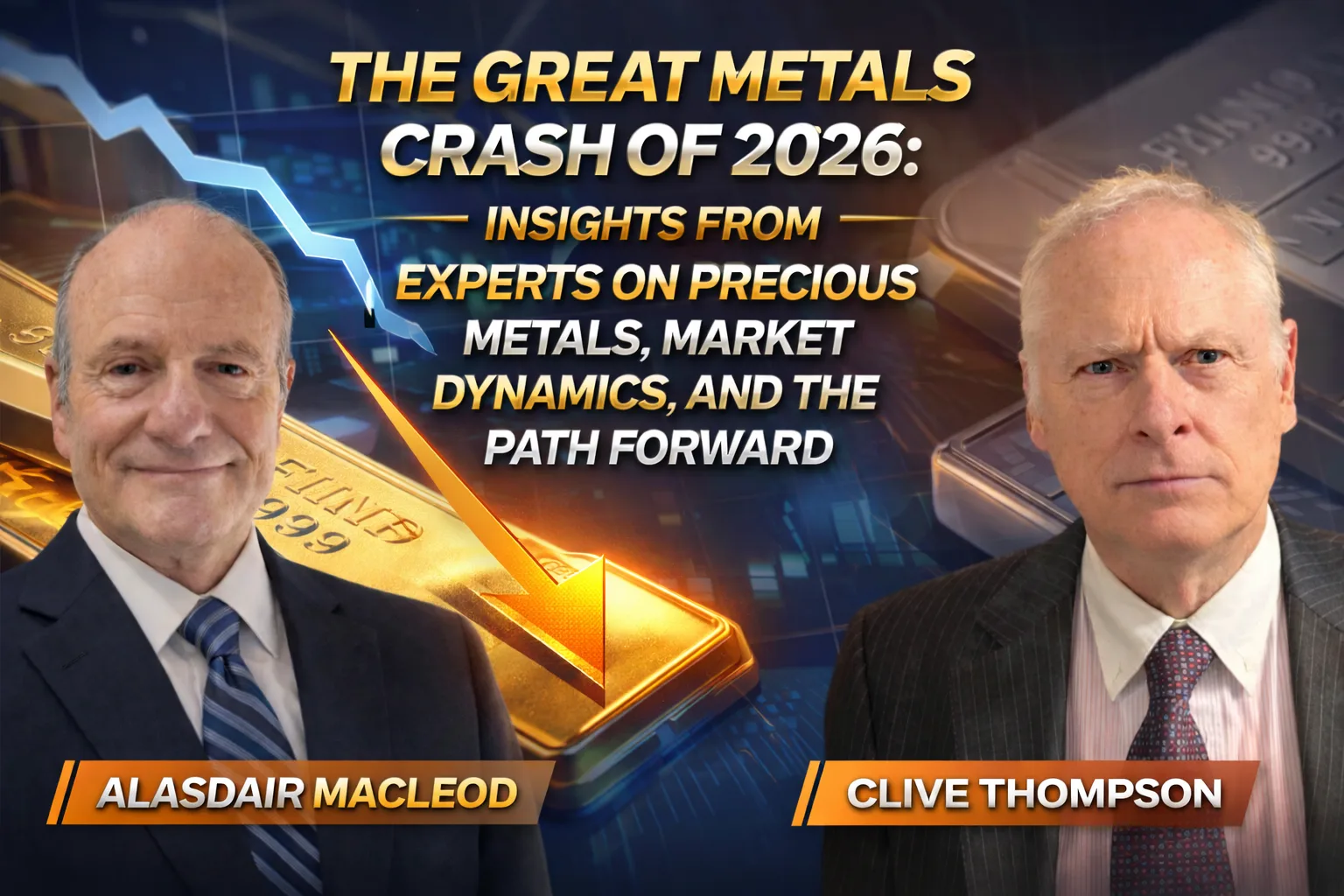
The biggest benefit of conducting interviews with market experts is getting their valuable insights—both on the record, where they share their public views and analysis, and off the record, where the most candid and unfiltered perspectives often emerge. This week I was fortunate to host two highly respected voices in the precious metals space, Clive Thompson and Alasdair Macleod, for in-depth discussions on gold and silver.
The Great Metals Crash of 2026 stands as one of the most dramatic episodes in modern precious metals history. On January 30, 2026, gold futures plunged over 11% in a single session, while silver suffered an even more severe collapse, dropping more than 30%—marking its largest one-day decline in decades. This event, often called the "Great Metals Crash," erased months of parabolic gains that had pushed gold toward $5,600/oz and silver above $120/oz earlier in January.As of February 8, 2026, markets have partially recovered but remain volatile. Spot silver trades around $78–$79 per ounce (with futures showing similar levels after a sharp rebound earlier in the week), while gold hovers near $4,950 per ounce. In India, physical silver is quoted at approximately ₹285 per gram (₹2,85,000 per kg), reflecting local premiums and recovery. These levels represent a significant pullback from January highs but still show impressive year-to-date gains compared to early 2025.This extensive analysis draws from expert insights—particularly retired Swiss banker and wealth manager Clive Thompson and economist Alasdair Macleod—to dissect the crash's causes, aftermath, physical market signals, systemic risks, and long-term outlook. Their perspectives highlight a market torn between leveraged paper dynamics and unrelenting physical demand.
Clive Thompson described the setup vividly:
That "dry wood" consisted of widespread stop-loss orders and highly leveraged positions across CFD platforms, futures exchanges, and margin accounts. In leveraged trading, investors control large positions with minimal capital (e.g., 10% margin for silver), but brokers enforce automatic liquidations when equity falls below thresholds.Once the Warsh announcement hit, initial selling triggered stop-losses, which cascaded lower prices, igniting the next wave—like dominoes or a forest fire.
Thompson emphasized:
Alasdair Macleod added nuance, noting the timing exploited low liquidity (China closed for the weekend, February contract expiry). With minimal speculative longs per COT data, bullion banks and swaps dealers faced little resistance in marking prices down aggressively.Mainstream coverage often focused on "Trump policy fears" or dollar strength, but experts agree the real story was technical leverage unwinding, not fundamental deterioration.
Thompson's analysis of 140+ years of data across gold, silver, and stock market crashes (5%+ single-day drops) reveals a consistent pattern: about two-thirds rebound positively within a year, often strongly.
Why? Crashes create oversold conditions—panic selling + forced liquidations exceed what fundamentals justify. Post-crash, underlying drivers remain: silver's industrial demand (solar, EVs, electronics), geopolitical tensions, currency debasement, and its U.S. strategic metal status.Thompson stressed:
As of February 8, 2026, silver has rebounded sharply from sub-$70 lows earlier in the week, supporting the historical "two-out-of-three" recovery thesis.
Thompson pointed to lagged reporting:
Miners' responses? Rising dividends and selective buybacks. Conference calls typically project optimism in rising-price environments, prompting analyst upgrades. Algorithms chase stocks with elevated target-to-price ratios, fueling post-earnings jumps.
Thompson noted:
Miners appear undervalued bargains if stabilization continues.
Macleod observed:
This East-West divide underscores a paper vs. physical decoupling—a core vulnerability.
Thompson warned:
Macleod noted counterparty risks on shorts but suggested authorities hide failures via bailouts. Low speculative interest allowed aggressive markdowns.If March sees mass deliveries without rollovers/closures, a failure-to-deliver could expose fractional-reserve futures fragility—potentially cascading across markets.
Macleod predicted:
On alternatives: CBDCs are overhyped—mere unbacked credit. Bitcoin heads to zero. Instead, China may peg yuan trade to gold, domestic to silver (ratio 12–15:1). India could follow, placing ~35% of global population on metallic standards.
As Macleod summarized the macro shift:
Precious metals remain a hedge against fiat erosion. In February 2026, amid volatility, the long-term trajectory appears resilient—if not outright bullish—for those focused on physical reality over paper illusions.