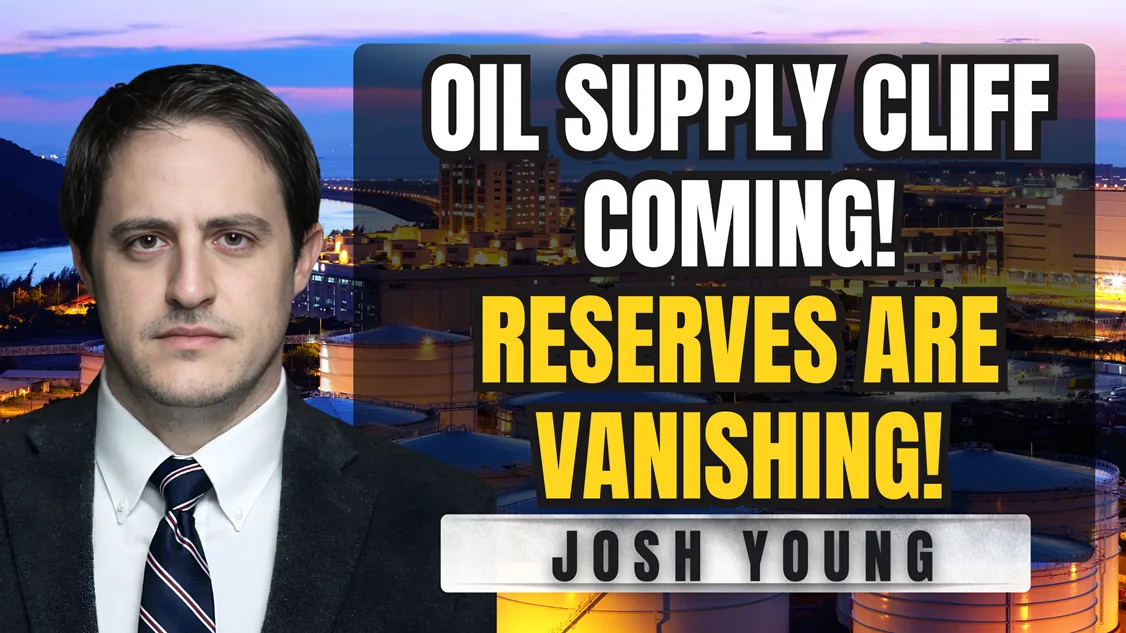

We sat down with contrarian energy investor Josh Young to unpack one of the most polarizing questions in global markets: why oil and gas, despite years of underperformance and neglect, may still represent the most compelling contrarian opportunity as we move deeper into 2026.
Young, who has spent nearly two decades investing in energy securities, does not argue that oil is misunderstood because of short-term price fluctuations. Instead, he believes the market is fundamentally misreading long-term supply dynamics, underestimating geopolitical risk, and overestimating the durability of shale-driven abundance.
Young founded Bison Interest in 2015 with a deliberately contrarian mindset. The firm’s name itself reflects the philosophy: while investors flee storms, bison walk straight into them. In energy equities, he argues, the storm has never really passed.
Despite a brief resurgence in popularity during the 2021 commodity rally—when Bison delivered extraordinary returns and energy briefly graced the pages of mainstream outlets like Barron's—capital has continued to exit the sector. Generalist investors, commodity specialists, and even many energy-focused funds have largely stayed away.
As Young puts it, “The problem has been that everyone’s continued to run away.”
That persistent aversion is precisely what sustains his conviction. Unlike other once-shunned commodities—where producers and service companies have already dramatically outperformed—oil equities remain broadly unloved outside of a narrow group of mega-cap names.
One of the most critical misunderstandings, according to Young, lies in how investors interpret supply data. Global oil production may sit near all-time highs, but that statistic masks a deeper structural problem: reserve depletion.
Young likens today’s oil system to “burning the furniture to stay warm.” Production continues, but discoveries are scarce, reinvestment is insufficient, and reserves are quietly being exhausted without replacement. The world remains warm—for now—but the fuel source is shrinking.
This matters because oil supply is not just about current output. It is about the pipeline of future production. In shale, that pipeline is thinning rapidly. High-decline wells require constant reinvestment just to maintain flat production, and that reinvestment is no longer happening at prior levels.
For more than a decade, U.S. shale accounted for effectively all non-OPEC supply growth. While shale crude represents roughly 13% of global oil supply, total U.S. liquids production approaches 20%—a staggering share for a single country.
That growth engine now appears to be stalling. Recent revisions from the Energy Information Administration show declining forward guidance, and rig counts continue to fall. More importantly, productivity is deteriorating as operators exhaust their best acreage.
Young highlights this as a pivotal inflection point: “If your incremental growth source is going into decline, that’s a real problem.”
In his view, the market is fixated on short-term inventory builds and ignoring what he calls the “second derivative” of shale production—where growth slows, then plateaus, and finally reverses.
While oil prices have remained relatively subdued despite widespread geopolitical unrest, Young argues that the risk distribution is heavily asymmetric. The probability of a catastrophic supply shock may be low, but the consequences would be enormous—and markets are not pricing that tail risk adequately.
Disruptions in Russia, Kazakhstan, Venezuela, Iran, Iraq, the Red Sea, and the Strait of Hormuz all contribute to a fragile equilibrium. Even modest outages—on the order of 500,000 to 1 million barrels per day—could rapidly tighten markets.
Reflecting on this imbalance, Young notes, “The market is so tight right now that even a relatively small disruption… could send prices sharply higher.”
This helps explain why options markets periodically show speculative bets on triple-digit oil prices, even as spot prices remain range-bound.
Contrary to popular belief, Young does not see refining capacity as the primary long-term constraint. While refinery outages can cause temporary dislocations, the industry has proven remarkably adept at rebuilding and adapting.
What investors often miss, however, is the rise of natural gas liquids (NGLs). These products—ethane, propane, butane—are increasingly produced directly from shale wells and feed the fastest-growing segment of energy demand: petrochemicals.
By bypassing traditional refining, NGLs effectively relieve pressure on downstream infrastructure. For Young, this explains why upstream supply—not refining—is where the true scarcity lies.
From an investment standpoint, Young is most enthusiastic about the least fashionable corners of the energy market:
Small-cap upstream producers, many trading at two to three times operating cash flow.
Under-the-radar oilfield service companies, particularly smaller players with niche capabilities or takeover potential.
Large integrated producers, by contrast, now trade at valuations that assume stability rather than scarcity. The real opportunity, Young believes, lies where capital has been absent the longest.
As he bluntly summarizes, “There’s just money sitting there essentially.”
If investors focus on only one indicator over the next several years, Young suggests it should be U.S. shale production relative to rig counts. Confirmation of sustained decline would validate the thesis that oil markets are structurally tighter than consensus believes.
On the demand side, even average global growth—around 1.5 million barrels per day—could be enough to tip the market into persistent deficit. In that scenario, price becomes the balancing mechanism, not surplus supply.
Young closes with an analogy that captures his view of today’s oil market perfectly: Wile E. Coyote running off a cliff, suspended briefly in midair by cartoon physics before gravity asserts itself.
Prices may appear stable, even comfortable. But beneath the surface, the structural supports are eroding.
And when gravity finally returns, it rarely does so gently.
WATCH THE INTERVIEW HERE: