As 2026 opens with gold at record highs and silver pushing into new territory, investors around the world are asking the same question: What exactly is happening beneath the surface of the global financial system?
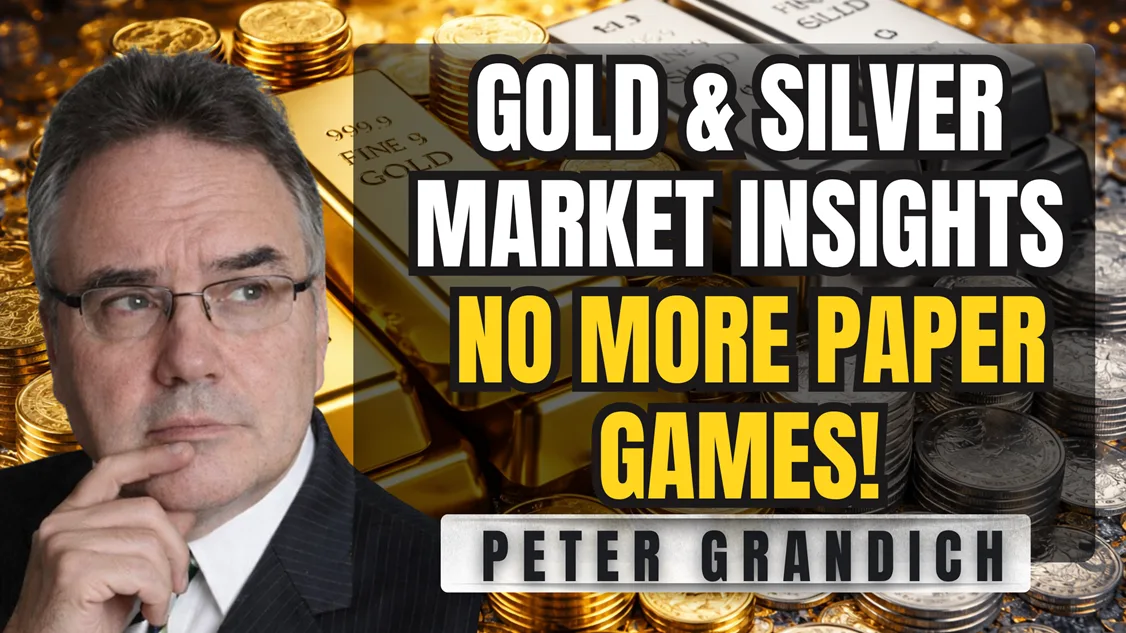
In a recent episode of Triangle Investor Interviews, we sat down with veteran market strategist Peter Grandich, whose 40+ years of financial experience have earned him the reputation of being one of the most candid and forward-looking commentators in the business.
The conversation, spanning global macroeconomics, geopolitical realignments, metals markets, and systemic risks, paints a complex, often concerning portrait of a world in transition.
Gold’s all-time highs across major currencies have stirred debate: Is the metal reflecting monetary stress? A flight from fiat? A simple repricing?
For Grandich, the answer is “all of the above,” but the roots go back years.
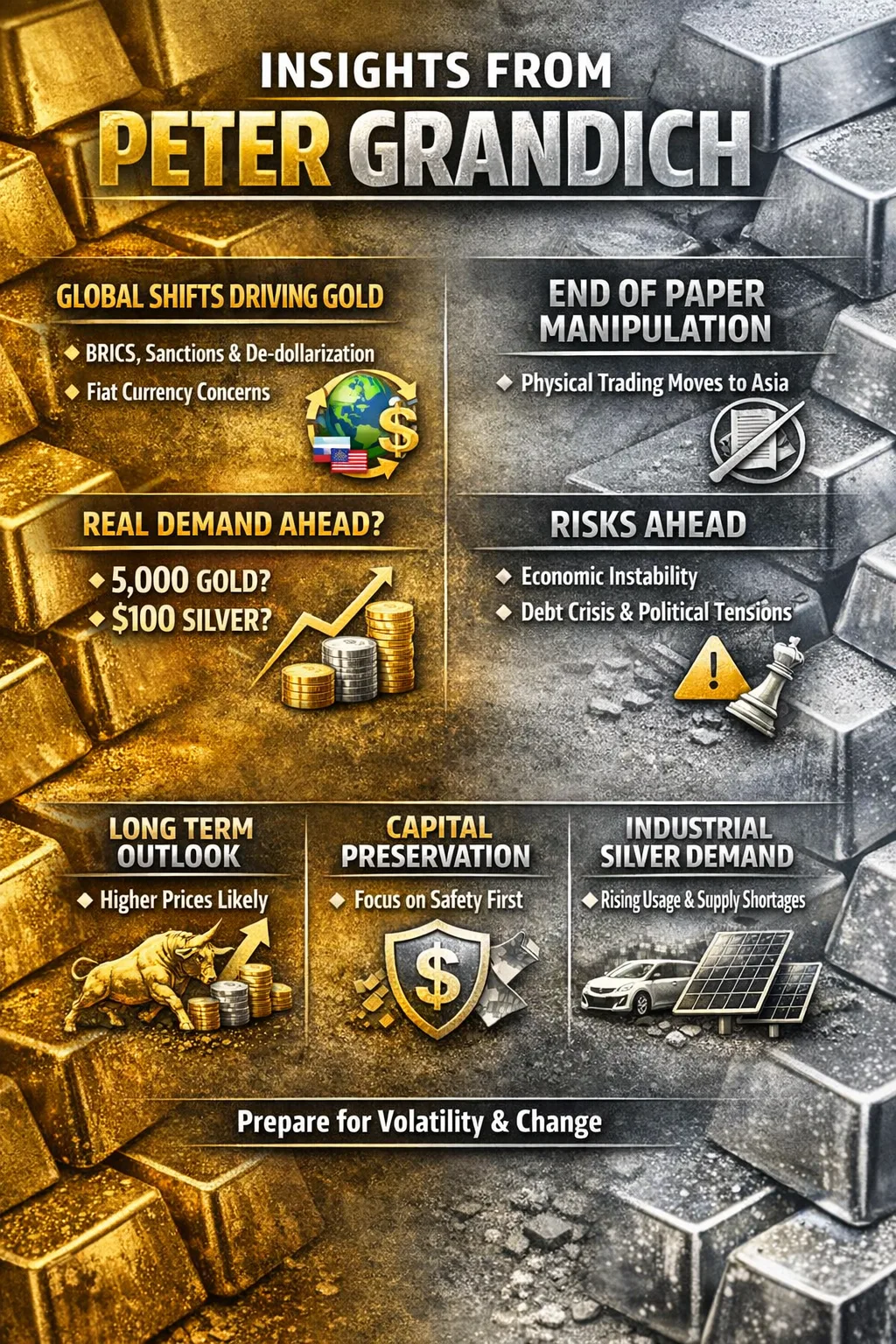
He traces the turning point to a combination of the rise of BRICS and the financial weaponization of the U.S.-led system following the Russia–Ukraine conflict. The expulsion of Russia from SWIFT and the freezing of its reserves sent a message that echoed far beyond Moscow.
“That really opened the door to the eyes of certain countries… the new membership director at BRICS suddenly had an extra selling point: join us, or risk having your assets frozen,” Grandich noted.
According to him, that moment accelerated a multipolar realignment, with gold at its center. Central banks began aggressively accumulating physical metal—not as a hedge, but as a foundation for new trade systems, currency arrangements, and geopolitical autonomy.
And unlike previous eras, the traditional “paper market” influence from London and New York has weakened. Physical trading migrated eastward, primarily to China, undermining decades of price suppression.
“They can no longer manipulate the physical market—Asia now controls it,” he emphasized.
Despite gold’s parabolic move, Grandich insists the public hasn’t even entered the market yet. In the U.S. and Canada, retail investors remain largely absent from physical metals—suggesting that the run-up is driven overwhelmingly by institutional and sovereign demand.
This creates the possibility for another leg higher, albeit with volatility.
Grandich warns that if gold reaches $5,000 and silver $100—levels he considers feasible—the world will likely be facing serious economic and social consequences.
“If they double again from there… whatever negative issues we talk about today not only came true, but new ones emerged,” he cautioned.
His concern is not the prices themselves, but what they would reflect: a breakdown in confidence in currencies, financial systems, and political leadership.
One of the most surprising developments, even for Grandich, has been Wall Street’s reluctant acceptance of gold.
For decades, institutional finance treated gold as “kryptonite,” as he put it—irrelevant, unproductive, even dangerous to the status quo. Yet in late 2025, several major financial institutions began recommending a new portfolio structure: 60% stocks, 20% bonds, 20% gold.
If widely adopted, this shift could fundamentally reprice the metals market. The average U.S. investor currently holds 1% or less in gold or silver.
A move to 3–5% would be seismic.
Anyone familiar with Grandich knows he once dismissed silver as uninteresting—“like kissing your sister,” he joked. But a deep reassessment of silver’s industrial fundamentals changed his mind.
He now views silver’s rise as a combination of two forces:
The collapse of price manipulation, as the physical market moved east.
Exploding industrial demand, particularly for solar, electronics, EVs, and high-tech applications.
Unlike gold, silver faces a genuine supply crunch—one driven not by speculation, but by industrial necessity.
The conversation drifted to global geopolitics, particularly Europe’s declining economic position. Grandich was blunt: he believes the EU’s economic engine—Germany—has “blown up,” leaving Europe structurally weakened.
He contrasts this with Asia, which he considers the primary center of future growth.
“The central banks to focus on are in the Far East—China and India are absorbing gold and silver continuously.”
Europe’s political fragmentation, aging demographics, and economic stagnation only accelerate the trend.
When asked about the U.S. stock market and the future of the Dow, Grandich highlighted what he considers the biggest systemic risk: passive investing.
Over half of all invested money in the U.S. sits in passive index funds. These funds buy stocks blindly, based on index weightings—not fundamentals. This creates a self-reinforcing cycle during bull markets, but a potentially catastrophic feedback loop during downturns.
Grandich fears that most financial advisors today—many of whom were not even born when he entered the industry—have only lived through a long bull market supported artificially by Federal Reserve intervention.
Their clients, likewise, are dangerously complacent.
When a true bear market hits, both advisors and investors may be psychologically and structurally unprepared.
Grandich is not broadly bullish, but he acknowledges several sectors with continued upside:
Uranium and nuclear energy, due to structural global demand.
Select metals and mining companies, especially those tied to electrification.
Infrastructure and electrical grid modernization, which he believes is urgently needed in the U.S.
Water, food, and agriculture, sectors increasingly strained by aging farmers and declining domestic capacity.
However, he cautions that none of these sectors are undervalued anymore—they simply have momentum and long-term structural support.
Grandich highlighted a demographic trend with massive economic implications: longevity.
If two people are 65 today, there's a 25% chance one will live to 100. Yet almost no one is financially prepared for a 35-year retirement—least of all in the U.S., where two-thirds of Americans live paycheck to paycheck.
This, combined with political division—“the worst since the Civil War,” he argues—creates a fragile national condition.
His message for older investors is crystal clear:
“Capital preservation must override capital appreciation. I’d rather be early than a day too late.”
The Grandich conversation paints a world where:
Gold is re-emerging as a geopolitical anchor.
Silver is shifting into a critical industrial role.
Passive investing poses systemic risks.
Demographics and political division strain Western economies.
Asia increasingly dictates the future of global trade and monetary systems.
Through it all, Grandich’s advice remains grounded in experience—half a century of watching markets rise, fall, and reinvent themselves.
As the world enters a period of structural change, his voice offers both caution and clarity.
WATCH THE INTERVIEW HERE: