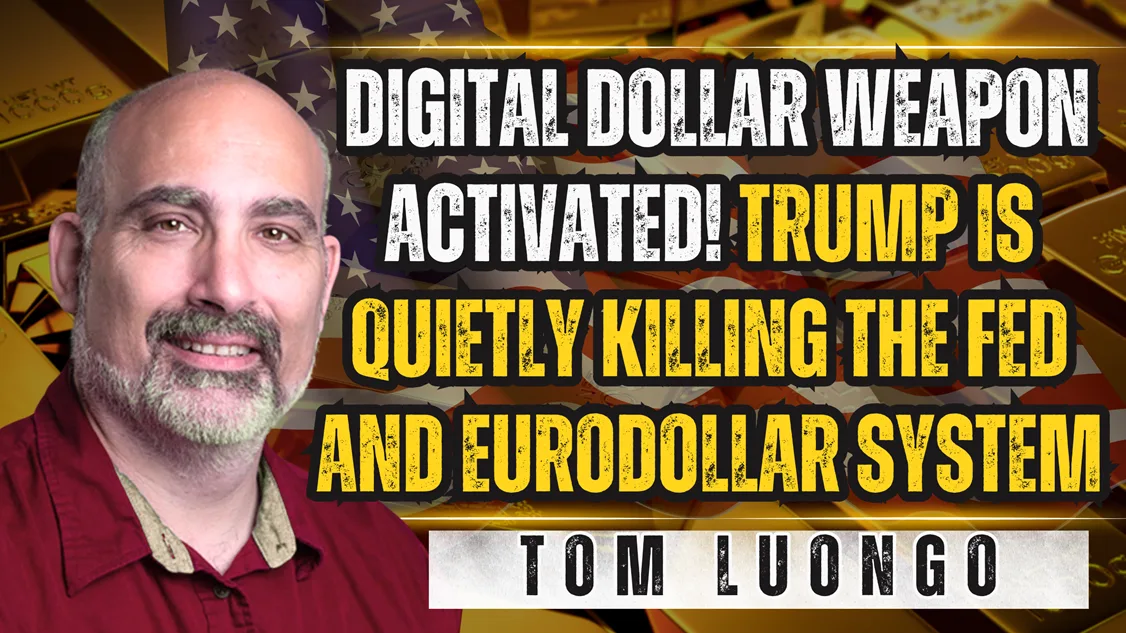

In a wide-ranging interview, geopolitical and macroeconomic analyst Tom Luongo laid out a stark, often uncomfortable thesis: the post-Cold War world order is collapsing, and what is replacing it is not a return to liberal idealism, but a hard-nosed struggle for sovereignty, power, and control over money, commodities, and trade.
From Venezuela to Ukraine, from gold markets to stablecoins, Luongo argues that the world is moving away from British-designed financialization and toward a multipolar system dominated by industrial powers seeking predictability rather than chaos. This transition, he warns, will not be polite, legalistic, or morally pure. It will be messy, coercive, and deeply destabilizing—especially for Europe.
What follows is a synthesis of Luongo’s core arguments, broken into five major themes.
1. Venezuela and the Return of Hemispheric Sovereignty
Luongo frames recent U.S. actions against Venezuelan oil shipping not as a prelude to a conventional war, but as a reassertion of American dominance in the Western Hemisphere. From his perspective, the idea that China could meaningfully project naval power in the Americas is largely illusory. What matters more is signaling.
According to Luongo, Washington’s message is blunt:
the Western Hemisphere remains under U.S. control, regardless of whether that reality makes allies or adversaries uncomfortable.
Venezuela, in this framework, is not simply about oil. It is a central node in a multi-ethnic, transnational criminal network involving drugs, money laundering, intelligence services, and legacy Cold War arrangements stretching back decades. Luongo emphasizes that these systems were not built recently—they trace their origins to the Iran-Contra era and earlier, when overlapping intelligence, political, and criminal networks became embedded across Latin America.
Rather than a traditional “color revolution,” Luongo sees current pressure on Caracas as a hybrid strategy:
Direct military intimidation
Exposure of criminal networks
Coercive diplomacy aimed at forcing compliance rather than regime replacement
In his view, President Trump is attempting to “thread the needle”: keep Nicolás Maduro nominally in power while subordinating him to U.S. strategic objectives, thereby avoiding the chaos and blowback of outright regime change.
This approach, Luongo argues, reflects a broader shift away from idealistic democracy promotion toward transactional, power-based politics—what he openly calls “mob boss politics.”
2. Ukraine, Europe, and the War That Cannot End
On Ukraine, Luongo is unequivocal: the war continues not because it must, but because Europe cannot afford for it to end.
He advances a controversial but internally consistent argument:
European governments have already spent Russia’s seized foreign exchange reserves and issued loan guarantees to Ukraine based on that money. If the war ends without Russia’s defeat, those guarantees will blow back onto European banks—potentially triggering a systemic crisis.
This, Luongo suggests, explains Europe’s desperation:
Its hostility toward peace initiatives
Its resistance to U.S.–Russian negotiations
Its willingness to escalate militarily despite dwindling public support
He points to the International Court of Justice’s decision to advance Russia’s claims regarding pre-war actions in the Donbas as a potential legal turning point. If Russia ultimately prevails both militarily and legally, Luongo argues, it could seek reparations not just politically, but judicially—turning Europe’s moral narrative on its head.
From this perspective, Britain emerges as the true driver of escalation. Luongo repeatedly emphasizes that Ukrainian military actions are tightly coordinated with British intelligence, portraying London as the last great champion of the old imperial order.
The irony, he notes, is stark:
while the U.S., Russia, and China increasingly operate through pragmatic deal-making, Europe clings to moral absolutism precisely because it is financially trapped.
3. The Coming European Bond Crisis
Luongo has long warned of what he calls a “euro-trash bond meltdown,” and he believes the conditions for it are now firmly in place.
Several signals concern him:
Emergency liquidity operations by the Federal Reserve
Persistent stress in European sovereign debt
Rising yields that threaten already fragile banking systems
In Luongo’s telling, Ukraine has always been the catalyst rather than the cause. The real issue is structural: Europe built a financial system dependent on perpetual stability, cheap energy, and American security guarantees. All three are now gone.
He predicts that when peace finally arrives—whether through negotiation or exhaustion—the financial reckoning will begin. Bond markets, not equities, will be the epicenter of the crisis, as governments struggle to refinance debts accumulated under assumptions that no longer hold.
4. Gold, Silver, and the End of London’s Price Control
One of Luongo’s most technical but crucial arguments concerns the breakdown of the London-centered commodity pricing system.
He sees several converging developments:
Gold holding above $4,200
Silver volatility spiking
Major banks exiting short positions
Growing emphasis on physical delivery
Luongo argues that futures markets have been hijacked by financial speculation, particularly in London, transforming them from tools of industrial coordination into mechanisms of monetary manipulation.
The solution, in his view, is disaggregation:
Futures markets should coordinate physical supply and demand
Speculation should be pushed into ETFs, CFDs, or crypto instruments
Physical commodities should no longer be endlessly rehypothecated
He believes the U.S., China, and Russia all share an interest in breaking London’s control over commodity pricing—not for ideological reasons, but because industrial economies require predictability. No country can plan infrastructure, manufacturing, or defense when key inputs swing wildly week to week.
The gradual decline in oil price volatility, which Luongo tracks closely, is for him a sign that this transition is already underway.
5. Stablecoins, the Fed, and a New Dollar System
Luongo views the explosion of stablecoins—notably dollar-pegged ones—as one of the most underappreciated shifts in global finance.
Rather than weakening the dollar, he argues, stablecoins:
Extend dollar liquidity offshore
Undermine Eurodollar dominance
Bypass legacy European banking systems
In this framework, the Federal Reserve itself is poised for reform. Luongo rejects the idea that conflicts between Trump, Treasury officials, and Fed leadership are personal. Instead, he sees coordinated institutional change.
He suggests the Fed’s future role will be narrower but more strategic:
Lender of last resort for domestic paper markets
Enforcer of dollar parity
Gatekeeper for offshore dollar access
Stablecoins, meanwhile, become the mechanism for re-dollarizing regions long trapped in post-colonial monetary systems—particularly in Africa—without relying on European intermediaries.
This, Luongo insists, is what real financial sovereignty looks like.
6. Why Bonds Will Break Before Stocks
Contrary to popular crash narratives, Luongo does not foresee an imminent equity collapse. Instead, he expects:
Credit-based assets to deflate
Commodity-based assets to inflate
Equities to trade sideways for years
He likens capital flows to water sloshing in a basin—constantly moving, rarely settling. In such an environment, stocks may hold nominal value even as real value erodes relative to gold, energy, and hard assets.
The real danger, he argues, lies in bonds:
Rising yields
Fiscal stress
Political instability
By 2026, Luongo believes these forces could converge into a systemic bond crisis, triggering government failures, bank collapses, and intensified geopolitical conflict.
Conclusion: An Uncomfortable Transition
Tom Luongo’s worldview is not optimistic, but it is internally consistent. He rejects the notion that the world is governed by rules, institutions, or moral consensus. Instead, he sees power, leverage, and control of resources as the only constants.
In his telling, the liberal international order is not being reformed—it is being dismantled. What replaces it will be harsher, more transactional, and far less forgiving. Yet, paradoxically, it may also be more stable in the long run, precisely because it is grounded in realities rather than illusions.
Whether one agrees with Luongo or not, his analysis forces a reconsideration of deeply held assumptions—about war, money, markets, and the meaning of sovereignty in a world that is rapidly losing its old certainties.
Watch the interview here: