
DISCLAIMER: PRESENTED COMPANY IS OUR CLIENT!
Introduction
In a rapidly evolving global energy landscape, companies must adapt quickly to survive and thrive. Few stories illustrate this better than Fusion Fuel Green, an integrated energy platform listed on NASDAQ under the ticker HTOO.
Originally founded as a green hydrogen technology company, Fusion Fuel Green has undergone a significant strategic pivot. Today, the company is positioning itself as a diversified energy platform anchored by long-term royalty income and supported by multiple operating businesses across different energy sectors and geographic markets.
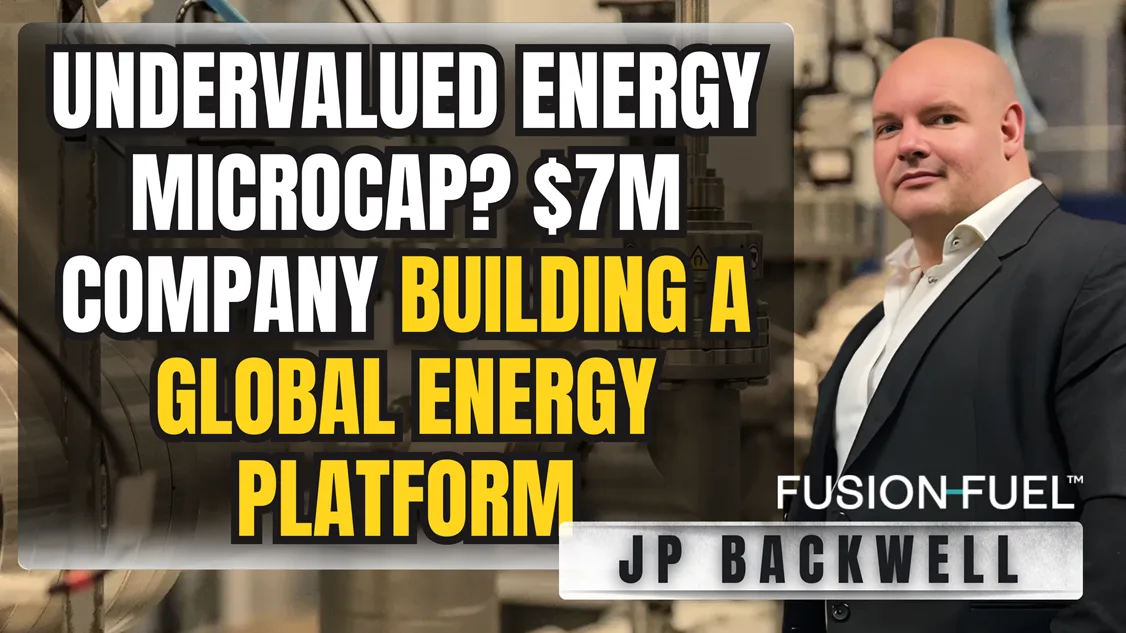
In a recent interview on our platform, CEO John Paul Backwell discussed the company’s transformation, its asset portfolio, and the opportunities that lie ahead as the global energy transition accelerates.
From Green Hydrogen Startup to Diversified Energy Platform
Fusion Fuel Green began with a strong focus on green hydrogen technology. The company went public on the Nasdaq in 2021 with the ambition of becoming a major participant in the emerging hydrogen economy.
At the heart of its early strategy was proprietary electrolyzer technology designed to produce green hydrogen using renewable energy. The company deployed projects in Southern Europe and invested heavily in hydrogen innovation.
However, the economics of the hydrogen industry changed rapidly.
Chinese manufacturers entered the electrolyzer market with dramatically lower prices, which significantly altered the competitive landscape. For a smaller company attempting to scale manufacturing in Europe, competing with these price dynamics became increasingly difficult.
According to CEO John Paul Backwell, management ultimately faced a clear strategic decision: continue competing in a segment where pricing had collapsed, or pivot toward a broader and more resilient energy strategy.
The company chose the latter.
This decision led to a transformation of Fusion Fuel Green into a diversified energy platform combining operating energy businesses with royalty-based assets.
Management believes the new structure provides stronger long-term stability while maintaining exposure to major energy transition trends.
The New Business Model: A Royalty-Anchored Energy Platform
Today, Fusion Fuel Green describes itself as a royalty-anchored energy platform.
The core concept is relatively simple. The company combines two different types of businesses:
First, long-term royalty income streams tied to natural resource production.
Second, operating energy businesses that generate near-term cash flow.
This hybrid model is designed to create value across multiple time horizons. Operating businesses generate revenue and support growth today, while royalties provide exposure to long-term commodity cycles and resource development.
The royalty model itself has proven highly successful in other sectors of the resource industry.
In mining, companies such as Franco-Nevada and Wheaton Precious Metals built multi-billion-dollar businesses using royalty and streaming models. These companies provide capital or acquire royalty rights in exchange for a percentage of future production revenue.
The key advantage is capital efficiency. Once the royalty is acquired, the holder typically has no operating costs, no capital expenditures, and no responsibility for running the underlying project.
Fusion Fuel is attempting to apply a similar model within the energy sector, particularly through exposure to uranium and natural gas assets.
Core Operating Businesses
Alongside its royalty platform, Fusion Fuel operates several businesses across different energy segments and geographic regions. These businesses provide operating revenue and support the company’s diversified strategy.
Al Shola Gas
The company’s primary revenue driver today is Al Shola Gas, an established LPG distribution business based in Dubai.
Fusion Fuel owns 51 percent of the company.
Al Shola Gas has operated in the UAE market for more than four decades and serves approximately 38,000 customers. The company employs roughly 130 staff and operates a fleet of more than 50 vehicles delivering LPG to residential, commercial, and industrial clients.
The business generates strong margins and recurring demand due to the essential nature of gas distribution services.
Bulk LPG supply margins typically approach 40 percent. According to management, each delivery truck in operation can generate between $100,000 and $130,000 in monthly revenue.
The company continues to expand its fleet and infrastructure as demand grows.
Al Shola Gas secured nearly $10 million in new contracts during 2025 and currently has an estimated 18-month backlog of projects.
Management expects the group’s overall revenue in 2025 to be approximately ten times higher than the company generated in 2024, largely driven by growth in this business.
Bright Hydrogen Solutions
Although Fusion Fuel moved away from manufacturing hydrogen electrolyzers, it continues to maintain a presence in the hydrogen sector through Bright Hydrogen Solutions.
This subsidiary focuses on hydrogen engineering, consulting, and infrastructure development.
Unlike the earlier manufacturing-focused strategy, this business operates with a capital-light structure. Instead of building factories or producing equipment, the company provides engineering design and advisory services for hydrogen projects.
This approach reduces capital requirements while allowing the company to remain connected to developments in the hydrogen economy.
Bright Hydrogen has already secured engineering contracts totaling approximately 15 megawatts of project capacity. The company is also negotiating the delivery of a two-megawatt hydrogen plant.
In addition, management is developing a 30 million euro hydrogen infrastructure investment vehicle designed to attract external capital for hydrogen projects.
BioSteam Energy
Fusion Fuel has also expanded into biomass-based energy solutions through BioSteam Energy, a joint venture in which the company owns 51 percent.
BioSteam focuses on providing biomass-powered thermal energy for industrial facilities, particularly in South Africa.
The market opportunity in South Africa is driven by structural challenges in the national electricity system. The country’s state-owned electricity provider, Eskom, has struggled with reliability and infrastructure problems, leading to frequent power shortages.
Many industrial operations require stable thermal energy around the clock. BioSteam’s biomass steam systems offer an alternative energy source capable of operating continuously.
The company’s first commercial project, located at Fairfield Dairies, is expected to generate approximately $650,000 in annual revenue and roughly $150,000 in net income.
BioSteam currently has 17 additional projects in its sales pipeline, suggesting potential for significant expansion.
Royal Uranium: The Strategic Anchor
The long-term centerpiece of Fusion Fuel’s strategy is its royalty portfolio, managed through the subsidiary Royal Uranium.
The company currently holds 19 royalty interests connected to uranium and natural gas assets.
Many of the uranium royalties are located in Canada’s Athabasca Basin, widely considered one of the most important uranium mining regions in the world.
Major operators in this region include Cameco, Orano, Uranium Energy Corp, and other leading uranium producers.
Owning royalties on projects in these areas allows Fusion Fuel to participate in uranium production without directly operating mines or funding large-scale development.
Six of the company’s 19 royalties are considered relatively advanced projects with potential production timelines ranging from two to ten years.
In addition to uranium, the portfolio includes natural gas royalties that already generate approximately $500,000 in annual revenue.
Why Uranium?
Fusion Fuel’s focus on uranium reflects management’s belief that nuclear energy is entering a new growth phase.
More than 60 nuclear reactors are currently under construction worldwide, and global nuclear generating capacity is expected to expand significantly over the coming decades.
Many governments are reconsidering nuclear energy as a reliable, low-carbon source of electricity capable of supporting electrification, data centers, and artificial intelligence infrastructure.
Industry projections suggest global uranium demand could increase by more than 100 percent by 2040.
For Fusion Fuel, the royalty model provides exposure to this long-term trend without the operational risks associated with mining.
Strategic Governance Move: Uranium Investor James Passin Joins the Board
A recent development further highlights the importance of the uranium strategy.
In March 2026, Fusion Fuel approved the appointment of uranium investor James Passin to its board of directors.
Passin brings more than two decades of experience investing in uranium and natural resources. He previously managed resource-focused investment portfolios and has long been active in the uranium sector.
His appointment comes as Fusion Fuel accelerates the development of its uranium royalty platform.
According to the company, Passin will contribute expertise in commodity markets, capital allocation, and resource investment strategy.
He has been appointed as a Class III director and will serve on several board committees, including the audit, compensation, and corporate governance committees.
His presence on the board is closely connected to Fusion Fuel’s planned acquisition of Royal Uranium, which would provide the company with a diversified portfolio of uranium and natural gas royalties across the Americas.
The transaction is expected to close during 2026, subject to shareholder approval and regulatory conditions.
If completed, the acquisition would significantly strengthen Fusion Fuel’s position in the uranium royalty market.
Global Geographic Footprint
Fusion Fuel’s operations span several regions around the world.
The United Arab Emirates is currently the company’s most important market in terms of revenue due to the presence of Al Shola Gas.
Canada plays a strategic role through the uranium royalty portfolio concentrated in the Athabasca Basin.
South Africa offers strong growth potential through BioSteam’s biomass energy projects.
Meanwhile, Spain and Portugal represent key markets for hydrogen engineering services through Bright Hydrogen.
This geographic diversification helps reduce reliance on any single market or energy segment.
Growth Strategy: Acquisitions and Expansion
Acquisitions remain central to Fusion Fuel’s long-term growth strategy.
The company is pursuing two main acquisition tracks.
The first focuses on expanding the royalty portfolio. Fusion Fuel has engaged three specialist mineral advisory firms tasked with identifying new uranium and natural gas royalty opportunities.
The second track focuses on acquiring profitable operating businesses within the energy sector.
One example is a potential acquisition currently under negotiation in the United Kingdom.
Management intends to finance most acquisitions through debt rather than equity in order to minimize shareholder dilution.
Financial Profile and Valuation
Fusion Fuel currently has a market capitalization of roughly $7 million, placing it firmly within the micro-cap category.
However, management believes the company’s market valuation does not fully reflect the underlying value of its assets.
Internal assessments and fairness opinions suggest that certain business units alone could be worth multiples of the current market capitalization.
For example, the Al Shola Gas business has been valued at more than $20 million in recent asset assessments.
The company is preparing to release a comprehensive third-party sum-of-the-parts valuation that will provide additional transparency for investors.
Capital Structure and Cash Flow
Another distinctive feature of Fusion Fuel’s structure is its relatively low burn rate at the parent company level.
Most of the company’s operating subsidiaries either generate positive cash flow or cover their own costs.
Al Shola Gas is already profitable and expanding.
Bright Hydrogen recently reached breakeven.
Royal Uranium generates cash flow through existing gas royalties.
BioSteam’s first commercial project is expected to begin producing revenue shortly.
This structure provides a stable financial foundation for future growth while limiting the need for constant capital raises.
Key Catalysts Ahead
Several upcoming developments could act as catalysts for the company.
These include the release of Fusion Fuel’s annual report and a comprehensive investor update expected in the near future.
Management also plans to publish a third-party valuation analysis that outlines the value of the company’s various assets.
Additional uranium royalty acquisitions may be announced as the company expands the Royal Uranium portfolio.
Closing the potential UK acquisition could also represent a significant growth milestone.
Meanwhile, new hydrogen engineering contracts and additional BioSteam projects could further expand operating revenue.
Conclusion
Fusion Fuel Green’s story illustrates how companies in emerging energy sectors must adapt quickly to changing market conditions.
After pivoting away from pure hydrogen technology, the company has rebuilt itself as a diversified energy platform combining operating businesses with long-term royalty assets.
Its strategy now spans several sectors including LPG distribution, hydrogen engineering, biomass energy, and uranium royalties.
If management successfully executes its acquisition strategy and expands its royalty portfolio, Fusion Fuel could evolve from a micro-cap energy company into a broader asset-owning platform.
For now, the transformation remains in progress. But the company’s goal is clear: build a portfolio of long-life, cash-generating energy assets capable of delivering value across both the energy transition and global commodity cycles.
WATCH THE CEO INTERVIEW HERE: