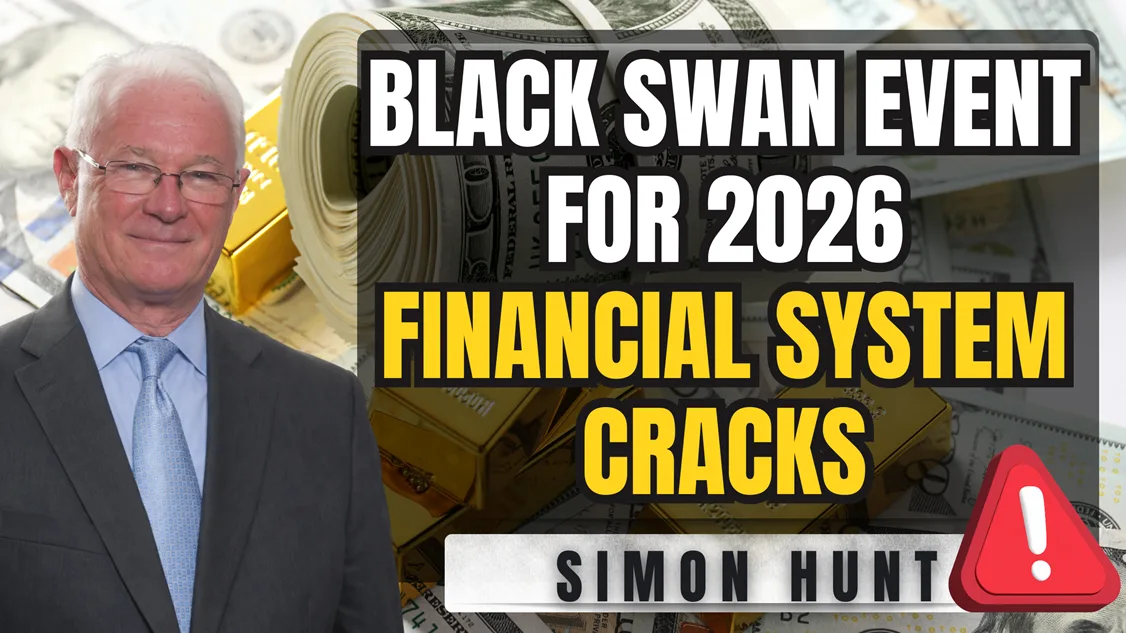

Global geopolitics, financial fragility, and escalating military tensions are converging toward a decisive turning point. In a wide-ranging interview, Simon Hunt—founder of Simon Hunt Strategic Services—offered a stark assessment of the global order, the West–BRICS divide, and the economic instability building through 2026. His outlook suggests the world is heading into a period of structural upheaval, rising conflict risk, and monetary transformation that will shape the rest of the decade.
Hunt begins with a blunt warning: “the momentum of tension will increase this year and next year with a risk that something mega breaks out in 2028 or 2029.” While he does not expect a full-scale confrontation between the West and BRICS in 2026, he sees the world moving toward a major geopolitical rupture later in the decade.
According to Hunt:
Russia will win militarily
No diplomatic settlement will end the war
The conflict likely continues through late 2026
His assessment is unequivocal: “The war will be won on the battlefield, which Russia will win. And then they will sit down and say, these are our terms.”
He also warns that Western miscalculations—such as a potential false-flag escalatory action—could bring the U.S. closer to the conflict than intended.
The Iran file is where Hunt sees the greatest danger:
A U.S.–Israeli strike was reportedly considered but halted
Two U.S. carrier groups are heading toward Bahrain
Non-essential U.S. personnel are being replaced with combat forces
Iran is fully prepared for a large-scale conflict and backed by China and Russia
Hunt notes that Chinese and Russian cargo planes have recently landed in Tehran, suggesting coordinated preparation for a potential confrontation.
Why would Washington risk such a strike? Hunt points to three motivations: disrupting BRICS logistics, gaining control over global energy flows, and enabling regime change.
But the risk is enormous: if Washington fails, Gulf states may realign toward Iran, Russia, and China.
Hunt believes the U.S.–China relationship has crossed a critical threshold. In his words, “America and China are shifting from being competitors to being adversaries.” The reason? China’s aggressive adoption of AI-driven robotics, humanoids, and fully automated “dark factories” that operate without human labor, lighting, or heating.
China’s advantages include:
1.3 million engineering graduates yearly
Vast power generation capacity
Domestic control of critical robotics materials
This revolution enables ultra-low-cost manufacturing, threatening Western industrial competitiveness. Hunt argues Washington will intensify efforts to slow or block China’s ascendancy in the Fourth Industrial Revolution.
Hunt forecasts:
A global slowdown through mid-2026
Fiscal and monetary stimulus afterward
A subsequent rise in inflation and bond yields
He expects U.S. 10-year Treasury yields to dip below 3% before rising again later in the year.
Hunt calls the official CPI numbers “fake,” pointing to alternative measures showing inflation closer to 9–11% in 2025–2026. With more stimulus coming, he says the U.S. is entering stagflation—low growth combined with fast-rising prices.
By 2028:
Bond yields could reach 8–10%
The U.S. and G7 could face severe financial instability
Hunt’s most dramatic macro prediction centers on the U.S. dollar. In his view:
“The dollar’s days are all over.”
He expects:
Continued dollar rallies, but within a long-term downtrend
A 50% decline in the DXY index by 2028–2029
Meanwhile, BRICS nations plan to launch a gold-based reserve currency—the Unit—backed by:
40% gold
60% member currencies
In parallel:
China’s digital yuan is expanding internationally
More countries are adopting CIPS, China’s alternative to SWIFT
China is building BRICS-wide gold vaults to support currency-for-gold swaps
This emerging system is intended to offer a dollar-independent, commodity-anchored financial network.
Hunt expects a 3–6 month correction in industrial metals:
Copper could fall from ~$13,000–14,000/t to ~$7,000/t
A new bull market begins late 2026 into 2027
Geopolitical stress will be the primary upward driver.
He forecasts:
Gold could reach $9,000/oz by 2029
A short-term washout is needed to shake weak hands from the market
He declines to project silver due to conflicting data and narratives.
Hunt warns that something is breaking within the global financial system. He points to:
A massive £948 billion liquidity injection by the Bank of England
Large ongoing Federal Reserve repo operations
His conclusion: the next black swan will come from a sudden financial collapse—possibly a major institutional failure or liquidity event.
Hunt expects the global financial landscape to look radically different by early 2030:
A functioning, gold-linked BRICS currency
Broad adoption of China’s digital yuan
Widespread use of CIPS for international payments
Distributed BRICS gold vaults enabling instant swaps
This multipolar system aims to erode the dollar’s dominance in trade and reserves.
Simon Hunt’s analysis suggests the world is entering a decade of profound transformation. From the destabilization of Western financial systems and the weakening of the dollar, to BRICS’ monetary innovations and China’s robotics-driven revolution, the geopolitical and economic landscape of the late 2020s is poised for historic change.
Whether all these predictions materialize or not, Hunt’s core message is clear:
A major reset is coming—and investors cannot afford to ignore it.