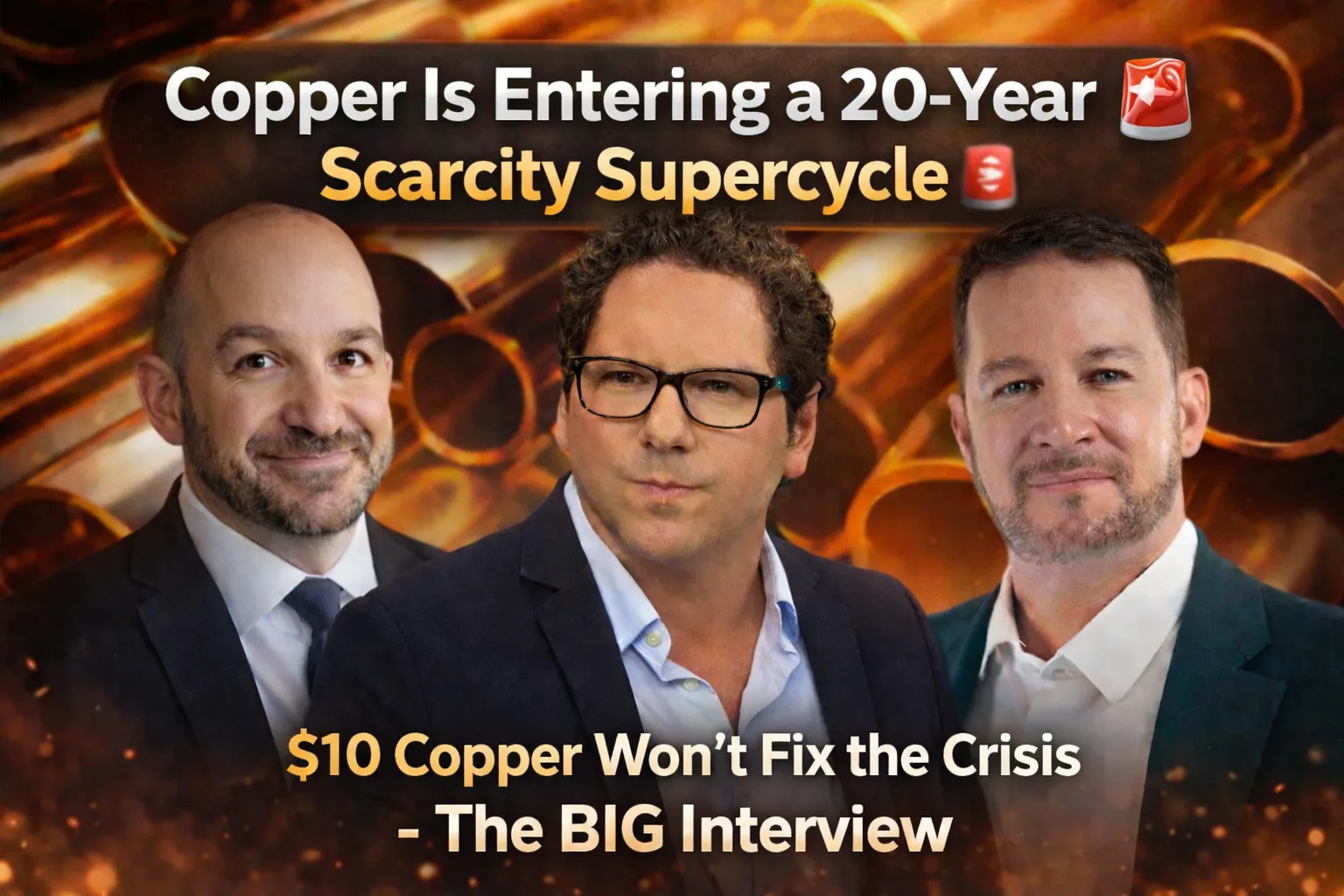
The global copper market is entering one of the most transformational periods in modern history. Electrification, AI-driven power demand, shrinking mine supply, and geopolitical realignments are converging into what experts increasingly call a Copper Supercycle — a multi-decade stretch where demand meaningfully outstrips supply.
To break down these forces, I interviewed three leading voices in the industry:
Gianni Kovacevic
Ivan Bebek of Copernico Metals
Ian Harris of Copper Giant Resources
This article distills their full conversation into a detailed guide to today’s copper market — and what’s coming next.
Gianni Kovacevic opened with a crucial statistic:
75% of global copper consumption is tied directly to electricity — generation, transmission, storage, and end-use.
Only 25% goes to traditional sectors like plumbing and HVAC.
As the world pushes away from fossil fuels, nearly every electrification technology — EVs, solar, wind, grids, transformers, charging networks — requires substantial copper.
Historically, ~20% of global final energy consumption was electrified.
China jumped from 20% to 30% in ten years.
The world is now moving toward 40–50% electrification, where copper intensity increases sharply.
This structural shift forms the backbone of the multi-decade bull case.
Kovacevic and Harris highlighted a major new copper demand vector: AI compute.
Data centers and hyperscale infrastructure could add 300,000–500,000 tonnes of copper demand per year by 2030, on top of already rising EV and renewable requirements.
AI is now competing with automakers and utilities for the same copper supply – and it’s only accelerating.
Ivan Bebek stressed that many of the world’s largest copper mines — including supergiants like Escondida Mine — are:
Getting deeper
More expensive to operate
Lower grade than ever
Facing higher strip ratios
Meanwhile, global copper grades have fallen 50% since 2000.
Since 2015, only a handful of large-scale copper discoveries have been made.
Bebek notes this is one of the worst droughts in modern mining history.
Permitting now takes:
10–15 years for exploration-to-construction in normal jurisdictions
20–30+ years in complex jurisdictions
Some deposits may never be mined due to social complexities
This is the biggest bottleneck in global copper supply.
A major theme from all three experts is this:
The copper price cannot incentivize enough new supply fast enough.
Major mines take 15–25 years to develop
Grade decline is accelerating
Social license is harder to obtain
Governments increase taxes & royalties as prices rise
Environmental restrictions are tightening
No pipeline of shovel-ready mega-deposits exists
Ian Harris bluntly stated:
“It doesn’t matter what the price is. Copper must go way higher just to be short.”
All three experts agree aluminum will grow as a substitute — but only when:
Copper is unavailable, or
Copper is priced out temporarily
However:
Aluminum is 60% less conductive
Requires much thicker wires
Is more brittle
Is less efficient over long distances
Substitution eases pressure but does not fix the supply deficit.
Harris explained that recycling cannot meaningfully fill the global copper shortage:
Most scrap copper is already recycled
The U.S. ships huge quantities abroad instead of reprocessing them domestically
Scrap supply depends on demolition and infrastructure retirement cycles
Conclusion:
Recycling shifts material around — it does not create new supply.
Every developed and developing nation needs massive grid upgrades to handle:
EV charging
AI data loads
Renewable energy variability
Electrified heating
This represents millions of tonnes of hidden copper demand.
Military technology is becoming more electric, digital, and copper-intensive.
The world’s population has doubled since the 1980s — dramatically increasing construction and copper-intensive urbanization.
Harris believes copper stocks remain far below fair value, especially compared to gold or silver miners.
Investors still view copper as “boring”
Generalist funds haven’t entered the space
Majors fear overpaying after past cycles
Scarcity of high-quality projects keeps valuations depressed
But as Harris points out:
“Once the first major moves, the rest move like a pack of dogs.”
A massive M&A wave is coming.
Bebek expects M&A in:
Chile
Peru
Ecuador
These regions hold the world’s largest undeveloped copper systems and long histories of mining.
Selective jurisdictions with strong geological endowment.
He warns that many other regions — with political instability or weak permitting frameworks — will remain unmineable for decades.
Kovacevic highlighted an upcoming project from Ross Beaty’s Lumina group in Poland — containing:
1.5 billion ounces of silver
One of the world’s largest copper deposits
This showcases how gold or silver by-product credits can dramatically improve copper project economics.
However, Bebek cautions:
Metallurgy can make by-products difficult to recover
Permitting remains the primary constraint
Even excellent deposits need decades to develop
Kovacevic’s advice:
Not one-man operations, but strong syndicates with repeated financing capacity.
Copper climbs “a wall of worry” — speculators push it up, then panic pushes it down.
A 5–10 year view is necessary.
World-class discoveries rarely happen on the first drill hole.
True wealth in mining comes from early exposure to major discoveries.
Triangle Investor asked Harris for a specific number.
Harris declined, because:
“The price doesn’t matter — there simply aren’t enough deposits.”
Even supergiants like Filo del Sol (400,000 t/y potential) barely move the needle, and the world needs two of those every single year.
The real problem:
We have a deposit shortage, not a price shortage.
Copper is not replacing oil — but it is becoming the oil of the electrified world.
Everything from:
AI
EVs
Grids
Renewables
Homes
Defence systems
Data infrastructure
depends on copper.
And we do not have enough of it.
According to all three experts, the next 10–20 years will be defined by copper scarcity, rising prices, and a once-in-a-generation opportunity for investors positioned early.
WATCH THE INTERVIEW HERE;