
Disclaimer: This is a paid collaboration. This is not a recomendation to buy/sell any shares/services or products!
In 2026, the copper market stands at a pivotal moment. Prices remain strong, global inventories are tight, and governments are openly discussing strategic stockpiles. Meanwhile, electrification, renewable energy, artificial intelligence, and data centers are accelerating demand for a metal that underpins modern civilization.
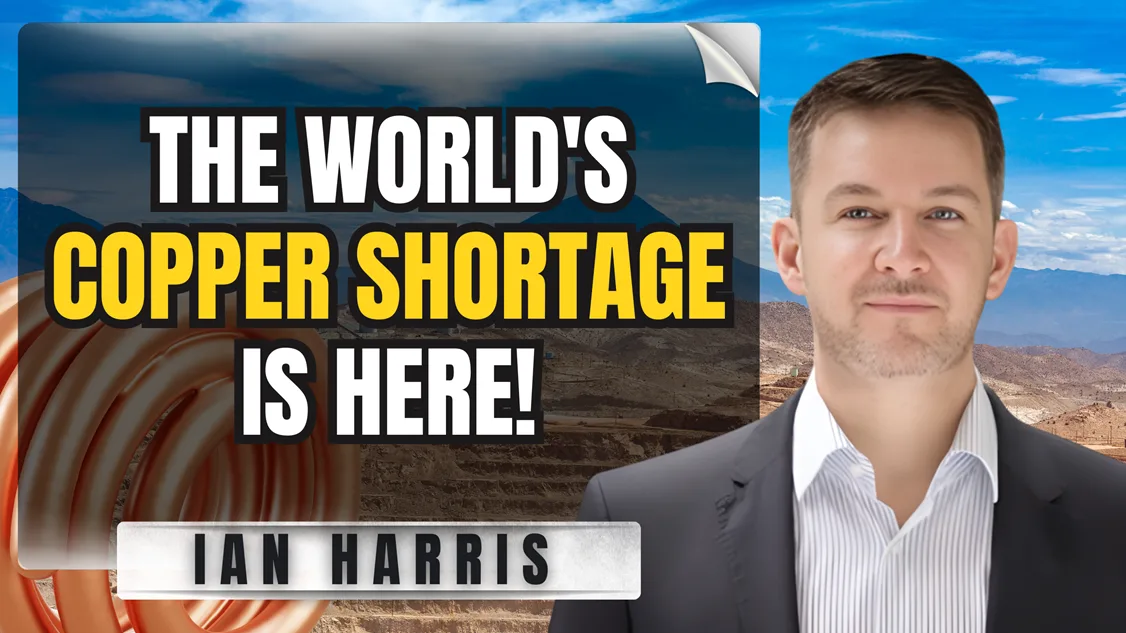
Against this backdrop, Copper Giant Resources, led by President and CEO Ian Harris, is advancing one of the largest undeveloped copper-molybdenum systems in Colombia: the Mocoa Project.
This article explores the macro forces reshaping copper, the structural supply deficit forming beneath the surface, and how Copper Giant is positioning itself within an increasingly strategic metals landscape.
The Global Copper Market: A Structural Problem in the Making
A Supply Story Decades in the Making
Ian Harris approaches the copper market from the perspective of a mining engineer. His career has centered on transforming deposits into producing mines—giving him a supply-side lens on today’s market dynamics.
The fundamental issue is not merely short-term volatility. It is structural:
The industry relied heavily on expansions and technological advances—such as dump leaching—to extract more metal from existing operations. But that approach has limits.
As Harris puts it metaphorically, the industry has been “squeezing the last drops from the turnip.” Now, there’s little left to squeeze.
Demand Is Accelerating—And It’s Different This Time
Historically, global copper demand grew at roughly 2% annually. Today, that number is rising toward 3% or more, with some forecasts climbing higher as AI infrastructure projections expand.
What’s driving this?
Anything that carries electrons relies on copper.
But there’s another major shift: the fragmentation of globalization.
During the globalization era, supply chains were optimized for efficiency. Every segment minimized excess capacity. Commodities were treated as interchangeable inputs.
Now, strategic concerns are reshaping policy:
Copper is no longer just a commodity. It is becoming strategic infrastructure.
The Magnitude of the Coming Gap
Based on conservative modeling, the world may require at least 1 million tonnes per year of new copper supply in the coming years.
Yet over the last decade, only about 250,000 tonnes annually were added from newly built large projects.
Bridging that gap would require roughly:
But there simply aren’t enough advanced-stage, large-scale projects ready to fill the void.
This is where Copper Giant believes it fits in.
The Mocoa Project: A Billion-Tonne Foundation
Copper Giant’s flagship Mocoa Project recently surpassed 1 billion tonnes in resource scale, with 1.12 billion tonnes of inferred resources at 0.51% CuEq.
In the world of copper development, this is a critical threshold.
Why One Billion Tonnes Matters
Major mining companies do not merely look for deposits—they look for districts capable of generational production.
A billion-tonne near-surface resource:
Harris emphasizes that many large copper projects entering feasibility stages are often around this size—but few exceed it significantly in the development category.
Even more compelling, parts of Mocoa contain higher-grade core zones that could support robust economics.
Copper + Molybdenum: A Strategic Combination
The Mocoa system is not just a copper deposit. It is a copper-molybdenum porphyry system, and molybdenum may prove strategically critical.
Why Molybdenum Matters
Approximately 80% of global molybdenum supply comes as a byproduct of copper mining. But as copper grades decline globally, molybdenum recovery becomes more difficult.
At Mocoa:
In an environment where strategic metals are gaining attention, this copper-moly combination enhances both economics and geopolitical relevance.
2026: A Year of De-Risking and Expansion
Copper Giant has laid out an ambitious 2026 program focused on three pillars:
Upgrading a significant portion of inferred resources to indicated category—potentially 30–50%—to support a Preliminary Economic Assessment (PEA).
Testing areas within the conceptual pit shell that remain undrilled and exploring extensions such as the La Estrella target.
The company controls approximately 135,000 hectares, much of which remains underexplored.
Mocoa formed over roughly 10 million years, with multiple mineralizing pulses. This geological complexity raises the possibility of additional porphyry centers nearby—suggesting district-scale potential.
The Jurassic Copper Belt Advantage
Mocoa sits within the Jurassic porphyry belt of the Andes—a geologic corridor that extends through Peru, Ecuador, and Colombia.
This belt hosts numerous significant copper and gold systems, yet Colombia remains underexplored relative to its southern neighbors.
As geological models mature and investment returns, underexplored jurisdictions often offer disproportionate discovery upside.
Colombia: Risk, Perception, and Catalyst
Colombia’s recent political climate has created uncertainty in mining markets. However:
For Copper Giant, these elections represent a potential catalyst. Market sentiment toward jurisdiction can materially affect valuation multiples.
Financing, Sponsorship, and Institutional Pathway
Copper Giant recently completed a $12 million financing, strengthening its treasury ahead of major milestones.
A key shareholder is Frank Giustra, principal of Fiore Group.
Giustra’s involvement provides:
Harris emphasizes that building a successful mining company requires four aligned elements:
In his view, those four elements are now converging.
Valuation: The “Pounds in the Ground” Phase
At present, the company trades at a valuation that management considers modest relative to resource scale.
Early-stage copper developers are often valued based on:
Completion of a PEA—targeted for late 2026—could shift valuation metrics from simple resource multiples to discounted cash flow modeling, potentially narrowing the gap between market value and underlying asset value.
M&A Environment: Building a “Must-Own” Asset
The global copper M&A environment is active.
Major mining companies face:
Harris frames the strategy clearly:
A project must be large enough that majors cannot ignore it.
Small projects may be built independently. Giant projects attract competition among majors. But mid-sized assets can be squeezed in between.
By surpassing one billion tonnes and continuing to grow, Copper Giant aims to enter the category of “must-own” projects—where strategic competition may drive value.
Near-Term Catalysts (Next 2–6 Months)
Investors can expect:
Consistent news flow is critical in exploration markets, and management anticipates regular updates as drilling advances.
The Bigger Picture: A Generational Setup?
Copper’s role in the energy transition is widely acknowledged. What is increasingly discussed, however, is the pace at which supply can realistically respond.
When:
then timing becomes critical.
Copper Giant Resources is positioning itself not merely as another exploration story—but as a potential district-scale, long-life copper-molybdenum asset in a tightening global market.
Whether the coming years validate the thesis depends on execution, political stability, capital markets, and continued resource growth.
But one thing is increasingly clear:
Copper is no longer just cyclical.
It is structural.
WATCH THE INTERVIEW HERE: